Agentic AI Systems 2026: Executive Strategy & Implementation Guide
Deploy autonomous AI agents in 2026. Strategic framework for business leaders: ROI analysis, implementation roadmap, platform comparison & risk management.
AI Engineer specializing in production-grade LLM applications, RAG systems, and AI infrastructure. Passionate about building scalable AI solutions that solve real-world problems.
By 2026, the gap between companies deploying agentic AI and those still using traditional chatbots will be insurmountable. While ChatGPT handles 800 million weekly users with 81% market share, the real revolution isn't chat—it's autonomous AI agents that plan, execute, and adapt across 30+ hour workflows without human intervention. This is the $103.6 billion market that will define competitive advantage for the next decade.
Agentic AI systems are autonomous software agents that plan multi-step workflows, execute actions using external tools, learn from feedback, and operate independently to achieve business goals. Unlike traditional AI that responds to prompts, agentic AI proactively breaks down complex objectives, makes decisions, uses APIs and databases, and self-corrects over hours or days without human intervention.
This executive guide provides the strategic framework you need to deploy agentic AI successfully: ROI analysis, implementation roadmaps, platform comparisons, risk management, and proven strategies from companies already achieving 250-500% returns.
The Agentic AI Revolution: Why 2026 is the Tipping Point
The AI landscape has fundamentally shifted from reactive chatbots to proactive autonomous agents. Three converging forces are driving this $103.6 billion market opportunity:
The $103.6B Market Opportunity
The agentic AI market is experiencing explosive growth. From $7.38 billion in 2025, the market is projected to reach $103.6 billion by 2032—representing a staggering 1304% growth rate. This isn't hype; it's the result of breakthrough capabilities in models like Claude Opus 4.5, which can now operate autonomously for 30+ hours, completing complex multi-day projects without human intervention.
According to MIT Sloan Management Review, agentic AI is the "most trending AI development" for 2025-2026, with companies across industries racing to deploy production-ready agent frameworks. Google's Gemini became the most searched AI topic globally in 2025, underscoring mainstream recognition that AI is evolving beyond simple question-answering into true autonomous operation.
Why Traditional AI is No Longer Competitive
Traditional AI chatbots are reactive—they respond to prompts and generate text. This works for customer support FAQs and basic content generation, but falls apart for complex business processes requiring:
- Multi-step planning: Breaking down "increase sales pipeline" into research, outreach, follow-up, and CRM updates
- Tool integration: Accessing databases, APIs, email systems, calendars, and business applications
- Adaptive decision-making: Adjusting strategies based on outcomes and changing conditions
- Long-running execution: Operating continuously over hours or days to complete projects
- Error handling: Detecting failures and implementing recovery strategies
Companies relying on chatbots face a 40% productivity disadvantage compared to those deploying autonomous agents. The gap compounds monthly as agent capabilities accelerate.
What Changed: Claude Opus 4.5's 30+ Hour Autonomy
The breakthrough came in November 2025 when Anthropic released Claude Opus 4.5, the first model capable of autonomous operation exceeding 30 hours. This wasn't incremental improvement—it represented a phase change in what AI can accomplish:
- Before: AI agents could handle 2-4 hour tasks (research a topic, draft a report)
- After: AI agents can complete multi-day projects (build and deploy a web application, conduct comprehensive market research with 50+ sources, manage entire sales cycles from lead to close)
Combined with GPT-5.2's 90% score on ARC-AGI-1 benchmark (released December 2025) and Gemini 3's multimodal capabilities, we now have the foundation for agents that genuinely augment knowledge worker productivity at scale.
ChatGPT's 800 million weekly users and 81% market share demonstrate mass adoption, but forward-looking companies are moving beyond chat interfaces to deploy specialized agents that autonomously handle entire workflows.
What is Agentic AI?
Agentic AI systems are autonomous software agents that plan multi-step workflows, execute actions using external tools, learn from feedback, and operate independently to achieve business goals. Unlike traditional AI that responds to prompts, agentic AI proactively breaks down complex objectives, makes decisions, uses APIs and databases, and self-corrects over hours or days without human intervention.
Traditional AI vs. Agentic AI: The Critical Difference
The distinction between chatbots and agents is fundamental:
| Capability | Traditional AI (Chatbots) | Agentic AI Systems |
|---|---|---|
| Interaction Model | Reactive (responds to prompts) | Proactive (pursues goals) |
| Planning Ability | None (single-turn responses) | Multi-step strategic planning |
| Tool Usage | Limited to training data | Full API/database access |
| Autonomy Duration | Seconds (one response) | Hours to days (ongoing tasks) |
| Learning | Static (fixed weights) | Dynamic (learns from execution) |
| Business Value | Information retrieval | Task completion & automation |
| Cost Efficiency | $0.002-0.03 per query | $2-20 per completed task |
| Example Use Case | "Explain our pricing" | "Research 50 leads, personalize outreach, schedule qualified meetings" |
The 5 Core Capabilities of Autonomous Agents
Effective agentic AI systems demonstrate five critical capabilities that distinguish them from traditional AI:
1. Goal Decomposition: Breaking complex objectives into executable sub-tasks. Instead of answering "How do I increase sales?", an agent plans: research target accounts → identify decision-makers → craft personalized outreach → schedule meetings → update CRM → follow up.
2. Tool Orchestration: Seamlessly using external systems. Agents access email, CRM (Salesforce, HubSpot), calendars, databases, APIs, web browsers, and internal applications to complete tasks that span multiple platforms.
3. Adaptive Reasoning: Evaluating outcomes and adjusting strategies. If email outreach has low response rates, the agent tests different subject lines, sending times, and personalization approaches—learning what works for your specific audience.
4. Memory & Context: Maintaining state across extended operations. Unlike chatbots that forget previous turns, agents remember: which leads were contacted, what responses were received, which approaches succeeded, and where to resume after interruptions.
5. Error Recovery: Detecting failures and implementing fixes. When an API call fails, data is missing, or results don't meet quality thresholds, agents troubleshoot, retry with different approaches, or escalate to human oversight.
Real-World Example: Sales Agent vs. Sales Chatbot
Sales Chatbot: User asks "Tell me about Company X". Bot searches training data, returns paragraph summarizing what it knows. User must manually research further, craft email, send outreach, track response.
Sales Agent: User sets goal "Generate 10 qualified meetings with enterprise SaaS companies in healthcare". Agent autonomously:
- Researches 200 target companies matching criteria
- Identifies decision-makers via LinkedIn and company websites
- Analyzes each company's tech stack, recent news, pain points
- Generates personalized outreach emails with relevant case studies
- Sends emails at optimal times based on industry data
- Tracks opens, clicks, responses
- Schedules meetings for interested prospects
- Updates CRM with all activities and intelligence gathered
- Provides weekly summary of pipeline progress
The chatbot saves 2 minutes per query. The agent saves 40 hours per week and generates $500K in qualified pipeline.
The Business Case for Agentic AI
The financial case for agentic AI is compelling when implemented strategically. Companies deploying autonomous agents report consistent productivity gains and cost reductions that deliver ROI within 3-6 months.
Quantified Business Impact: The 40% Productivity Gain
Real-world deployments across industries demonstrate measurable impact:
Productivity Gains: Knowledge workers using AI agents report 40% time savings on routine tasks. This isn't aspirational—it reflects documented results from Microsoft's analysis of 800 million ChatGPT weekly users and enterprise case studies.
Cost Reduction: Customer service operations achieve 60% cost reductions by automating ticket triage, routing, and resolution of routine issues. The remaining human agents handle complex cases requiring empathy and judgment.
Revenue Impact: Sales teams using autonomous SDR (Sales Development Representative) agents increase qualified meetings by 150-300% while reducing cost per meeting by 65%.
Decision Speed: Executives report 60% faster decision-making when agents provide real-time analysis, competitive intelligence, and scenario modeling.
These gains compound. A 40% productivity improvement in a 100-person organization equates to 40 full-time equivalent employees without increasing headcount.
Where Agentic AI Creates the Most Value
Not all use cases deliver equal returns. Prioritize applications with these characteristics:
High-volume repetitive tasks: Customer support (>1,000 tickets/month), data entry, document processing, report generation. ROI potential: 300-500%.
Data-intensive analysis: Financial modeling, market research, competitive intelligence, supply chain optimization. ROI potential: 200-400%.
Multi-system workflows: Processes requiring 5+ tool integrations (CRM + email + calendar + analytics + database). ROI potential: 250-450%.
24/7 operations: Tasks needing continuous coverage like fraud monitoring, infrastructure management, global customer support. ROI potential: 200-350%.
Personalization at scale: Customizing communications, recommendations, or experiences for thousands of customers simultaneously. ROI potential: 150-300%.
The Cost of Delayed Adoption
The competitive penalty for waiting grows exponentially:
Q1 2026 disadvantage: Competitors deploy first agents, gain 20% efficiency advantage Q2 2026 disadvantage: Competitors refine systems, advantage grows to 35% Q3 2026 disadvantage: Competitors build proprietary data moats, advantage reaches 50%+ Q4 2026 disadvantage: Market position shift becomes nearly impossible to reverse
Companies that delayed cloud adoption by 3-5 years faced similar compounding disadvantages. The AI shift is occurring 3x faster.
Case Study: Enterprise SaaS Company - Sales Agent
Company Profile: Mid-market B2B SaaS company with $50M annual recurring revenue and 180 employees. Sales team of 25 (5 AEs, 20 SDRs) struggling with pipeline generation.
Challenge: SDRs spending 45 minutes per lead on research and qualification. Only 40% of outreach resulted in responses. Sales team could only effectively manage 30 target accounts per rep. Pipeline wasn't growing fast enough to hit $100M ARR goal.
Implementation: Deployed autonomous sales development agent using Claude Opus 4.5 with integrations to Salesforce, LinkedIn Sales Navigator, ZoomInfo, email system, and calendar.
Timeline:
- Months 1-2: Pilot with 3 SDRs and 500 target accounts
- Months 3-4: Refinement and full rollout to 20 SDRs
Results After 6 Months:
- Lead qualification time: 45 minutes → 8 minutes (82% reduction)
- Qualified meetings booked: +156% increase (from 120/month to 307/month)
- SDR capacity: Each SDR now manages 90 target accounts (3x increase)
- Response rate: 40% → 62% (improved personalization)
- Cost per qualified lead: $180 → $62 (66% reduction)
- Annual savings: $840,000 (reduced headcount needs for scale)
- Pipeline quality: Meetings convert to opportunities at 45% vs. previous 32%
Investment:
- Platform costs: $85,000/year
- Implementation: $120,000 (one-time)
- Training and change management: $15,000
- Total Year 1: $220,000
ROI:
- Year 1: 282% ROI
- Year 2: 520% ROI (ongoing cost only $85K, full benefit realization)
- Payback period: 3.8 months
Key Success Factors: Clear success metrics defined upfront, SDRs trained as "agent managers" rather than displaced, leadership commitment to process changes, tight feedback loop for first 60 days.
AI Agent Platform Comparison 2026
Choosing the right platform determines implementation speed, total cost, and long-term flexibility. The landscape offers enterprise-managed solutions, open-source frameworks, and vertical-specific products.
Major AI Agent Platforms
| Platform | Best For | Pricing | Autonomy Level | Integration Complexity | Key Advantage |
|---|---|---|---|---|---|
| OpenAI Assistants API | General-purpose agents | $0.03-0.06/1K tokens | High (multi-hour) | Medium | Largest ecosystem, GPT-5 access |
| Anthropic Claude Agents | Compliance-sensitive industries | $0.015-0.045/1K tokens | Very High (30+ hours) | Medium | Constitutional AI, safety focus |
| Google Vertex AI Agents | Google Workspace integration | $0.02-0.05/1K tokens | Medium-High | Low (for GCP users) | Seamless Google ecosystem |
| Microsoft Copilot Studio | Microsoft 365 environments | $200/user/month | Medium | Very Low | Native Office integration |
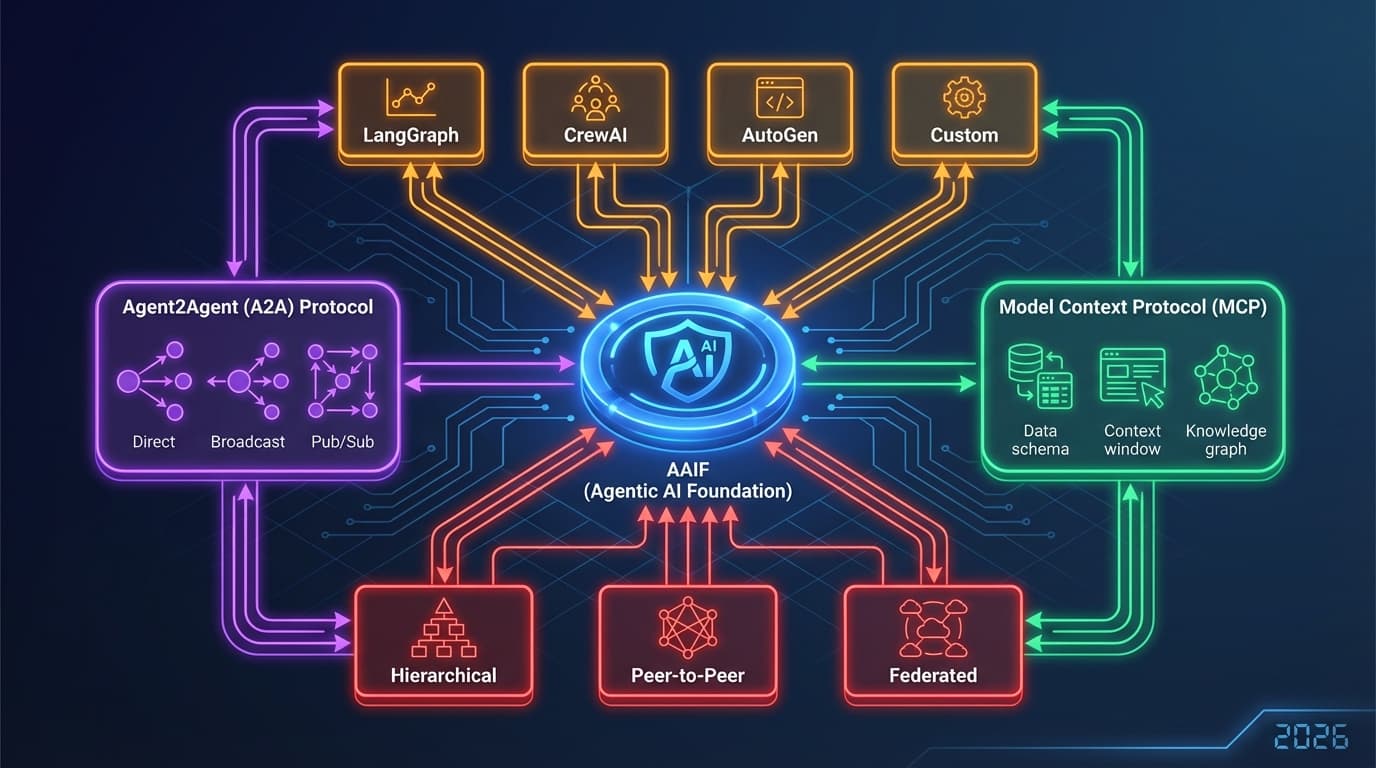
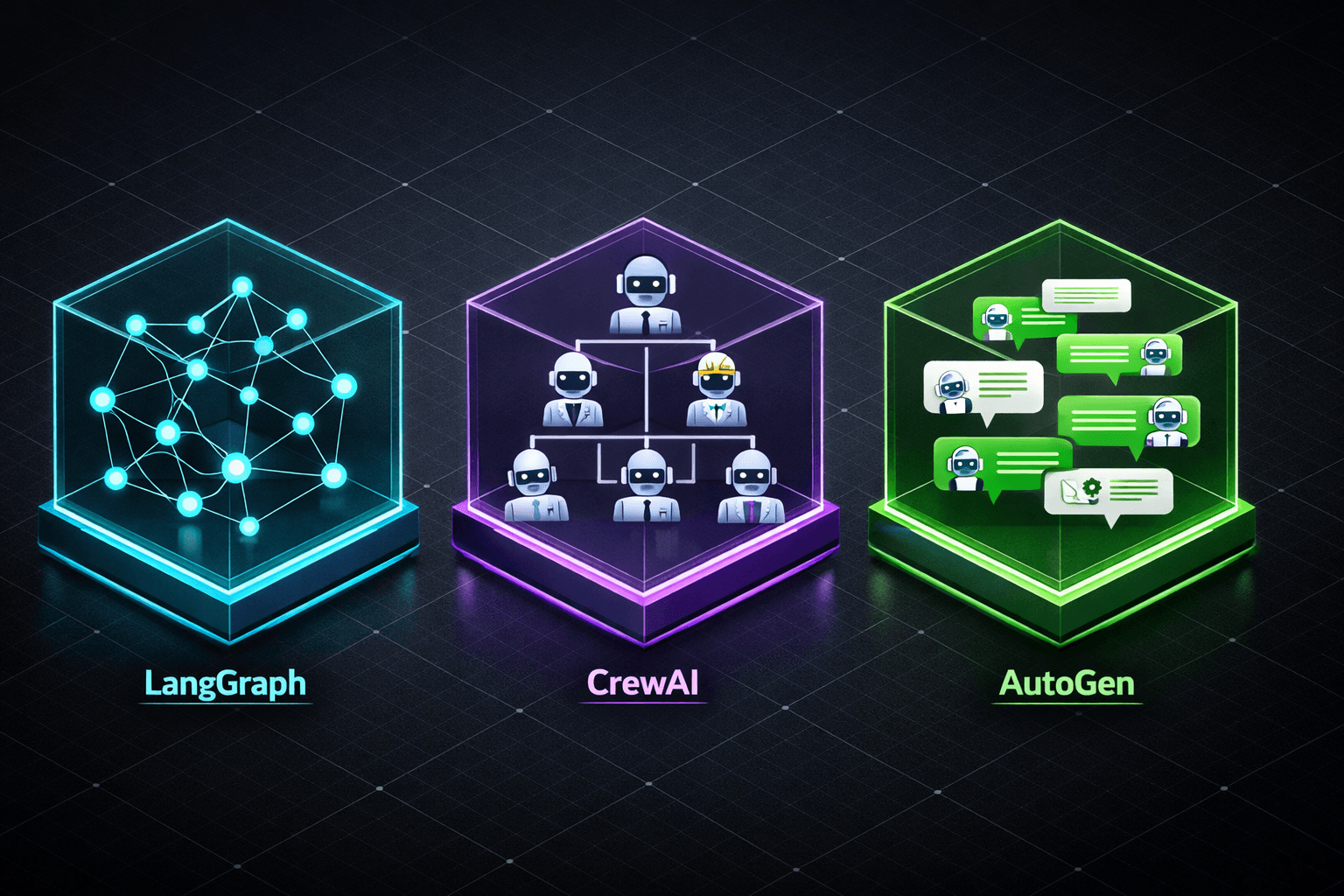
| LangChain/LangGraph | Custom workflows, flexibility | Open-source + compute | Fully customizable | High (requires dev team) | Maximum control & customization |
| CrewAI | Multi-agent collaboration | Open-source + compute | High | Medium | Role-based agent orchestration |
| Salesforce Agentforce | CRM-centric operations | $2/conversation | Medium | Very Low (for SFDC) | Native CRM data access |
Enterprise Platforms: OpenAI, Anthropic, Google
OpenAI Assistants API leads in ecosystem breadth. With GPT-5.2's industry-leading capabilities and the largest developer community, it's the default choice for general-purpose agents. Best for: companies wanting maximum flexibility and widest tool integration options.
Anthropic Claude Agents excel in regulated industries. Constitutional AI principles and 30+ hour autonomy make it ideal for healthcare, finance, and legal applications requiring explainability and safety. Best for: enterprises where compliance and audit trails are critical.
Google Vertex AI Agents integrate seamlessly with Google Workspace. If your team lives in Gmail, Docs, Sheets, and Meet, Vertex AI offers the lowest friction deployment. Best for: organizations already committed to Google Cloud Platform.
For a comprehensive comparison of these AI platforms across more dimensions, see our detailed AI tools comparison guide for 2026.
Open-Source Frameworks: LangChain, LangGraph, CrewAI
LangChain/LangGraph provide maximum control for teams with engineering resources. You can build custom agent architectures, integrate proprietary tools, and maintain complete data privacy. Trade-off: requires 2-4 engineers and 3-6 months to build production-ready systems.
CrewAI simplifies multi-agent orchestration with role-based agent teams. Define agents as "researcher", "writer", "editor" that collaborate on complex projects. Faster to deploy than pure LangChain but still requires technical team.
Learn more about implementing these frameworks in our AI agent orchestration guide.
Vertical Solutions: Industry-Specific Agents
Vertical platforms offer pre-built workflows for specific industries:
- Legal: Harvey AI, CoCounsel (contract review, legal research)
- Healthcare: Nuance DAX, Abridge (clinical documentation, patient engagement)
- Finance: Bloomberg GPT agents (financial analysis, trading research)
- HR: Eightfold, Phenom (recruiting, candidate screening)
Vertical solutions deploy 50-70% faster than horizontal platforms but limit flexibility for custom workflows.
Build vs. Buy Decision Framework
Choose managed platform (OpenAI/Anthropic/Google) if:
- You lack 5+ person engineering team
- Time-to-value matters more than customization
- You need broad ecosystem integrations
- Your use cases align with platform capabilities
Choose open-source (LangChain/CrewAI) if:
- You have strong engineering team (3+ AI specialists)
- Proprietary workflows require deep customization
- Data privacy mandates on-premise deployment
- You're building agents as core competitive advantage
Choose vertical solution if:
- Industry-specific workflows match exactly
- Regulatory compliance requires specialized features
- Faster deployment (2-4 months) is priority
- You're willing to trade flexibility for speed
For small and mid-sized businesses weighing these options, our AI agents implementation guide provides budget-conscious recommendations.
High-Value Use Cases for Business Leaders
Agentic AI delivers maximum value when applied to high-volume, repetitive, data-intensive workflows. These four use cases consistently achieve 200-500% ROI across industries.
Sales & Marketing Automation
Sales Development Agent (ROI: 250-400%, Payback: 3-5 months)
Automates lead research, qualification, personalized outreach, meeting scheduling, and CRM updates. Particularly valuable for B2B companies with complex sales cycles and high customer acquisition costs.
What the agent does:
- Researches target accounts using LinkedIn, company websites, news, tech stack data
- Identifies decision-makers and builds contact lists
- Crafts personalized outreach based on company pain points and initiatives
- Sends email sequences with optimal timing
- Tracks engagement (opens, clicks, responses)
- Books meetings with qualified prospects
- Updates CRM with all activities and intelligence
Typical results: 3x increase in SDR capacity, 60-80% reduction in cost per qualified lead, 40-60% improvement in response rates due to better personalization.
Best for: B2B SaaS, professional services, enterprise software, healthcare technology, financial services—any company with $500K+ annual sales and marketing budget.
Customer Success & Support
Customer Support Triage Agent (ROI: 300-500%, Payback: 2-4 months)
Handles 24/7 ticket classification, routing, and auto-resolution of routine issues. Human agents focus on complex cases requiring judgment and empathy.
What the agent does:
- Monitors support channels (email, chat, social media, portal)
- Categorizes tickets by urgency, type, and required expertise
- Resolves common issues automatically (password resets, billing questions, account changes)
- Routes complex tickets to appropriate specialist with full context
- Escalates urgent issues based on sentiment and business impact
- Generates response suggestions for agents handling complex cases
- Tracks resolution time and customer satisfaction
Typical results: 60-75% of tickets auto-resolved, 24/7 coverage without added headcount, 40% reduction in average handling time, 15-25% improvement in CSAT scores.
Best for: Companies with >1,000 support tickets monthly, SaaS platforms, e-commerce, consumer technology, financial services.
For detailed cost comparisons and pricing models, see our AI chatbot cost guide for small businesses.
Finance & Operations
Financial Analysis & Reporting Agent (ROI: 200-350%, Payback: 4-6 months)
Automates data gathering from multiple systems, performs analysis, generates reports, and identifies anomalies requiring attention.
What the agent does:
- Extracts data from ERP, accounting systems, spreadsheets, databases
- Performs variance analysis comparing actual vs. budget vs. forecast
- Generates monthly/quarterly financial reports with commentary
- Creates executive dashboards highlighting key metrics
- Identifies unusual transactions or patterns requiring review
- Models scenarios for strategic planning
- Maintains audit trail of all data sources and calculations
Typical results: Finance teams save 20-30 hours weekly on reporting, reports available 10x faster (days → hours), 40% reduction in manual errors, executives get real-time insights instead of stale monthly reports.
Best for: Mid-market to enterprise companies with >$50M revenue, complex multi-entity structures, companies with limited finance team resources.
HR & Recruiting
HR Screening & Candidate Engagement Agent (ROI: 180-300%, Payback: 5-7 months)
Screens resumes, conducts initial interviews, assesses candidate fit, maintains engagement throughout hiring pipeline.
What the agent does:
- Reviews applications against job requirements and company culture criteria
- Scores candidates using consistent rubric (eliminates unconscious bias)
- Conducts asynchronous text or video screening interviews
- Asks follow-up questions based on candidate responses
- Schedules interviews with hiring managers for qualified candidates
- Sends personalized updates to all candidates (improves candidate experience)
- Maintains engagement with promising candidates not hired immediately
- Generates hiring manager briefings with candidate highlights and concerns
Typical results: Recruiter capacity increases 4x, time-to-hire decreases 35-50%, candidate experience scores improve 25%, more diverse candidate pools (reduced unconscious bias).
Best for: Companies hiring >50 people annually, high-volume hourly hiring, competitive talent markets, regulated industries requiring documented screening processes.
Cost & ROI Framework for Executives
Understanding total cost of ownership and realistic ROI expectations is critical for investment decisions. This framework provides the financial analysis needed for board approval.
Total Cost of Ownership (TCO) Breakdown
| Cost Component | Year 1 | Year 2-3 (Annual) | Notes |
|---|---|---|---|
| Platform License | $60K-$200K | $60K-$200K | Based on usage volume |
| API/Compute Costs | $24K-$120K | $30K-$150K | Scales with adoption |
| Integration & Development | $150K-$400K | $50K-$100K | Custom workflows, connectors |
| Data Preparation | $80K-$250K | $20K-$50K | Data cleaning, labeling, pipelines |
| Change Management | $40K-$100K | $20K-$40K | Training, communication, adoption |
| Ongoing Monitoring | $30K-$80K | $40K-$100K | Performance tracking, optimization |
| Compliance & Security | $50K-$150K | $30K-$60K | Audits, documentation, governance |
| TOTAL TCO | $434K-$1.3M | $250K-$700K | Depends on scale and complexity |
Cost drivers: Volume of agent interactions, number of integrated systems, degree of customization, data quality improvements needed, level of human oversight required.
Cost reduction opportunities: Start with SaaS platform vs. build, limit initial scope to 1-2 use cases, leverage existing integrations, phase deployment over 6-12 months.
ROI Calculation Model
Use this framework to model expected returns:
Annual Benefit = (Labor Hours Saved × Hourly Cost) + (Error Reduction × Cost per Error) + (Revenue Impact)
Example: Customer Support Agent
- Labor Hours Saved: 15,000 hours × $35/hr = $525,000
- Error Reduction: 2,000 errors × $50 = $100,000
- Revenue Impact: 5% retention increase = $200,000
- Total Annual Benefit: $825,000
Investment:
- Year 1 TCO: $600,000
- Ongoing annual: $250,000
Returns:
- Net Value Year 1: $225,000
- Net Value Year 2+: $575,000 annually
- ROI: 38% (Year 1), 230% (Year 2)
- Payback Period: 8.7 months
For comprehensive strategies on reducing AI infrastructure costs while maintaining quality, explore our AI cost optimization guide.
Hidden Costs to Anticipate
Budget for these often-overlooked expenses:
Technical debt from integrations: Custom connectors require ongoing maintenance as APIs change. Budget 15-20% of integration costs annually for updates.
Model drift monitoring: Agent performance degrades as business processes, data patterns, and competitive landscape change. Budget for quarterly retraining and tuning.
Change resistance: Some employees resist automation fearing job displacement. Invest in change management, retraining programs, and clear communication about role evolution.
Scope creep: Successful agents generate requests for expansion. Set clear boundaries and prioritization framework to avoid overextending resources.
Compliance overhead: Regulated industries face audits, documentation requirements, and governance processes that add 20-30% to base implementation costs.
When Agentic AI Doesn't Make Financial Sense
Be honest about scenarios where ROI won't materialize:
Task volume <100 hours/month: Fixed implementation costs don't justify automation for low-volume workflows. Human execution often costs less.
Highly variable creative work: Tasks requiring genuine creativity, empathy, complex judgment don't benefit from automation. Focus on data-driven, rules-based processes.
Regulatory prohibits AI decisions: Some industries ban automated decision-making for high-stakes scenarios (medical diagnosis, loan approval). Agents can support but not replace humans.
Data quality too poor: If underlying data is incomplete, inconsistent, or inaccurate, agents amplify rather than solve problems. Fix data foundations first.
Organization lacks technical talent: Successfully deploying agents requires at least 1-2 people with AI/ML background for oversight, troubleshooting, and optimization.
90-Day Implementation Roadmap
This week-by-week plan gets you from concept to production pilot in one quarter, minimizing risk while maximizing learning.
Phase 1: Assessment & Planning (Weeks 1-4)
Week 1: Executive Alignment
- Convene leadership team for 2-hour AI strategy session
- Review business objectives and identify 5-10 high-pain processes
- Form AI task force with representatives from IT, Operations, Legal, Finance
- Define success metrics: productivity gains, cost savings, revenue impact
- Assign executive sponsor and project lead
Week 2: Process Mapping & Prioritization
- Document current workflows for identified processes
- Quantify volume, cost, error rates, cycle time for each
- Assess automation feasibility based on: data availability, rules-based vs. creative, integration complexity
- Rank by ROI potential using framework from Section 6
- Select 1-2 pilot use cases (start narrow, prove value, then expand)
Week 3: Platform Evaluation
- Request demos from 3-4 platform vendors
- Evaluate against criteria: capabilities, integration ease, cost, security, support
- Conduct reference calls with customers in similar industries
- Review technical architecture and data requirements
- Document decision matrix and recommendation
Week 4: Business Case Development
- Build detailed ROI model with conservative assumptions
- Define pilot scope, timeline, resources, budget
- Create governance framework (approval processes, risk management, oversight)
- Present business case to executive team for approval
- Secure budget ($150K-$300K for pilot)
Phase 2: Pilot Selection & Setup (Weeks 5-8)
Week 5: Platform Setup
- Sign vendor contract and provision accounts
- Configure security settings, access controls, SSO integration
- Set up development, testing, production environments
- Assign dedicated project team (1-2 engineers, 1 business analyst, 1 QA)
- Establish communication channels and meeting cadence
Week 6: Integration & Data Preparation
- Connect agent to required systems (CRM, email, calendar, databases)
- Build data pipelines for agent access to necessary information
- Clean and validate training data
- Test API connections and authentication
- Document integration architecture
Week 7: Agent Workflow Design
- Map detailed agent workflow from trigger to completion
- Define tool usage: when agent uses which system for what purpose
- Set decision logic and escalation rules
- Create quality thresholds (when to flag for human review)
- Build initial agent configuration
Week 8: Testing & Training
- Run agent against test scenarios with known outcomes
- Validate accuracy, latency, edge case handling
- Train pilot users on agent oversight and management
- Create user documentation and FAQs
- Prepare rollback plan if issues arise
Phase 3: Pilot Execution & Validation (Weeks 9-12)
Week 9-10: Pilot Launch
- Deploy agent to production for pilot user group (5-10 people)
- Monitor performance metrics hourly for first 48 hours
- Hold daily standups to address issues quickly
- Collect user feedback on experience and pain points
- Iterate on configuration based on real-world results
Week 11: Data Collection & Analysis
- Aggregate performance data: task completion rate, accuracy, latency, cost
- Compare to baseline metrics from pre-pilot manual processes
- Calculate realized vs. projected ROI
- Survey users for satisfaction and improvement suggestions
- Document lessons learned and required optimizations
Week 12: Stakeholder Review
- Present pilot results to executive team with data
- Review against success criteria from Week 1
- Make go/no-go decision on scaling based on evidence
- If successful: develop scaling plan and budget request
- If unsuccessful: diagnose failure, decide pivot vs. stop
Success Criteria Checklist
Use these thresholds to evaluate pilot outcomes:
- [ ] Agent completes target task end-to-end without human intervention >80% of time
- [ ] Accuracy/quality meets or exceeds human baseline (validate with sample reviews)
- [ ] Latency <10 seconds for urgent tasks, <5 minutes for complex tasks
- [ ] User satisfaction score >4.0/5.0 (agents are usable and helpful)
- [ ] Cost per task <50% of human equivalent (including platform + overhead)
- [ ] No critical security or compliance issues discovered
- [ ] Projected ROI >200% within 24 months at scale
- [ ] Clear path to scaling beyond pilot (technically and organizationally)
If 6+ criteria met: Strong case for scaling. Allocate resources for broader deployment. If 4-5 criteria met: Moderate success. Optimize based on gaps, extend pilot 30 days, re-evaluate. If <4 criteria met: Pilot failed. Analyze root causes, determine if fixable or if use case inappropriate.
For insights on why most AI projects fail to reach production and how to avoid common pitfalls, see our comprehensive analysis of why 88% of AI projects fail.
Case Study: Financial Services - Fraud Detection Agent
Company Profile: Regional bank with $8 billion in assets, 2,500 employees, 450,000 customers. Fraud investigation team of 12 analysts struggling with increasing transaction volume.
Challenge: Fraud analysts spending 4 hours per case investigating suspicious transactions. With transaction volume growing 15% annually, team couldn't keep pace. False positive rate of 75% meant most investigations found no fraud, wasting analyst time. True fraud took too long to detect, resulting in customer losses.
Implementation: Deployed autonomous fraud investigation agent using Claude Opus 4.5 with access to transaction database, customer profiles, behavioral analytics, external fraud databases, and case management system.
Timeline:
- Months 1-2: Pilot with 100 cases/week, 3 analysts
- Month 3: Refinement based on pilot learnings
- Months 4-5: Scaling to full team and 500+ cases/week
Results After 6 Months:
- Investigation time per case: 4 hours → 35 minutes (85% reduction)
- False positive rate: 75% → 28% (62% improvement)
- True fraud detection rate: +28% increase (caught more actual fraud)
- Analyst capacity: Each analyst handles 4x case volume
- Customer impact: 60% faster resolution of legitimate transaction holds
- Annual loss prevention: $4.2M (reduced fraud losses due to faster detection)
- Customer satisfaction: +18 NPS points (fewer false positives = less customer friction)
Investment:
- Platform costs: $180,000/year
- Implementation: $450,000 (included custom integrations to legacy systems)
- Compliance documentation: $100,000 (regulatory approval process)
- Training: $50,000
- Total Year 1: $780,000
ROI:
- Year 1: 439% ROI ($4.2M benefit - $780K cost = $3.42M net)
- Year 2+: >2,000% ROI ($4.2M+ benefit - $180K ongoing cost)
- Payback period: 2.7 months
Regulatory Compliance: Passed all audits. Maintained human-in-the-loop for final fraud determinations. Full audit trail of agent reasoning. Regular bias testing showed no demographic discrimination.
Key Success Factors: Strong executive sponsorship from Chief Risk Officer, close collaboration with compliance team from day one, phased rollout that built confidence, analyst reskilling program (investigators became complex case specialists), clear metrics and governance from start.
Risk Management & Governance
Successful agentic AI deployment requires robust governance to manage six critical risk categories. Boards and executives must establish frameworks before production deployment.
The 6 Critical Risk Categories
| Risk Category | Severity | Probability | Mitigation Strategy | Cost Impact |
|---|---|---|---|---|
| Security Breach | Critical | Low-Medium | API key rotation, access controls, audit logging | +$40-80K annual |
| Data Privacy Violation | Critical | Low | PII detection, data minimization, encryption | +$50-100K annual |
| Regulatory Non-Compliance | High | Medium | Legal review, documentation, human oversight | +$60-120K annual |
| AI Hallucination/Error | Medium-High | Medium-High | Validation layers, confidence thresholds, human review | +$30-60K annual |
| Vendor Lock-In | Medium | High | Multi-vendor strategy, open standards, data portability | Architecture complexity |
| Bias & Discrimination | High | Medium | Bias testing, diverse training data, fairness metrics | +$40-70K annual |
Total governance overhead: Add $220K-$430K annually to base platform costs for enterprise-grade risk management.
Governance Framework for Agentic AI
Implement these eight components for effective oversight:
1. AI Ethics Board: Cross-functional team (Legal, IT, Operations, HR, Executive) meeting quarterly to review agent deployments, incidents, and policy updates.
2. Usage Policies: Document acceptable use, prohibited applications, data handling requirements, human oversight mandates. Communicate to all employees interacting with agents.
3. Human Oversight Thresholds: Define decision types requiring human approval. Examples: financial transactions >$10K, customer communications on sensitive topics, hiring decisions, contract commitments.
4. Audit Logging: Record all agent actions with timestamp, user, input, output, reasoning, systems accessed. Retain logs 7 years for regulated industries.
5. Bias & Fairness Testing: Quarterly testing for demographic bias in agent outputs. Required for agents affecting employment, credit, housing, or other protected decisions.
6. Incident Response Plan: Documented procedures for agent failures, data breaches, compliance violations. Include escalation paths, communication templates, remediation steps.
7. Quarterly Reviews: Regular assessment of: agent performance metrics, user satisfaction, security incidents, compliance audits, cost vs. value realization.
8. Model Cards: Documentation for each agent describing: capabilities, limitations, training data sources, known biases, appropriate use cases, inappropriate use cases.
For comprehensive governance frameworks and security best practices, see our detailed guide on AI governance and security in production.
Regulatory Compliance (EU AI Act, US Framework)
EU AI Act (Effective March 2026): High-risk AI systems require conformity assessments before deployment. Agents making decisions about employment, credit, law enforcement, or critical infrastructure must undergo third-party audits. Non-compliance penalties: €35M or 7% global revenue (whichever is higher).
Compliance requirements:
- Risk assessment documentation
- Data governance and training procedures
- Human oversight mechanisms
- Transparency and user notification
- Accuracy and robustness testing
- Cybersecurity measures
- Record-keeping (10 years)
US AI Safety Framework (Expected June 2026): While less prescriptive than EU AI Act, proposed federal framework requires:
- Disclosure when users interact with AI systems
- Regular third-party audits for high-risk applications
- Reporting of significant incidents or failures
- Bias testing for protected class impacts
- Data privacy protections aligned with sector-specific regulations (HIPAA, SOX, GLBA)
Industry-Specific Regulations:
- Healthcare (HIPAA): Agents accessing PHI require Business Associate Agreements, encryption, access controls, breach notification procedures
- Finance (SOX, GLBA): Agents involved in financial reporting or customer data need audit trails, separation of duties, annual attestations
- Data Privacy (GDPR, CCPA): Agents processing personal data must implement data minimization, consent management, right-to-deletion workflows
Recommended approach: Build governance assuming strictest regulations apply. EU AI Act compliance generally satisfies US requirements plus most industry-specific rules. Better to over-invest in governance than face penalties or deployment delays.
Insurance & Liability Considerations
Cyber insurance is expanding to cover AI agent errors and liability. As of 2026:
Coverage availability: Major insurers (AIG, Chubb, Beazley) now offer AI-specific policies covering:
- Agent errors causing financial losses
- Data breaches through agent access
- Regulatory fines and penalties
- Legal defense costs for AI-related claims
- Business interruption from agent failures
Pricing: $50K-$200K annual premiums for enterprises depending on:
- Agent applications (customer-facing vs. internal)
- Data sensitivity
- Geographic operation
- Governance maturity
- Security controls
Requirements for coverage: Insurers mandate:
- SOC 2 Type II certification or equivalent
- Documented governance framework
- Regular bias and security testing
- Incident response plan
- Human oversight for high-stakes decisions
Vendor requirements: Many enterprise customers now require AI vendors to carry $2M-$10M liability insurance and name customer as additional insured.
Vendor Selection Criteria
Choosing the right vendor determines implementation speed, total cost, long-term flexibility, and risk exposure. Use this framework to evaluate options systematically.
Vendor Evaluation Scorecard
| Criteria | Weight | Evaluation Questions | Scoring |
|---|---|---|---|
| Technical Capability | 25% | Can platform handle our use case? What's the track record? | 1-5 scale |
| Integration Ease | 20% | Does it work with our existing systems? API quality? | 1-5 scale |
| Cost Transparency | 15% | Clear pricing model? Hidden costs? | 1-5 scale |
| Security & Compliance | 20% | SOC 2? ISO 27001? Industry certifications? | Pass/Fail |
| Support & SLA | 10% | Response times? Dedicated support? | 1-5 scale |
| Roadmap Alignment | 10% | Are they building features we need? | 1-5 scale |
Scoring methodology: Rate each vendor 1-5 on criteria (1=poor, 5=excellent). Multiply by weight. Sum weighted scores. Vendor with highest total score wins, assuming security compliance (Pass/Fail) is met.
Minimum threshold: Don't select vendor scoring <3.5 weighted average even if only option. Better to delay and find suitable vendor than deploy inadequate solution.
Red Flags to Watch For
Disqualify vendors exhibiting these warning signs:
Cannot provide customer references in your industry: Either they're too new (high risk) or hiding poor results. Demand 3+ references with similar use cases, company size, and industry.
No SOC 2 Type II or equivalent security certification: Unacceptable for production deployment with business data. ISO 27001, FedRAMP, or equivalent also acceptable.
Pricing model is "contact sales" with no transparent tiers: Indicates arbitrary pricing or vendor trying to maximize extraction. Demand published pricing or walk away.
No data portability or export options: Vendor lock-in trap. Must be able to export all data, agent configurations, and logs if relationship ends.
Require multi-year lock-in for pilot: Unreasonable. Pilots should be 30-90 days, month-to-month, or with 30-day cancellation. Annual commitments only after production validation.
Cannot demonstrate working product: Vaporware risk. Demand live demo on their system (not slideware), reference calls with production users, trial access to evaluate capabilities.
The 8 Critical Vendor Questions
Ask these during evaluation to uncover potential issues:
1. "Show me 3 customers using this in production for use cases similar to ours. May I speak with them?" Why: Validates vendor claims with real-world evidence.
2. "What percentage of your agent outputs require human correction or override?" Why: Reveals actual accuracy vs. marketing claims.
3. "Walk me through your data privacy and security architecture." Why: Uncovers data handling practices, encryption, access controls.
4. "What happens to our data if we stop using your service?" Why: Tests data portability and exit planning.
5. "How do you handle model updates or changes that might break our workflows?" Why: Reveals change management process and backward compatibility approach.
6. "What's your average response time for critical production issues?" Why: Tests support quality beyond marketing SLAs.
7. "Can you provide your SOC 2 Type II report and security questionnaire?" Why: Validates security compliance rather than trusting claims.
8. "What limitations or failure modes have your customers encountered?" Why: Honest vendors acknowledge limitations. Evasive answers are red flags.
Proof of Concept (POC) Best Practices
Structure POCs to maximize learning while minimizing wasted effort:
Duration: 30-60 days maximum. Longer POCs indicate vendor can't demonstrate value quickly or you haven't scoped properly.
Scope: One well-defined use case. Don't boil the ocean. Prove one thing works before expanding.
Success metrics: Quantitative and agreed upfront. Example: "Agent must achieve >85% accuracy on 100 test cases, with <5 second latency, and <$5 cost per task."
Data: Use production or production-like data. Test data doesn't validate real-world performance. Sanitize PII if needed, but maintain realistic data characteristics.
Cost: Free or <$10K for meaningful POC. Vendors charging more are either too expensive or POC scope is too large.
Support: Vendor provides hands-on technical support throughout POC. This tests support quality and vendor commitment to your success.
Exit criteria: Define upfront what happens if POC fails. Can you terminate without penalty? Do you get your data back? Is there kill switch?
Measuring Success: KPIs for Agentic AI
What gets measured gets managed. Establish comprehensive KPI tracking from day one to optimize agent performance and demonstrate business value.
Operational Metrics
Task Completion Rate: Percentage of tasks completed without human intervention
- Target: >85% by month 6
- Measurement: (Tasks completed successfully / Total tasks attempted) × 100
- Why it matters: Core measure of agent autonomy and reliability
Accuracy Rate: Percentage of agent outputs meeting quality standards
- Target: >90% by month 3
- Measurement: Sample random outputs, human reviewers score against rubric
- Why it matters: Agents must match or exceed human quality to create value
Latency (P95): 95th percentile response time for agent task completion
- Target: <30 seconds for routine tasks, <5 minutes for complex tasks
- Measurement: Track completion time from initiation to result delivery
- Why it matters: Slow agents create bottlenecks and user frustration
Cost per Task: Total cost divided by tasks completed
- Target: <50% of human equivalent cost
- Measurement: (Platform + compute + overhead costs) / tasks completed
- Why it matters: Fundamental ROI driver
Uptime/Reliability: Percentage of time system is operational
- Target: >99.5% uptime
- Measurement: (Total time - downtime) / Total time × 100
- Why it matters: Unavailable agents disrupt operations and erode user trust
Business Impact Metrics
Labor Hours Saved: Automated hours × loaded labor cost
- Target: 20% headcount equivalent by year 1
- Measurement: Baseline time per task × tasks automated × hourly rate
- Why it matters: Primary quantified benefit for ROI calculation
Revenue Impact: Additional revenue attributable to AI agents
- Target: Varies by use case (sales agents: 15-30% pipeline increase)
- Measurement: Compare revenue metrics before/after agent deployment with control groups
- Why it matters: Agents should drive top-line growth, not just cost savings
Cost Savings: Direct cost reduction vs. baseline
- Target: >$500K annually for mid-market deployments
- Measurement: Baseline operational costs - post-agent costs
- Why it matters: CFOs care about P&L impact
Error Reduction: Decrease in mistakes vs. human baseline
- Target: 30-50% reduction in errors
- Measurement: Error rate before agent / error rate after agent
- Why it matters: Quality improvement beyond cost savings
Customer Satisfaction: CSAT or NPS for AI interactions
- Target: Maintain or improve vs. human baseline
- Measurement: Survey customers after agent interactions
- Why it matters: Automation shouldn't degrade customer experience
For comprehensive frameworks on tracking these metrics in production, see our guide on AI model evaluation and monitoring.
User Adoption Metrics
Active Users: Percentage of target users regularly using agent
- Target: >75% weekly active by month 3
- Measurement: (Users with >1 agent interaction / week) / Total eligible users
- Why it matters: Unused tools don't deliver value
Task Diversity: Number of different task types agent handles
- Target: Expand 20% quarter-over-quarter
- Measurement: Count unique task types completed each period
- Why it matters: Broader usage indicates confidence and value realization
User Confidence: Measured through surveys
- Target: >4.0/5.0 average confidence rating
- Measurement: Quarterly survey: "How confident are you in agent outputs?"
- Why it matters: Low confidence leads to manual rework, negating benefits
Dashboard Structure
Create executive dashboard with:
Green/Yellow/Red Indicators: Each metric coded by performance vs. target
- Green: Meeting or exceeding target
- Yellow: 10-20% below target (needs attention)
- Red: >20% below target (requires intervention)
Trend Lines: Month-over-month and quarter-over-quarter changes
- Identify improving vs. degrading metrics
- Spot seasonal patterns
- Detect inflection points
Benchmark Comparisons: Context for interpretation
- Compare to human baseline (are we better?)
- Compare to pilot targets (are we on track?)
- Compare to industry benchmarks (how competitive are we?)
Drill-Down Capability: Click through to root cause analysis
- Which task types have highest error rates?
- Which users struggle most with adoption?
- When do performance issues occur (time of day, data volume, etc.)?
Monthly Executive Summaries: 1-page highlights for leadership
- Top 3 wins
- Top 3 concerns
- Actions required
- ROI realized vs. projected
2026 Predictions & Strategic Positioning
The agentic AI landscape will evolve rapidly through 2026. Position your organization for the next wave with these high-confidence predictions.
5 High-Confidence Predictions for 2026
1. Multi-Agent Systems Become Standard (85% confidence)
By Q4 2026, leading enterprises deploy teams of specialized agents collaborating on complex workflows. Instead of monolithic "do everything" agents, we'll see:
- Research agents gathering information
- Analysis agents processing data
- Writing agents creating content
- QA agents reviewing quality
- Coordination agents orchestrating workflows
Market impact: Multi-agent platforms grow 120% year-over-year. CrewAI, AutoGen, and similar frameworks see enterprise adoption surge.
Strategic positioning: Start experimenting with agent teams for complex projects. Build organizational muscle managing multi-agent coordination before competitors do.
2. GPT-5 Unlocks 10x Longer Autonomous Operations (75% confidence)
Current state: Claude Opus 4.5 operates autonomously for 30+ hours. By mid-2026, GPT-5 or equivalent models enable 5-7 day autonomous operations completing entire projects:
- "Design, build, test, and deploy a web application"
- "Conduct comprehensive market research across 20 countries"
- "Audit entire codebase and generate security remediation plan"
Market impact: Tasks previously requiring human project managers become fully automated. Knowledge worker productivity gains accelerate from 40% to 70%+.
Strategic positioning: Identify week-long projects suitable for full automation. Build trust through shorter-duration agents first, then scale to multi-day workflows.
3. Industry-Specific Agent Solutions Dominate (80% confidence)
Horizontal platforms (OpenAI, Anthropic) lose market share to vertical specialists:
- Healthcare agents pre-trained on medical knowledge with HIPAA compliance
- Legal agents with case law expertise and regulatory templates
- Finance agents with accounting rules and fraud detection models
By end 2026, 60% of enterprises prefer vertical over horizontal platforms for specialized workflows.
Market impact: Consolidation wave as horizontal vendors acquire vertical specialists. Expect 10-15 major acquisitions in 2026.
Strategic positioning: Evaluate vertical solutions for industry-specific workflows. They'll deploy 50-70% faster than customizing horizontal platforms.
4. Regulatory Compliance Becomes Competitive Advantage (70% confidence)
EU AI Act enforcement begins March 2026. Companies with mature governance frameworks win contracts in regulated industries. Non-compliant vendors lose market access in Europe and face increasing US restrictions.
Market impact: Governance and compliance tools become billion-dollar market. Insurance companies launch AI-specific liability products. Enterprises demand proof of compliance from all AI vendors.
Strategic positioning: Invest in governance infrastructure now. EU AI Act compliance becomes table stakes for enterprise sales. Build documentation, testing, and oversight processes today.
5. Agentic AI Insurance Market Emerges (60% confidence)
Cyber insurance expands to cover AI agent errors, breaches, and liability. By Q3 2026:
- Major insurers offer AI-specific policies
- Pricing: $50K-$200K annual premiums for enterprise coverage
- Many customers mandate AI insurance from vendors
- Insurance replaces extensive vendor liability negotiations
Market impact: Insurance requirements drive governance standardization. Vendors without insurance coverage lose enterprise deals.
Strategic positioning: Engage insurance broker to understand coverage options. Factor insurance costs into TCO models. Consider requiring insurance from AI vendors.
The Agentic AI Maturity Model
Assess your organization's current level and plan progression:
Level 1 - Experimental (30% of enterprises)
Characteristics:
- Running 1-2 pilots
- No production deployments
- Limited executive awareness
- Ad hoc governance
- Budget <$200K
Actions to advance:
- Accelerate pilots with clear success criteria
- Prove value with one production deployment
- Build executive coalition
- Develop basic governance framework
- Secure $500K-$1M budget for scale
Level 2 - Operational (45% of enterprises)
Characteristics:
- 1-3 agents in production
- Localized to specific teams (sales, support, etc.)
- Documented ROI
- Basic governance and monitoring
- Budget $500K-$2M
Actions to advance:
- Scale successful pilots to adjacent teams
- Standardize on 1-2 platforms
- Establish center of excellence
- Build proprietary data assets
- Expand budget to $2M-$5M
Level 3 - Strategic (20% of enterprises)
Characteristics:
- 5+ agents across multiple functions
- Cross-functional deployment
- Agents core to operations
- Mature governance
- Budget $2M-$10M
Actions to advance:
- Develop proprietary agent capabilities
- Build competitive moats with data
- Explore multi-agent orchestration
- Invest in agent R&D team
- Industry thought leadership
Level 4 - Transformative (5% of enterprises)
Characteristics:
- 10+ agents, business model revolves around AI
- Agents are competitive differentiation
- Industry-leading capabilities
- Board-level AI oversight
- Budget $10M+
Actions to advance:
- Innovate next-generation capabilities
- Acquire AI startups and talent
- Explore AGI preparation
- Set industry standards
- Build platform businesses
Where are you today? Where do you need to be by end of 2026?
Getting Started: Your Next Actions
The gap between knowing and doing determines success. Take these concrete steps this week, this month, and this quarter to deploy your first agent.
This Week: 3 Actions to Take Now (Before Friday)
1. Schedule AI Strategy Session (2 hours with leadership team)
Agenda:
- Review this guide and discuss strategic implications
- Identify top 3-5 high-pain business processes
- Brainstorm potential agent use cases
- Assign executive sponsor for AI initiative
- Allocate resources for assessment phase
Who to invite: CEO or division head, CFO, CTO/CIO, COO, heads of departments with identified use cases
2. Identify 3 High-ROI Use Cases from your operations
Use these criteria:
-
500 hours annual effort (substantial volume)
- Repetitive and rules-based (not highly creative)
- Data is available and accessible (or can be with reasonable effort)
- High business impact if improved (cost, revenue, or customer experience)
- Not mission-critical initially (start with important but not business-ending if fails)
Document for each: current process, volume, cost, pain points, success metrics
3. Book Vendor Demos with 2-3 platforms
Based on your technical environment:
- If Microsoft 365 shop: Microsoft Copilot Studio
- If Google Workspace shop: Google Vertex AI Agents
- If flexible or mixed: OpenAI Assistants API + Anthropic Claude Agents
Request: 1-hour demo focused on your specific use case (not generic pitch)
This Month: Building Your Business Case
Week 2-3: Conduct Internal Process Audit
- Shadow employees performing target workflows
- Document current process step-by-step
- Quantify: time spent, error rates, costs, bottlenecks
- Identify integration points with existing systems
- Assess data availability and quality
Deliverable: Process maps with quantified baselines for 3 use cases
Week 3: Form AI Implementation Task Force
Cross-functional team:
- IT/Engineering (2 people): Technical feasibility, integration
- Operations (1 person): Process expertise, user needs
- Legal/Compliance (1 person): Regulatory and risk assessment
- Finance (1 person): ROI modeling, budget
- Executive Sponsor (1 person): Decision authority, resource allocation
Establish: Meeting cadence (weekly), communication channels, decision-making authority
Week 4: Build Business Case
Using ROI framework from Section 6:
- Calculate expected labor hours saved, error reduction, revenue impact
- Estimate total cost of ownership (platform, integration, change management)
- Model payback period and 3-year ROI
- Document risks and mitigation strategies
- Create 1-page executive summary + 10-page detailed analysis
Present to executive team for approval and budget allocation ($150K-$300K pilot)
This Quarter: Launching Your First Pilot
Months 1-2: Platform Setup and Integration
Following 90-day roadmap from Section 7:
- Contract with selected vendor
- Configure security and access controls
- Integrate with required systems (CRM, email, databases)
- Prepare training data
- Design agent workflows
- Test thoroughly before production
Milestone: Agent operational in test environment
Month 3: Pilot Execution
- Deploy to 5-10 pilot users
- Monitor performance metrics daily
- Collect user feedback weekly
- Iterate based on real-world results
- Document lessons learned
Milestone: 30-day pilot completion with documented results
Month 4: Scale Decision
- Analyze pilot data against success criteria
- Calculate realized ROI
- Present results to leadership
- Make go/no-go decision on scaling
- Develop scaling plan if successful
Milestone: Executive approval for scaling (or documented learnings from failure)
Case Study: Manufacturing - Quality Control Agent
Company Profile: Automotive parts supplier with 3,200 employees and $420M annual revenue. Manufacturing 1.2 million parts annually across 8 product lines. Quality inspection team of 45 inspectors struggling with increasing complexity and throughput demands.
Challenge: Visual inspection of critical safety components taking 12 minutes per part. Inspection backlog causing production delays. Defect detection rate of 88% (missing 12% of defects). False positive rate of 35% (flagging good parts as defective). Scrap and rework costs: $4.5M annually.
Implementation: Deployed autonomous quality control agent using GPT-5 with computer vision capabilities, integrated with manufacturing execution system, inspection cameras, and quality management database.
Timeline:
- Months 1-3: Pilot on 1 product line, 2 inspectors
- Month 4-6: Scaling to 5 product lines, 20 inspectors
Results After 12 Months:
- Inspection time per part: 12 minutes → 90 seconds (88% reduction)
- Inspection throughput: +640% increase
- Defect detection rate: 88% → 96% (34% improvement in catching actual defects)
- False positive rate: 35% → 10% (71% reduction)
- Scrap and rework costs: $4.5M → $1.4M annually ($3.1M savings)
- Warranty claims: -42% reduction (fewer defective parts shipped)
- Production delays: Eliminated (inspection no longer bottleneck)
- Regulatory compliance: 100% audit pass rate with AI documentation
Investment:
- Platform and computer vision tools: $320,000/year
- Implementation and custom integration: $250,000 (one-time)
- Camera upgrades: $50,000 (one-time)
- Training: $25,000
- Total Year 1: $645,000
ROI:
- Year 1: 380% ROI ($3.1M savings - $645K cost = $2.45M net value)
- Year 2+: 869% ROI ($3.1M savings - $320K ongoing cost)
- Payback period: 2.4 months
Employee Impact: Zero layoffs. Inspectors retrained as quality engineers focusing on:
- Root cause analysis of defects
- Process improvement initiatives
- Agent oversight and exception handling
- Supplier quality audits
Key Success Factors: Strong union partnership (early engagement, transparent communication), phased rollout built confidence, inspector reskilling program with job security guarantees, clear metrics showing both productivity and quality gains, regulatory approval obtained upfront from industry safety boards.
Resources & Further Reading
Deepen your knowledge with these complementary guides:
Technical Implementation:
- AI Agent Observability in Production - Monitoring, debugging, and optimizing autonomous agents in live environments
- Building Production-Ready LLM Applications - Technical architecture patterns for scalable AI systems
Cost Optimization:
- AI Cost Optimization: Reducing Infrastructure Costs - Proven strategies to reduce operational expenses while maintaining quality
Risk Management:
- Why 88% of AI Projects Fail: Pilot to Production - Avoid common failure modes that kill AI projects
Scaling Strategies:
- From Prototype to Production: Deploying AI at Scale - Move beyond pilots to enterprise-wide deployment
Frequently Asked Questions
What is the difference between AI chatbots and agentic AI systems?
AI chatbots respond to user prompts with text responses, while agentic AI systems autonomously plan and execute multi-step workflows to achieve goals. Chatbots are reactive (answer questions), agents are proactive (complete tasks).
For example, a chatbot can explain your pricing structure when asked. An agentic AI system can research 50 target companies, identify decision-makers, analyze each company's tech stack and recent news, generate personalized outreach emails with relevant case studies, send emails at optimal times, track responses, schedule meetings for interested prospects, and update your CRM with all activities—all without human intervention.
The distinction matters because chatbots save minutes per interaction, while agents save hours per workflow. Chatbots reduce support costs 20-30%. Agents enable 40-70% productivity gains across knowledge worker roles.
How much does it cost to implement agentic AI in an enterprise?
First-year total cost of ownership typically ranges from $434K to $1.3M for mid-market to enterprise deployments, including:
- Platform licenses: $60K-$200K
- API/compute costs: $24K-$120K
- Integration and development: $150K-$400K
- Data preparation: $80K-$250K
- Change management: $40K-$100K
- Monitoring: $30K-$80K
- Compliance and security: $50K-$150K
Ongoing annual costs drop to $250K-$700K after initial implementation.
However, most enterprises achieve ROI within 6-12 months and see 250-500% returns over three years. The key is starting with high-value use cases that save >500 hours annually or generate substantial revenue impact.
Small to mid-sized businesses can start with focused pilots for $50K-$150K using SaaS platforms, achieving 200-300% returns even at smaller scale.
Which industries benefit most from agentic AI?
Financial services, healthcare, technology, professional services, and manufacturing see the highest ROI from agentic AI deployments:
Financial Services (fraud detection, trading, compliance): High-value transactions and regulatory requirements create massive ROI from improved accuracy and speed. Banks report $2M-$5M annual savings per deployed agent.
Healthcare (clinical workflows, diagnosis support, patient engagement): Labor-intensive processes and critical accuracy requirements benefit enormously. Health systems achieve 30-50% administrative time savings.
Technology (software development, DevOps, customer success): Technical teams adopt fastest and see immediate productivity gains. Developer productivity increases 40-60% with coding agents.
Professional Services (legal, consulting, accounting): Knowledge-intensive work with high hourly rates delivers exceptional ROI. Law firms report 35-55% reduction in research and document review time.
Manufacturing (quality control, supply chain optimization, predictive maintenance): Continuous operations and data-rich environments enable 24/7 agent deployment. Manufacturers achieve 20-40% efficiency gains.
Any industry with repetitive, data-intensive processes and high labor costs can benefit significantly. The key is identifying workflows where agents add more value than they cost.
Is agentic AI safe for business-critical operations?
Yes, with proper governance frameworks. Leading enterprises report <0.1% critical failure rates when deploying agents with:
Validation layers: Agents check their own work before finalizing. Confidence scores flag uncertain outputs for human review.
Human oversight: High-stakes decisions (financial transactions >$10K, legal commitments, medical diagnoses) require human approval before execution.
Comprehensive audit logging: Record all agent actions with timestamp, user, input, output, reasoning, and systems accessed. Enables root cause analysis of any failures.
Regular bias testing: Quarterly testing for demographic bias in agent outputs, particularly for decisions affecting employment, credit, housing, or other protected categories.
Incident response plans: Documented procedures for agent failures, data breaches, and compliance violations with clear escalation paths.
Start with low-risk use cases (data entry, research, reporting), validate thoroughly with parallel human execution, then expand to mission-critical operations once confidence is established.
Companies following EU AI Act governance requirements (even if not legally required) achieve the highest reliability and lowest incident rates.
How long does it take to see ROI from agentic AI?
Most organizations achieve positive ROI within 6-12 months, with payback periods ranging from 2.4 to 8.7 months depending on use case complexity and implementation quality.
Quick wins (2-5 month payback):
- Customer support automation: 2-4 months
- Data entry and document processing: 3-5 months
- Sales lead qualification: 3-5 months
Medium complexity (4-7 month payback):
- Financial reporting automation: 4-6 months
- HR screening and recruiting: 5-7 months
- Quality control automation: 4-6 months
Complex deployments (6-12 month payback):
- Fraud detection systems: 6-9 months
- R&D and scientific research: 8-12 months
- Multi-system workflow automation: 7-10 months
However, complex deployments often generate higher absolute returns. Our fraud detection case study achieved $4.2M annual benefit despite longer implementation—resulting in 439% first-year ROI.
The key factors determining payback speed: clear success criteria from day one, executive sponsorship, dedicated implementation team, high-quality training data, and phased deployment that builds organizational confidence.
Can small and mid-sized businesses afford agentic AI in 2026?
Absolutely. While enterprise implementations cost $400K-$1.3M in year one, SMBs can start with focused pilots for $50K-$150K using SaaS platforms like OpenAI Assistants API, Anthropic Claude Agents, or vertical-specific solutions.
SMB-friendly approaches:
- Start with one high-ROI use case (customer support, lead generation, document processing)
- Use managed SaaS platforms (avoid custom development)
- Leverage no-code/low-code agent builders
- Begin with 30-60 day pilot before committing to annual contracts
- Scale gradually based on proven results
Realistic SMB ROI examples:
- 50-person company automating customer support: $80K implementation, $240K annual savings, 200% ROI
- Professional services firm (25 people) automating research: $65K implementation, $180K annual value, 177% ROI
- Retail business automating inventory management: $90K implementation, $260K annual benefit, 189% ROI
Many SMBs achieve full cost recovery within 4-6 months even with smaller absolute dollar amounts. The productivity gains and competitive advantages are accessible to companies of all sizes.
The critical success factor for SMBs: choosing use cases with clear, measurable business impact rather than experimental "innovation" projects.
What's the biggest risk of delaying agentic AI adoption?
Competitive disadvantage compounds rapidly. Competitors deploying agents gain 40% productivity advantages, serve customers faster, and operate at 30-50% lower costs. By late 2026, this gap becomes nearly insurmountable.
The compounding effect:
Q1 2026: Competitors deploy first agents, gain 20% efficiency advantage. You think "we'll wait and see."
Q2 2026: Competitors refine systems based on real-world learnings, advantage grows to 35%. They're serving customers 35% faster at 30% lower cost.
Q3 2026: Competitors use efficiency gains to invest in better products, hire top talent, and build proprietary data advantages. Gap reaches 50%+.
Q4 2026: Market position shift becomes nearly impossible to reverse. Competitors have refined processes, trained agents on proprietary data, and captured market share. Your "catch-up" requires 2-3x investment to match their capabilities.
We've seen this pattern with cloud adoption (2010-2015), mobile (2008-2013), and e-commerce (2000-2005). Companies that delayed 3-5 years faced similar compounding disadvantages.
The AI shift is occurring 3x faster than previous technology waves. The "wait and see" approach that worked for past technologies doesn't apply to agentic AI's exponential pace.
Start now with focused pilots. Learn organizational and technical lessons while risks and costs are low. Scale based on evidence. Waiting guarantees falling behind competitors who started months earlier.
Sources
This guide synthesized research and data from authoritative sources:
- Google's Year in Search 2025 - Gemini search trends and AI adoption data
- MIT Sloan Management Review: Five Trends in AI and Data Science for 2025 - Agentic AI as top trend
- Semrush AI Overviews Study - AI Overview appearance rates and SEO impact
- Anthropic: Introducing Claude Opus 4.5 - 30+ hour autonomy capability
- GPT-5.2 vs Claude Opus 4.5 Comparison - Market share and capability analysis
- Coronium AI Models Guide 2025 - Platform comparison and market data