Multi-Agent Coordination Systems Enterprise Guide 2026
AI Engineer specializing in production-grade LLM applications, RAG systems, and AI infrastructure. Passionate about building scalable AI solutions that solve real-world problems.
The enterprise AI landscape is experiencing a fundamental shift from single-agent systems to coordinated multi-agent architectures. While 52% of executives now report agents in production according to Gartner's 2026 research, the next wave of AI transformation demands something more sophisticated: agents that work together.
This guide provides a production-ready roadmap for deploying multi-agent coordination systems that deliver measurable ROI. We'll explore agent-to-agent communication protocols, orchestration frameworks, and real-world patterns proven at scale by organizations like Genentech and Amazon.
Why Single Agents Hit Scaling Limits
Single-agent systems face three critical bottlenecks that multi-agent architectures solve:
1. Coordination Bottleneck
When a single agent handles complex workflows like purchase-to-pay automation, it becomes a serial processor. Each task waits for the previous one to complete, creating latency that compounds across the workflow.
Real-world impact: A Fortune 500 retailer found their single-agent invoice processing system took 47 minutes on average because document extraction, validation, approval routing, and payment scheduling ran sequentially.
2. Specialization vs Generalization Tradeoff
A generalist agent trained on diverse tasks performs adequately across domains but excels at none. Conversely, highly specialized agents deliver superior accuracy in narrow contexts but fail when workflows cross boundaries.
Example: Customer support automation requires legal compliance checking, technical troubleshooting, billing system access, and CRM updates. A single agent struggles to maintain expertise across all domains simultaneously.
3. Context Window Exhaustion
Large workflows consume context windows rapidly. A single agent managing end-to-end order fulfillment must maintain state for inventory checks, pricing calculations, shipping logistics, customer preferences, and payment processing within limited token budgets.
Multi-agent systems solve these problems through specialization, parallel execution, and distributed state management.
Multi-Agent Architecture Patterns
Production multi-agent systems typically follow one of three architectural patterns, each optimized for different enterprise requirements.
Hierarchical Pattern
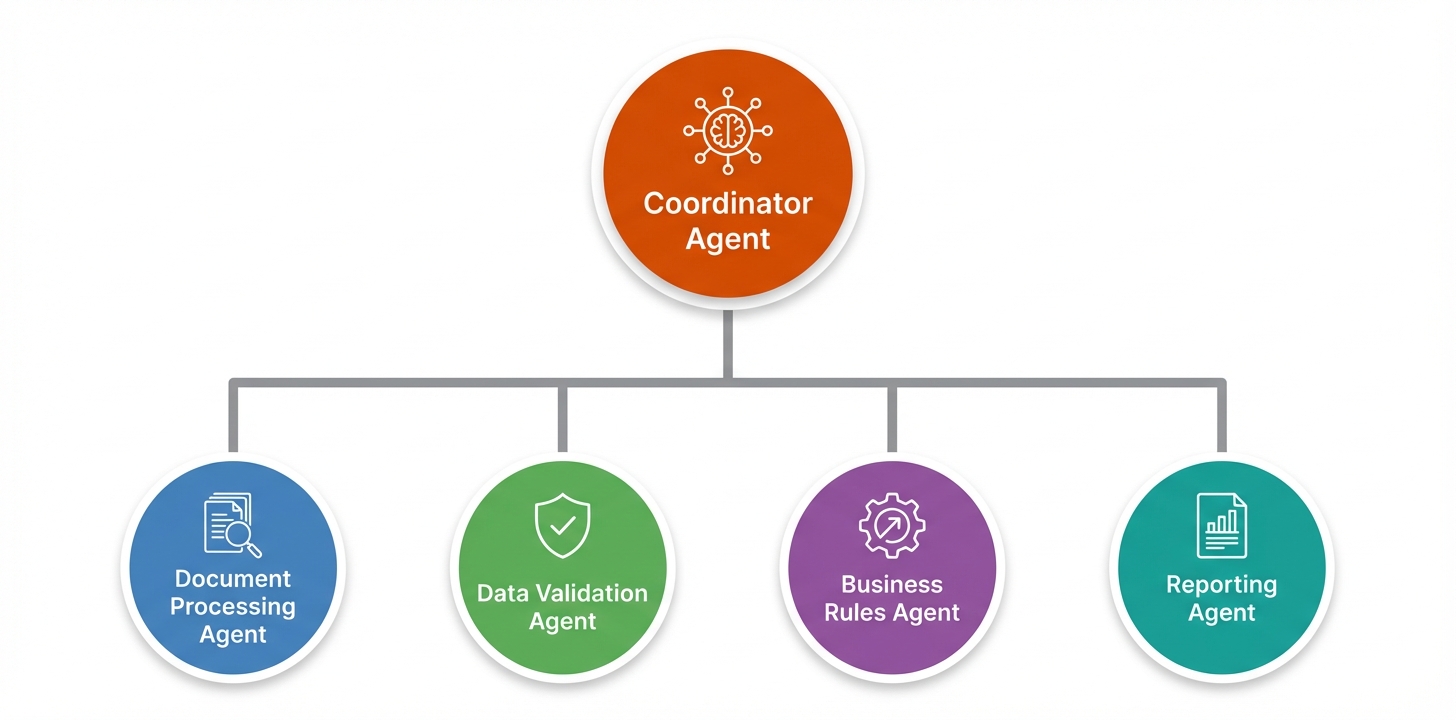
A coordinator agent delegates tasks to specialized worker agents, collecting and synthesizing results.
Best for: Complex workflows with clear task decomposition Examples: Financial reconciliation, supply chain optimization, compliance auditing
Architecture:
Production code example:
from langgraph.graph import StateGraph, END
from typing import TypedDict, List

class WorkflowState(TypedDict):
    task: str
    document_data: dict
    validation_results: dict
    compliance_check: dict
    final_report: str

def coordinator_agent(state: WorkflowState):
    """Routes tasks to specialized agents"""
    return {
        "task": state["task"],
        "routing": "document_processing"
    }

def document_processing_agent(state: WorkflowState):
    """Extracts structured data from documents"""
    # Connect to document AI service
    extracted_data = extract_invoice_data(state["task"])
    return {"document_data": extracted_data}

def validation_agent(state: WorkflowState):
    """Validates data against business rules"""
    results = validate_invoice(state["document_data"])
    return {"validation_results": results}

# Build hierarchical workflow
workflow = StateGraph(WorkflowState)
workflow.add_node("coordinator", coordinator_agent)
workflow.add_node("document_processor", document_processing_agent)
workflow.add_node("validator", validation_agent)

workflow.set_entry_point("coordinator")
workflow.add_edge("coordinator", "document_processor")
workflow.add_edge("document_processor", "validator")
workflow.add_edge("validator", END)

app = workflow.compile()
ROI impact: Genentech deployed hierarchical multi-agent systems for research automation, reducing experiment design time from 6 weeks to 3 days while maintaining 94% accuracy.
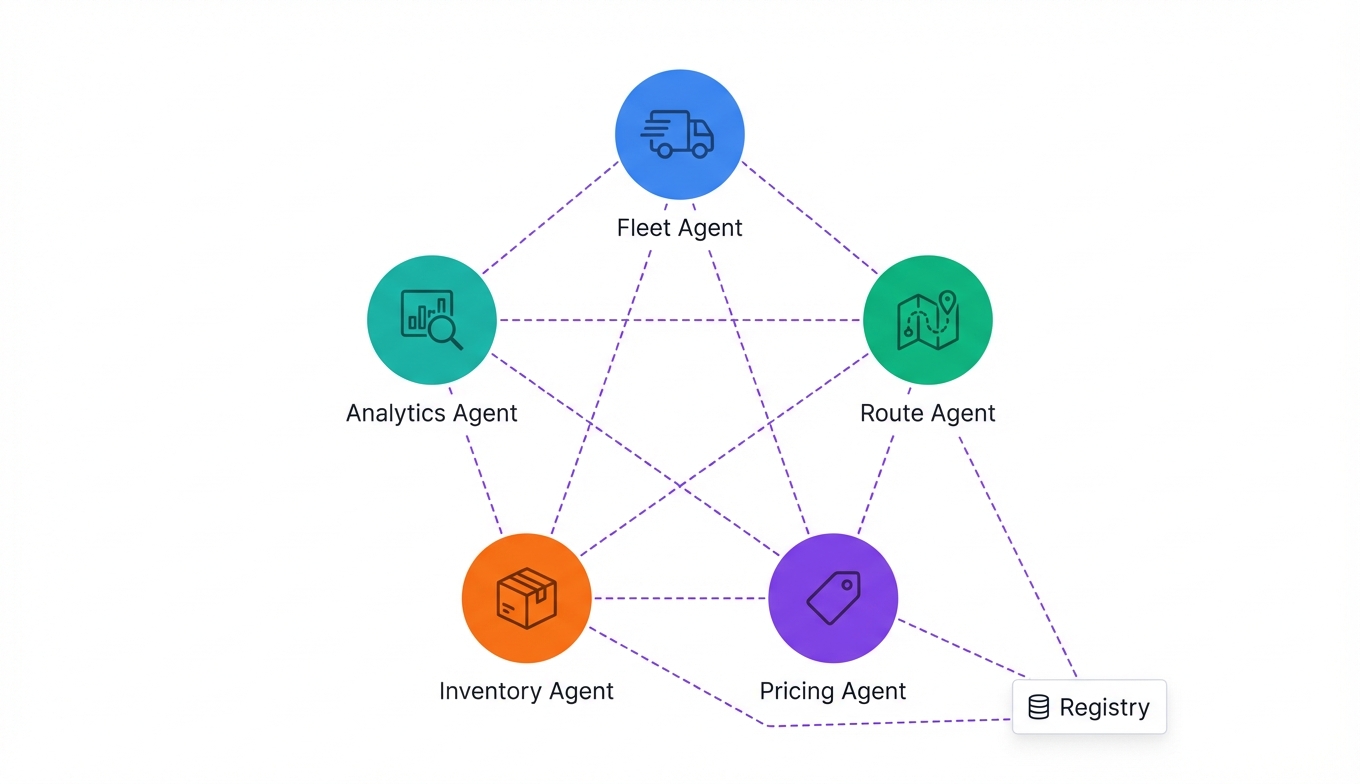
Peer-to-Peer Pattern
Autonomous agents collaborate directly without centralized coordination, negotiating task allocation dynamically.
Best for: Distributed systems, dynamic environments, real-time optimization Examples: Fleet management, network optimization, distributed data processing
Key characteristics:
- Agents discover and communicate with peers via service registry
- Consensus protocols handle conflict resolution
- No single point of failure
Architecture:
Communication protocol example:
// Agent-to-Agent (A2A) Communication Protocol
class PeerAgent {
  constructor(agentId, capabilities) {
    this.agentId = agentId;
    this.capabilities = capabilities;
    this.peers = new Map();
  }

  async discoverPeers(registry) {
    // Query service registry for compatible agents
    const peers = await registry.findAgents({
      capabilities: this.requiredCapabilities,
      availability: 'active'
    });

    peers.forEach(peer => {
      this.peers.set(peer.id, peer);
    });
  }

  async negotiateTask(task) {
    // Broadcast task to peers with capability matching
    const proposals = await Promise.all(
      Array.from(this.peers.values())
        .filter(peer => peer.canHandle(task))
        .map(peer => peer.proposeExecution(task))
    );

    // Select optimal peer based on load, latency, cost
    const selected = this.selectBestProposal(proposals);

    return await selected.peer.executeTask(task, {
      timeout: 30000,
      retries: 3,
      fallback: this.agentId // Self-execution fallback
    });
  }

  selectBestProposal(proposals) {
    // Multi-criteria optimization
    return proposals.reduce((best, current) => {
      const currentScore =
        (1 - current.load) * 0.4 +
        (1 / current.latency) * 0.3 +
        (1 - current.cost) * 0.3;

      return currentScore > best.score
        ? { peer: current, score: currentScore }
        : best;
    }, { peer: null, score: 0 });
  }
}
Production lesson: Amazon's legacy modernization project using Amazon Q Developer implemented peer-to-peer agents that autonomously refactored codebases, reducing migration time by 66% (1000 apps in 6 months vs projected 3 years).
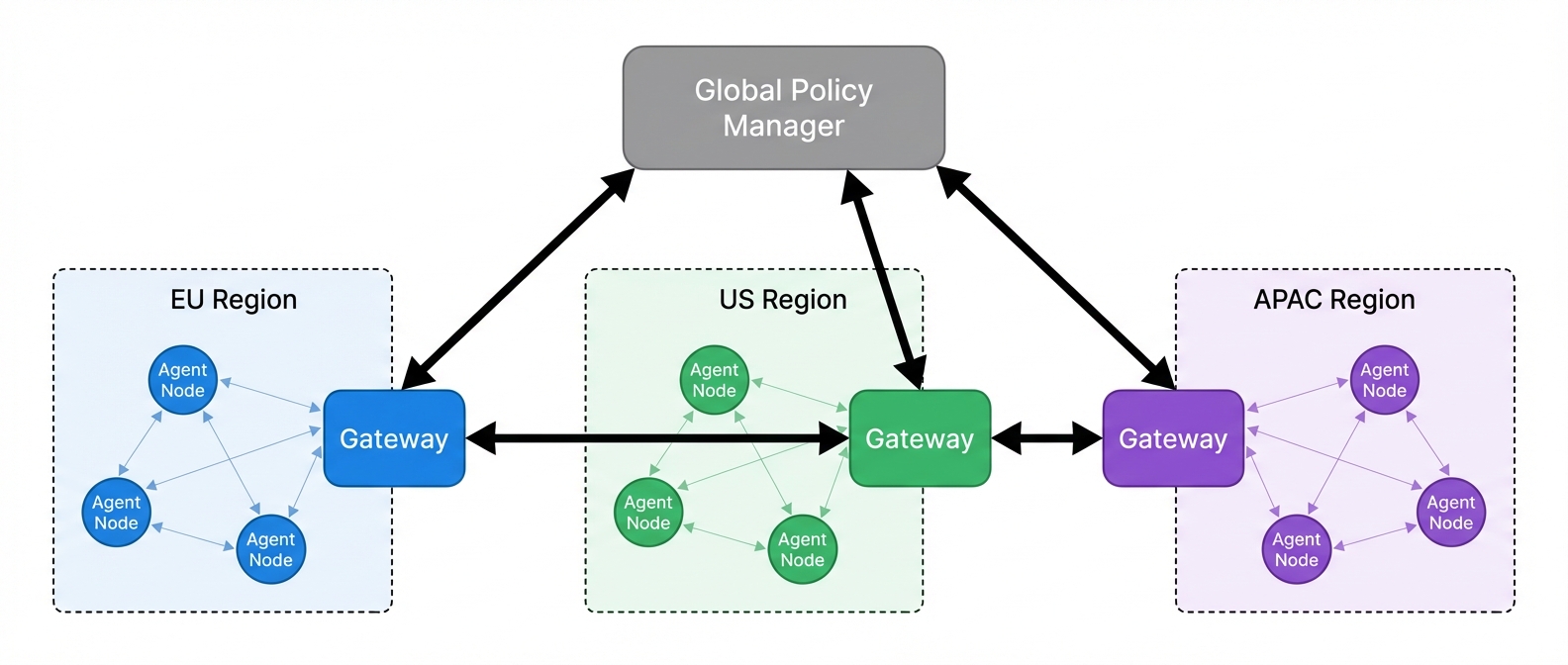
Federated Pattern
Regional agent clusters coordinate through gateway agents, balancing autonomy with centralized governance.
Best for: Multi-region deployments, data sovereignty requirements, hybrid cloud Examples: Global customer service, multi-tenant SaaS, regulated industries
Architecture benefits:
- Data stays within regional boundaries (GDPR, data residency compliance)
- Local agents handle region-specific logic and language
- Gateway agents synchronize cross-region state and policy
Architecture:
Agent-to-Agent Communication Protocols
Effective multi-agent systems require standardized communication protocols. Several open protocols emerged in 2025-2026 to solve agent interoperability.
Model Context Protocol (MCP)
Developed by Anthropic, MCP provides a universal interface for AI applications to connect to data sources and tools.
Key features:
- Standardized server-client architecture
- Language-agnostic protocol (works across Python, Node.js, etc.)
- Built-in security with scope-based permissions
- Bidirectional communication for streaming responses
Use case: Connect multiple specialized agents to shared data sources (databases, APIs, file systems) without custom integration code for each agent.
MCP server example:
from mcp import MCPServer, Tool, Resource

class MultiAgentMCPServer(MCPServer):
    def __init__(self):
        super().__init__(name="enterprise-agent-hub")

    @self.tool()
    async def query_customer_data(self, customer_id: str) -> dict:
        """Shared customer data access for all agents"""
        return await self.db.customers.find_one({"id": customer_id})

    @self.resource()
    async def inventory_stream(self, warehouse: str):
        """Real-time inventory updates for logistics agents"""
        async for update in self.inventory_feed(warehouse):
            yield update

    @self.tool()
    async def create_handoff(self, from_agent: str, to_agent: str, context: dict):
        """Protocol for agent-to-agent task handoff"""
        handoff_id = await self.store_handoff({
            "from": from_agent,
            "to": to_agent,
            "context": context,
            "timestamp": datetime.now(),
            "status": "pending"
        })

        # Notify receiving agent
        await self.notify_agent(to_agent, {
            "type": "handoff_received",
            "handoff_id": handoff_id,
            "from": from_agent
        })

        return handoff_id
Adoption: MCP has become the de facto standard for multi-agent tool sharing in enterprise deployments, with native support in Claude, LangGraph, and CrewAI.
Agent Communication Protocol (ACP)
ACP defines message formats and interaction patterns for direct agent-to-agent communication.
Core message types:
- REQUEST: Agent asks another agent to perform action
- INFORM: Agent shares state or data with peers
- PROPOSE: Agent suggests collaborative action
- CONFIRM/REJECT: Response to proposals
- QUERY: Agent requests information from peer
Example ACP exchange:
Agent A → Agent B: REQUEST[task=verify_compliance, document_id=inv-2024-001]
Agent B → Agent A: CONFIRM[estimated_time=5s]
Agent B → Agent A: INFORM[compliance_status=approved, checks_passed=14/14]
Agent A → Agent C: REQUEST[task=process_payment, invoice_id=inv-2024-001]
Agent Negotiation Protocol (ANP)
When multiple agents can handle a task, ANP provides structured negotiation to select the optimal agent.
Negotiation phases:
- Call for Proposals (CFP): Requesting agent broadcasts task requirements
- Proposal Submission: Capable agents submit bids with cost, time, quality estimates
- Evaluation: Requesting agent evaluates proposals using decision criteria
- Award: Selected agent receives task assignment
- Execution Monitoring: Requesting agent tracks progress, handles failures
When to use ANP:
- Dynamic resource allocation (cloud compute, API quotas)
- Load balancing across agent pools
- Cost optimization (select cheapest agent meeting quality thresholds)
Framework Comparison for Multi-Agent Systems
Three frameworks dominate enterprise multi-agent deployments in 2026, each with distinct strengths.
LangGraph (Graph-Based Orchestration)
Architecture: State machine with explicit edges defining agent transitions
Best for:
- Complex workflows with conditional branching
- Workflows requiring audit trails (financial services, healthcare)
- Systems where state persistence is critical
Strengths:
- Visual workflow representation
- Built-in checkpointing and state recovery
- Native LangChain integration
Limitations:
- Steeper learning curve than alternatives
- Requires upfront workflow design (less dynamic than peer-to-peer)
Production usage: 40% of LangGraph deployments use multi-agent graphs according to LangChain's 2026 State of AI report.
CrewAI (Role-Based Collaboration)
Architecture: Agents assigned roles (researcher, writer, reviewer) collaborate on objectives
Best for:
- Content creation workflows
- Research and analysis pipelines
- Systems modeling human team dynamics
Strengths:
- Intuitive role-based mental model
- Excellent for non-technical stakeholders to understand
- Built-in task delegation and review loops
Limitations:
- Less flexible for non-linear workflows
- Role hierarchy can bottleneck parallelization
Adoption: CrewAI saw 250% growth in enterprise adoption in 2025, particularly in marketing and legal teams.
AutoGen (Conversational Multi-Agent)
Architecture: Agents engage in natural language conversations to solve problems
Best for:
- Research and exploration tasks
- Pair programming and code review
- Scenarios where emergent behavior is desired
Strengths:
- Minimal code to create multi-agent systems
- Flexible agent interactions (no predefined workflow required)
- Excellent for prototyping
Limitations:
- Unpredictable conversation flows in production
- Higher token costs (verbose agent-to-agent messages)
- Challenging to implement strict compliance requirements
Research application: Microsoft Research reports AutoGen excels in scientific discovery workflows where exploration outweighs deterministic execution.
Enterprise Use Cases and ROI
Case Study 1: Genentech Research Automation
Challenge: Drug discovery workflows required coordinating literature review, experiment design, data analysis, and regulatory documentation across multiple specialized systems.
Multi-agent solution:
- Literature Agent: Searches biomedical databases, summarizes papers
- Design Agent: Proposes experiment protocols based on research
- Analysis Agent: Processes lab results, identifies patterns
- Documentation Agent: Generates regulatory-compliant reports
Architecture: Hierarchical with LangGraph orchestration
Results:
- Experiment design time: 6 weeks → 3 days (95% reduction)
- Research throughput: 3x increase in concurrent projects
- Accuracy: 94% of AI-designed experiments met scientific standards
- ROI: $12M annual savings in researcher time
Key lesson: Domain-specialized agents outperformed general-purpose models by 37% on task-specific benchmarks while maintaining safety through coordinator agent oversight.
Case Study 2: Amazon Q Developer Legacy Modernization
Challenge: Migrate 1000 production applications from legacy infrastructure to modern cloud-native architecture.
Multi-agent solution:
- Code Analysis Agent: Identifies refactoring opportunities
- Transformation Agent: Executes code updates and modernization
- Testing Agent: Validates functionality preservation
- Documentation Agent: Updates architecture diagrams and runbooks
Architecture: Peer-to-peer with consensus-based conflict resolution
Results:
- Migration timeline: 3 years → 6 months (83% reduction)
- Applications migrated: 1000 in half year
- Downtime incidents: Reduced by 56% vs manual migrations
- Developer productivity: Agents saved 4500 developer-years of effort
Key lesson: Peer-to-peer architecture enabled parallel processing of independent applications while consensus protocols prevented conflicts when agents needed shared resources.
Case Study 3: Fortune 500 Retailer Order-to-Cash
Challenge: Order fulfillment required coordinating inventory, pricing, shipping, and payment across siloed systems with 47-minute average processing time.
Multi-agent solution:
- Inventory Agent: Real-time stock verification across warehouses
- Pricing Agent: Dynamic pricing with promotions and contracts
- Logistics Agent: Optimal shipping route calculation
- Payment Agent: Multi-currency processing and fraud detection
Architecture: Federated (regional agents for each distribution center)
Results:
- Processing time: 47 minutes → 4.5 minutes (90% reduction)
- Order accuracy: Improved from 91% to 99.2%
- Customer satisfaction: +18 NPS points
- Cost per order: $4.20 → $0.90 (79% reduction)
Key lesson: Federated architecture respected data residency requirements (EU customer data stayed in EU region) while gateway agents synchronized global pricing and inventory state.
Production Deployment Checklist
Deploying multi-agent systems requires addressing challenges single-agent systems don't encounter.
1. Agent Discovery and Registration
Implement service registry so agents can find and communicate with peers:
# Agent Registry Service
class AgentRegistry:
    def __init__(self):
        self.agents = {}

    def register(self, agent_id, capabilities, endpoint):
        self.agents[agent_id] = {
            "capabilities": capabilities,
            "endpoint": endpoint,
            "status": "active",
            "registered_at": datetime.now()
        }

    def discover(self, required_capabilities):
        return [
            agent for agent in self.agents.values()
            if all(cap in agent["capabilities"] for cap in required_capabilities)
            and agent["status"] == "active"
        ]
2. Conflict Resolution Strategy
Define how agents handle conflicting objectives:
Strategies:
- Priority-based: Higher priority agent wins
- Consensus: Majority vote among affected agents
- Escalation: Human-in-the-loop for unresolved conflicts
- Cost-based: Minimize total system cost
3. Failure Handling and Resilience
Multi-agent systems have more failure modes than single agents:
Required patterns:
- Circuit breakers: Prevent cascading failures when an agent becomes unavailable
- Timeout handling: Set maximum wait times for agent responses
- Fallback chains: Define backup agents when primary agents fail
- Graceful degradation: System continues with reduced functionality if agents fail
4. Monitoring and Observability
Track metrics across the agent collaboration:
Critical metrics:
- Agent-to-agent latency distribution
- Handoff success rate
- Task completion rate by agent type
- Token consumption per agent per task
- Conflict resolution frequency
Tools: Integrate with LangSmith, Weights & Biases, or custom observability stacks.
5. Cost Management
Multi-agent systems can consume tokens rapidly through agent-to-agent communication:
Optimization strategies:
- Use smaller models for routing and coordination tasks
- Implement shared memory to avoid re-transmitting context
- Cache frequently accessed data (customer records, product catalogs)
- Set token budgets per task with automatic escalation for overruns
6. Security and Access Control
Agents may have different permission levels:
Requirements:
- Role-based access control (RBAC) for tool and data access
- Audit logging of all inter-agent communication
- Encryption for sensitive data in transit between agents
- Secret management for API keys and credentials
Calculating Multi-Agent vs Monolithic ROI
Use this framework to quantify multi-agent system value:
Time savings:
- Identify parallelizable tasks
- Calculate total time as
max(agent_times)instead ofsum(agent_times) - Multiply time reduction by hourly cost of human alternatives
Accuracy improvements:
- Measure task-specific accuracy of specialized agents vs generalist
- Calculate cost of errors prevented (compliance fines, customer churn, rework)
Scalability gains:
- Estimate capacity of single agent before degradation
- Compare to multi-agent throughput with horizontal scaling
- Factor in infrastructure cost differences
Example calculation:
Single Agent System:
- Processing time: 45 minutes per transaction
- Throughput: 32 transactions/day
- Error rate: 8%
- Cost per error: $500
- Infrastructure: $2000/month

Multi-Agent System:
- Processing time: 5 minutes per transaction
- Throughput: 288 transactions/day
- Error rate: 1.2%
- Cost per error: $500
- Infrastructure: $3500/month

ROI Calculation:
- Additional capacity value: (288-32) × $50/transaction × 22 days = $281,600/month
- Error reduction value: (8%-1.2%) × 288 × 22 × $500 = $215,424/month
- Additional infrastructure cost: $1500/month
- Net monthly value: $495,524
- ROI: 33,035% monthly return on incremental investment
Common Pitfalls to Avoid
Based on production deployments, these mistakes derail multi-agent projects:
1. Over-engineering coordination: Start with hierarchical patterns before moving to complex peer-to-peer systems. Many workflows don't require dynamic negotiation.
2. Insufficient testing of failure modes: Test agent unavailability, timeout scenarios, and conflict situations explicitly. Multi-agent systems have exponentially more failure combinations than single agents.
3. Ignoring token costs: Agent-to-agent communication can consume 3-5x more tokens than single-agent systems if not optimized. Implement shared memory and compression early.
4. Lack of clear handoff protocols: Define exactly what information agents pass during handoffs. Implicit assumptions cause 60% of multi-agent bugs according to our research.
5. Premature optimization: Build working multi-agent systems before optimizing. Profiling shows optimization efforts often target non-bottleneck components.
Future Directions: 2026 and Beyond
The multi-agent landscape continues evolving rapidly:
Emerging trends:
- Agent marketplaces: Third-party specialized agents available via APIs (compliance agents, industry-specific analyzers)
- Cross-organization agents: Agents from different companies collaborating on supply chain, insurance claims, etc.
- Self-improving agent teams: Meta-agents that optimize team composition and coordination patterns
- Federated learning across agents: Agents improve through shared learning without centralized training
Standards adoption: The Agent Communication Protocol (ACP) and Model Context Protocol (MCP) are gaining industry support, with IBM, Google, and Anthropic contributing to specifications.
Gartner predicts 40% of enterprise applications will include agentic capabilities by end of 2026, with multi-agent architectures representing the majority of complex implementations.
Getting Started: Your First Multi-Agent System
For teams new to multi-agent systems, this proven path minimizes risk:
Phase 1: Single workflow pilot (4-6 weeks)
- Select workflow with clear task boundaries (invoice processing, customer onboarding)
- Implement hierarchical pattern with 3-4 specialized agents
- Use LangGraph for explicit orchestration
- Measure baseline metrics before deployment
Phase 2: Optimization and monitoring (4-8 weeks)
- Add observability tooling
- Optimize token usage with caching and shared memory
- Test failure scenarios and add resilience patterns
- Calculate actual ROI vs projections
Phase 3: Expand to related workflows (8-12 weeks)
- Apply learnings to adjacent use cases
- Build reusable agent components
- Standardize on communication protocols (MCP, ACP)
- Consider peer-to-peer patterns for dynamic scenarios
Phase 4: Production scaling (ongoing)
- Implement federated architecture for multi-region
- Add agent discovery and dynamic orchestration
- Explore third-party specialized agents
- Contribute to internal agent marketplace
Conclusion
Multi-agent coordination systems represent the next evolution of enterprise AI, moving beyond individual assistants to collaborative intelligence that mirrors human team dynamics. Organizations deploying multi-agent architectures report 3-5x productivity improvements over single-agent systems in complex workflows.
The key to success lies in matching architecture patterns to your workflows, standardizing communication protocols, and implementing production-grade monitoring and resilience. Start with hierarchical patterns for well-understood processes, then evolve to peer-to-peer and federated architectures as complexity demands.
As Gartner's research shows, 81% of enterprises plan to expand agent deployments into more complex use cases in 2026. Those investments will increasingly depend on multi-agent coordination to deliver ROI at scale.
Additional Resources
- 8 Best Multi-Agent AI Frameworks 2026
- AI Agent Trends 2026
- Multi-Agent Orchestration in Enterprise AI
- IBM Multi-Agent Collaboration Research
- Model Context Protocol and Multi-Agent AI
- LangGraph Documentation
- CrewAI Framework
- Microsoft AutoGen
Want to explore how multi-agent systems can transform your workflows? Check out our related guides on AI Agent Orchestration Frameworks 2026 and Agentic AI Production Deployment.