AI Implementation Costs Breakdown 2025: What Small Businesses Actually Pay
Real cost analysis of implementing AI in small business: ChatGPT, Claude, automation tools. Includes hidden costs, pricing tiers, and 12-month budget planning.
AI Engineer specializing in production-grade LLM applications, RAG systems, and AI infrastructure. Passionate about building scalable AI solutions that solve real-world problems.
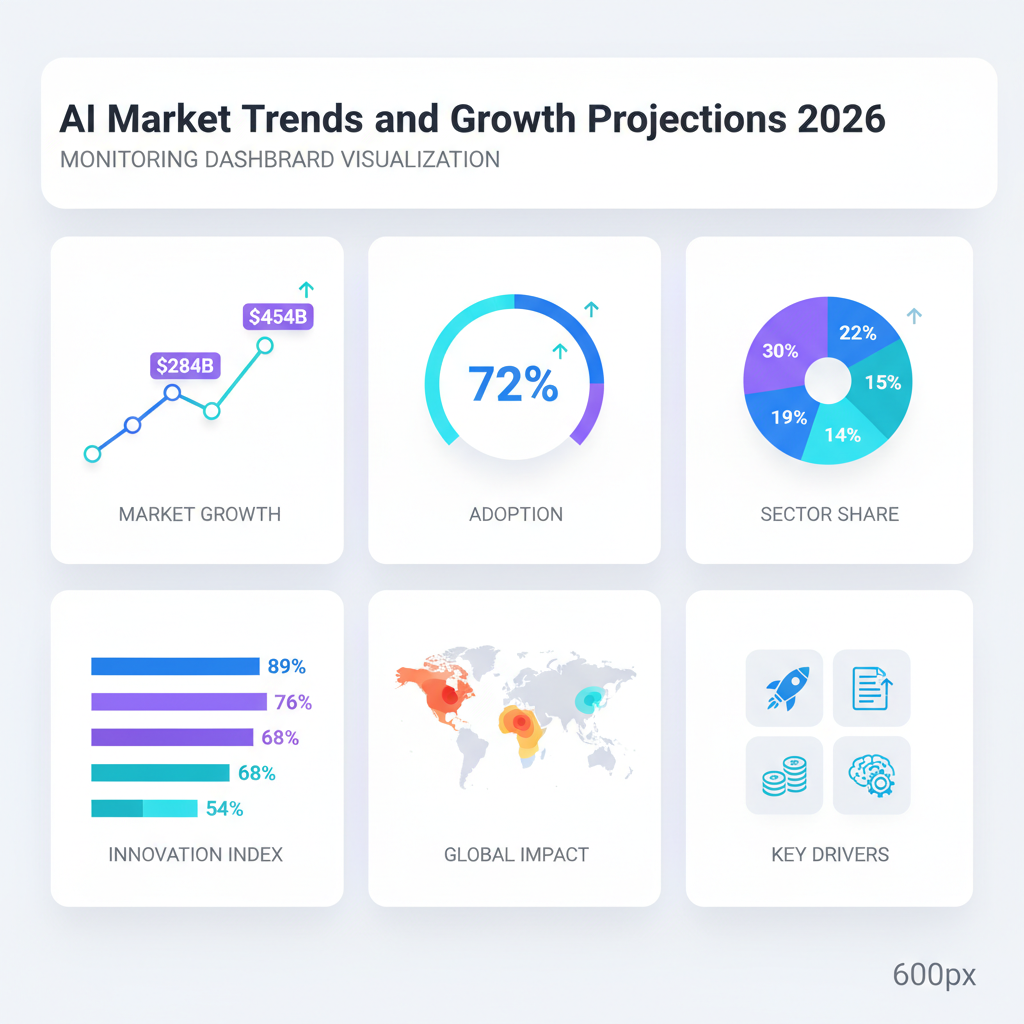
The artificial intelligence market is experiencing unprecedented growth in 2026, driven by breakthrough models like GPT-5, enterprise-wide adoption, and new regulatory frameworks shaping responsible AI deployment. With global AI spending projected to reach $454 billion—a 47% year-over-year increase—the technology has moved from experimental to essential infrastructure.
This analysis examines the most significant AI trends defining 2026, backed by market data, enterprise adoption patterns, and expert predictions for the year ahead.
Market Size and Growth Trajectory
The $454 Billion AI Economy
The global AI market has achieved remarkable scale:
- 2024: $184 billion (experimental and early adoption phase)
- 2025: $298 billion (62% growth, mainstream acceptance)
- 2026: $454 billion (47% CAGR, production deployments)
- Projected 2027: $680 billion (continued acceleration)
This growth is driven by three converging factors:
- Model capability breakthrough: GPT-5 and equivalents enable previously impossible tasks
- Infrastructure maturity: Production-grade tools and platforms are now available
- Demonstrated ROI: Early adopters prove measurable business value
Investment by Sector
AI spending distribution across industries in 2026:
| Sector | Investment Share | Growth Rate | Primary Use Cases |
|---|---|---|---|
| Technology | 30% ($136B) | 52% | Product features, developer tools, infrastructure |
| Healthcare | 22% ($100B) | 68% | Diagnostics, drug discovery, clinical workflows |
| Financial Services | 19% ($86B) | 45% | Fraud detection, trading, risk assessment |
| Retail | 15% ($68B) | 41% | Personalization, inventory, customer service |
| Manufacturing | 14% ($64B) | 38% | Quality control, predictive maintenance, robotics |
Healthcare leads growth due to:
- FDA approvals for AI diagnostic tools
- Breakthrough AI-designed pharmaceuticals
- Labor shortage driving automation adoption
Enterprise Adoption Reaches Tipping Point
The 72% Milestone
72% of Fortune 500 companies now run AI in production—up from just 35% in 2024. This represents a fundamental shift from experimentation to operationalization.
Adoption Breakdown:
- Advanced stage (AI integrated into core operations): 28%
- Scaling stage (multiple production deployments): 44%
- Pilot stage (testing specific use cases): 21%
- Planning stage (evaluating AI): 7%
The remaining 28% not yet in production face increasing competitive pressure, with 64% reporting "AI urgency" driving 2026 initiatives.
Most Common Enterprise Use Cases
Based on deployment data from 360 Fortune 500 companies:
-
Customer Service Automation (58% adoption)
- AI chatbots handling 40-70% of support tickets
- Average savings: $2.4M annually per company
- Customer satisfaction maintained or improved in 82% of cases
-
Software Development Assistance (54% adoption)
- Code generation, review, and debugging
- Productivity gains: 35-45% for routine coding tasks
- Adoption highest among tech, finance, and telecom
-
Content Creation and Marketing (49% adoption)
- Ad copy, product descriptions, personalization
- 10-15% improvement in conversion rates
- Concerns about brand voice being addressed with fine-tuning
-
Data Analysis and Business Intelligence (47% adoption)
- Natural language querying of databases
- Automated insight generation from reports
- Democratizing data access beyond analysts
-
Document Processing and Extraction (41% adoption)
- Invoice processing, contract review, compliance
- 80-90% time reduction for repetitive document tasks
- ROI often achieved within 6 months
Barriers to Faster Adoption
Despite enthusiasm, enterprises face obstacles:
- Data quality and availability (cited by 67% of adopters)
- Skills gap and talent shortage (61%)
- Integration with legacy systems (54%)
- Regulatory uncertainty (48%)
- Cost concerns and budget allocation (42%)
Organizations overcoming these barriers through vendor partnerships, upskilling programs, and phased implementation strategies are achieving 2-3x faster time-to-value.
GPT-5 and the Next Generation of Foundation Models
GPT-5: The Anticipated Breakthrough
OpenAI's GPT-5, expected in Q2 2026, represents the next major capability jump:
Rumored Capabilities:
- 10x improvement in reasoning: Solving complex math, logic, and planning problems
- Native multimodal: Unified understanding of text, images, video, and audio
- Extended context: 500K-1M token windows (1,200-2,400 pages)
- Improved accuracy: 95%+ on professional exam benchmarks
- Reduced hallucinations: Enhanced factual grounding and citation capabilities
Expected Impact:
- Enable autonomous agent systems capable of multi-day projects
- Replace knowledge workers for routine analytical tasks
- Accelerate scientific research through literature synthesis and hypothesis generation
- Drive new wave of AI-native products and services
Pricing Speculation: $40-60/month for individual tier, significantly higher API costs than GPT-4
Competitive Landscape
GPT-5 won't be alone—competitors are racing to match or exceed capabilities:
Anthropic Claude 5 (Q4 2026 expected):
- Focus on "extended reasoning" for complex, multi-step problems
- 500K token context with improved speed
- Enhanced safety features and constitutional AI
Google Gemini 3 (Q3 2026 expected):
- TPU-optimized for 10x speed improvement
- Advanced video understanding (full movie analysis)
- Tighter integration with Google ecosystem
Meta Llama 4 (Q3 2026):
- Open-source model rivaling commercial alternatives
- Optimized for edge deployment
- Driving democratization of AI capabilities
The model landscape is fragmenting from "one size fits all" to specialized models for specific domains (medical, legal, financial) and deployment contexts (cloud, edge, mobile).
Agentic AI: From Chat to Autonomous Systems
The Shift from Tools to Agents
2026 marks the transition from AI as a tool (responds to prompts) to AI as an agent (acts autonomously to achieve goals).
Agentic AI Characteristics:
- Goal-oriented: Given objectives, agents plan and execute multi-step workflows
- Tool-using: Access to APIs, databases, and external systems
- Self-correcting: Learn from feedback and adjust strategies
- Long-running: Operate over hours or days to complete complex tasks
Example Use Cases:
- Sales agent: Research leads, personalize outreach, schedule meetings, update CRM
- Research agent: Literature review, data gathering, synthesis, draft generation
- DevOps agent: Monitor systems, diagnose issues, apply fixes, verify resolution
- Financial agent: Portfolio analysis, rebalancing recommendations, execution
Market Growth: Agentic AI solutions are the fastest-growing segment at 89% year-over-year, with companies like Microsoft (Copilot Studio), Google (Vertex AI Agent Builder), and startups (LangChain, CrewAI) leading development.
Technical Foundations
Agentic AI relies on several technical advances:
# Simplified agentic AI architecture
from langchain.agents import AgentExecutor, create_openai_tools_agent
from langchain.tools import Tool
from langchain_openai import ChatOpenAI

# Define tools the agent can use
tools = [
    Tool(
        name="WebSearch",
        func=search_web,
        description="Search the internet for information"
    ),
    Tool(
        name="Calculator",
        func=calculate,
        description="Perform mathematical calculations"
    ),
    Tool(
        name="DatabaseQuery",
        func=query_db,
        description="Query internal database"
    )
]

# Create agent with GPT-5
llm = ChatOpenAI(model="gpt-5", temperature=0)
agent = create_openai_tools_agent(llm, tools, prompt_template)
agent_executor = AgentExecutor(agent=agent, tools=tools, verbose=True)

# Agent autonomously decides which tools to use and in what order
result = agent_executor.invoke({
    "input": "Research our top 10 competitors and create a comparison report"
})
This architecture enables complex workflows that previously required human coordination.
AI Regulation and Governance
Global Regulatory Landscape
2026 brings the first comprehensive AI regulations into force:
European Union AI Act (Effective March 2026):
- Prohibited AI: Social scoring, manipulative AI, mass surveillance
- High-risk AI: Healthcare, education, employment (strict requirements)
- General-purpose AI: Transparency and documentation requirements
- Penalties: Up to €35M or 7% of global revenue
United States AI Safety Framework (Expected June 2026):
- Sector-specific regulations (healthcare, finance, transportation)
- Mandatory disclosure of AI-generated content
- Algorithm auditing requirements for high-risk applications
- Federal AI Safety Board established
China AI Regulation (Updated January 2026):
- Algorithm registration and approval process
- Content control and censorship requirements
- Data localization mandates
- Preference for domestic AI providers
Implications for Businesses:
- Compliance costs: $200K-$2M for enterprise implementations
- Documentation requirements slow development cycles
- Risk of regulatory fragmentation across jurisdictions
- Competitive advantage for companies with mature governance
Responsible AI Practices
Leading organizations adopt proactive governance:
- AI ethics boards with cross-functional representation
- Model cards documenting training data, limitations, intended use
- Bias testing and mitigation across demographic groups
- Explainability requirements for high-stakes decisions
- Human-in-the-loop workflows for critical applications
Companies with strong AI governance see 23% fewer incidents, better customer trust, and easier regulatory compliance.
Multimodal AI: Beyond Text
Vision and Video Understanding
Multimodal AI—processing text, images, video, and audio in unified models—is a dominant trend:
Capabilities Achieving Production Quality:
- Document understanding: Extract structured data from scanned forms, invoices, contracts
- Visual question answering: "How many people in this photo?" "What's wrong with this X-ray?"
- Video analysis: Summarize meetings, analyze security footage, extract highlights
- Image generation: DALL-E 3, Midjourney, Stable Diffusion for creative and commercial use
Market Impact:
- 76% year-over-year growth in multimodal AI adoption
- Use cases expanding beyond tech sector to retail, real estate, healthcare
- New startups focused on industry-specific multimodal applications
Example Application - Real Estate:
- Analyze property photos to estimate renovation costs
- Generate virtual staging from empty rooms
- Create video tours with AI voiceovers
- Extract property details from listing photos
# Multimodal AI for image analysis
from openai import OpenAI

client = OpenAI()
response = client.chat.completions.create(
    model="gpt-4-vision-preview",
    messages=[{
        "role": "user",
        "content": [
            {"type": "text", "text": "Estimate renovation costs for this property"},
            {"type": "image_url", "image_url": {"url": property_image_url}}
        ]
    }]
)

# AI analyzes image and provides cost breakdown
print(response.choices[0].message.content)
Small Language Models and Edge AI
The Efficiency Revolution
While GPT-5 grows larger, a counter-trend emerges: Small Language Models (SLMs) optimized for efficiency:
SLM Characteristics:
- Model size: 1-10 billion parameters (vs. 100B+ for frontier models)
- Performance: 70-85% of GPT-4 quality for specific tasks
- Speed: 10-100x faster inference
- Cost: 90-95% cheaper to run
- Deployment: Can run on-device (smartphones, IoT, edge servers)
Leading SLMs:
- Microsoft Phi-3.5: 3.8B parameters, matches GPT-3.5 on many tasks
- Google Gemini Nano: 1.8B parameters, runs on Pixel phones
- Meta Llama 3.2: 7B parameters, open-source, fine-tunable
Use Cases:
- Privacy-sensitive applications: Healthcare, legal, financial (data never leaves device)
- Real-time applications: Gaming, AR/VR, robotics
- Cost-optimized deployments: High-volume, low-complexity tasks
- Offline capabilities: Rural areas, vehicles, IoT devices
SLM market growing at 68% annually as organizations balance capability vs. cost.
AI Cost Optimization: The 50% Reduction
Driving Down Inference Costs
AI compute costs are falling dramatically:
- 2023: $0.03 per 1K tokens (GPT-4)
- 2024: $0.01 per 1K tokens (GPT-4 Turbo)
- 2025: $0.005 per 1K tokens (improved infrastructure)
- 2026: $0.0025-0.0015 per 1K tokens (competition + efficiency)
Drivers of Cost Reduction:
- Model optimization: Quantization, distillation, pruning
- Infrastructure efficiency: Better GPUs (H100, H200), custom AI chips
- Competition: Multiple providers driving prices down
- Caching: Prompt caching reduces redundant computation by 60-80%
Implication: AI becomes economically viable for low-margin, high-volume use cases previously impractical (e.g., real-time personalization for every user interaction).
Predictions for the Year Ahead
High Confidence (80%+ Probability)
- GPT-5 launches Q2 2026 with significant capability improvements
- Enterprise AI adoption exceeds 80% of Fortune 500 by year-end
- EU AI Act enforcement begins, with first major fines issued
- Multimodal AI becomes default, text-only models seen as outdated
- AI coding assistants achieve 50% market penetration among developers
Medium Confidence (50-70% Probability)
- First fully autonomous AI agents deployed in production for complex workflows
- AI-designed drug reaches Phase III trials faster than traditional methods
- Major AI safety incident prompts regulatory response and industry standards
- Open-source models match GPT-4 quality, democratizing advanced AI
- AI energy consumption becomes political issue, driving efficiency research
Speculative (30-40% Probability)
- GPT-5 demonstrates AGI-like capabilities in narrow domains
- AI-generated content exceeds 50% of online text and images
- First AI-CEO experiment at a public company (likely in tech sector)
- Quantum-AI hybrid systems show advantage in specific applications
- AI wealth gap widens significantly, prompting policy discussions
Preparing for the AI-Driven Future
Recommendations for Businesses
For a comprehensive implementation guide with ROI calculations, see our AI strategy guide for business leaders.
Immediate Actions (Q1-Q2 2026):
- Establish AI governance framework before regulations tighten
- Pilot agentic AI for high-value workflows
- Evaluate GPT-5 and competitors as they launch - compare ChatGPT vs Claude vs Gemini
- Upskill workforce with AI literacy programs
Medium-Term Strategy (2026-2027):
- Transition from experimental to production AI deployments
- Build proprietary data assets for competitive advantage
- Develop multi-vendor AI strategy for resilience
- Invest in AI safety and responsible AI practices
Long-Term Positioning (2027+):
- Redesign business processes around AI capabilities
- Explore AI-native products and services
- Build organizational AI expertise as core competency
- Prepare for potential AGI-level breakthroughs
Recommendations for Individuals
For Knowledge Workers:
- Learn to work with AI as collaborator, not competitor
- Focus on skills AI can't replicate: creativity, empathy, strategic thinking
- Become proficient with AI tools in your domain
- Position yourself as human-AI collaboration expert
For Developers:
- Master agentic AI frameworks and orchestration
- Develop expertise in AI safety and alignment
- Build domain-specific AI applications
- Contribute to open-source AI projects
For Students:
- Prioritize AI literacy alongside traditional subjects
- Gain hands-on experience with latest AI tools
- Focus on complementary skills: critical thinking, communication, domain expertise
- Prepare for careers that don't yet exist
Conclusion: Navigating the AI Transition
2026 marks a pivotal year in artificial intelligence: moving from hype to widespread deployment, from experimentation to measurable business impact, and from unregulated innovation to governed development.
Key Themes:
- Market maturity: $454B market with proven ROI
- Capability breakthrough: GPT-5 and agentic AI unlock new possibilities
- Regulatory framework: First comprehensive AI laws take effect
- Enterprise adoption: 72% of Fortune 500 running AI in production
- Diversification: From one-size-fits-all to specialized models and deployment options
The organizations and individuals thriving in this landscape share common traits: they start with clear objectives, pilot rapidly, measure rigorously, govern responsibly, and scale systematically.
The AI revolution isn't coming—it's here. The question is not whether to adopt AI, but how to do so strategically, responsibly, and effectively to create sustainable competitive advantage.
Stay informed, experiment boldly, deploy carefully, and prepare for a future where artificial intelligence is as fundamental to business as electricity and the internet.