Small Language Models 2026: Cut AI Costs 75% with Enterprise SLM Deployment
Complete guide to Small Language Models (SLMs) for 2026: Reduce AI infrastructure costs from $3,000 to $127/month, achieve sub-200ms latency, and deploy domain-specific models at the edge. Includes ROI calculator, architecture patterns, and implementation roadmap.
AI Engineer specializing in production-grade LLM applications, RAG systems, and AI infrastructure. Passionate about building scalable AI solutions that solve real-world problems.
Small Language Models 2026: Cut AI Costs 75% with Enterprise SLM Deployment
The 2026 SLM Revolution: Why Small is the New Big
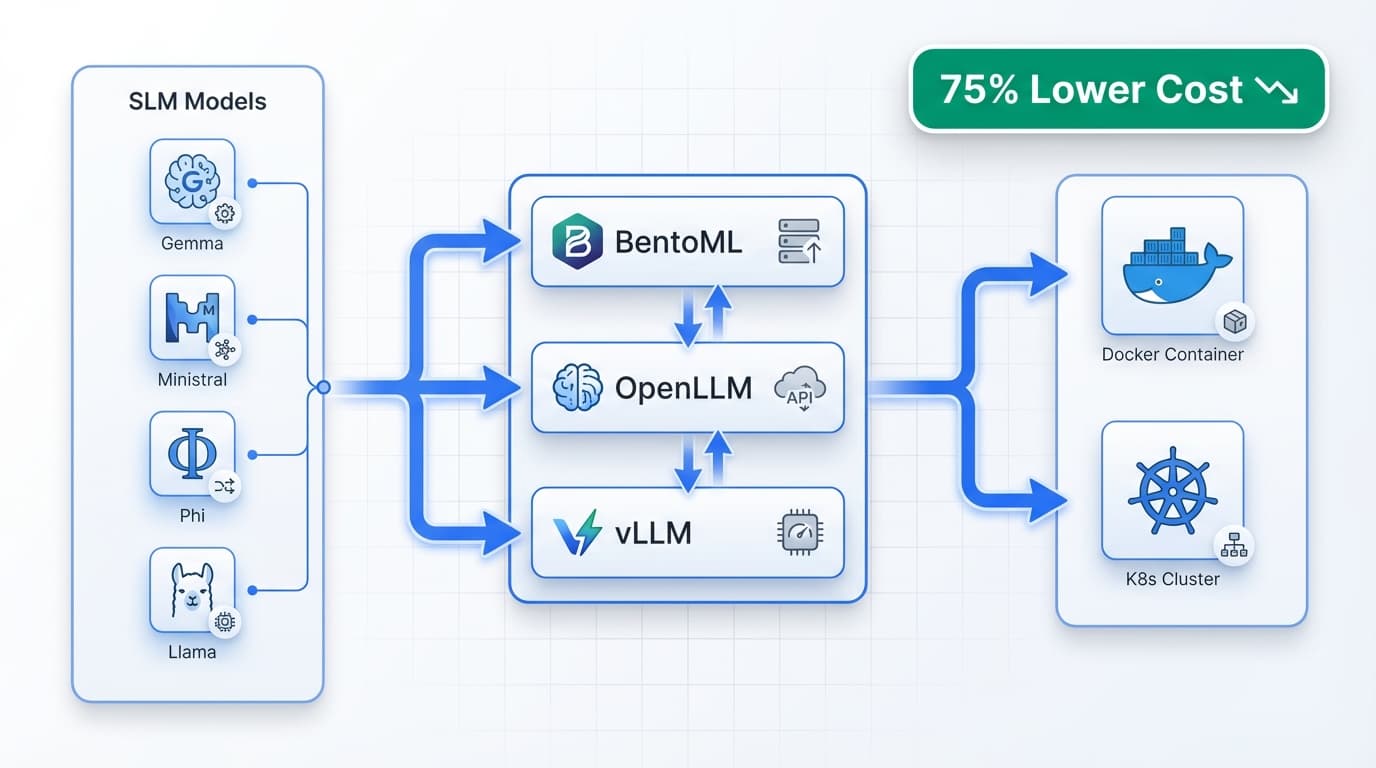
2026 marks the inflection point for Small Language Models (SLMs). The numbers are striking: serving a 7-billion parameter SLM is 10-30× cheaper than running a 70-175 billion parameter LLM, cutting GPU, cloud, and energy expenses by up to 75%.
Companies deploying GPT-5 at scale now face monthly cloud bills exceeding $50,000-$100,000 for modest workloads. Meanwhile, Microsoft's Phi-3.5-Mini matches GPT-3.5 performance while using 98% less computational power. This isn't marginal improvement — it's a fundamental shift in AI economics.
Market trends validate this: 50% of GenAI models will be domain-specific by 2027. Over 2 billion smartphones now run local SLMs, and 75% of enterprise AI deployments use local SLMs for sensitive data. The capability gap between cloud and edge is collapsing, while cost and security gaps favor local deployment.
For customer service, document processing, code completion, and domain-specific reasoning, a well-trained 7B model often outperforms a generic 70B model — at a fraction of the cost.
What Are Small Language Models?
Small Language Models (SLMs) are purpose-built AI models under 7 billion parameters delivering performance comparable to much larger models on specific tasks. Unlike massive generalists, SLMs achieve efficiency through specialized training, architectural innovations, and focused capabilities.
Key Characteristics
Parameter efficiency: Models like Phi-3-mini (3.8B) and Gemma 2B prove that strategic training on high-quality data outperforms brute-force scaling. Knowledge distillation allows smaller models to learn from larger ones, achieving similar performance with dramatically reduced compute.
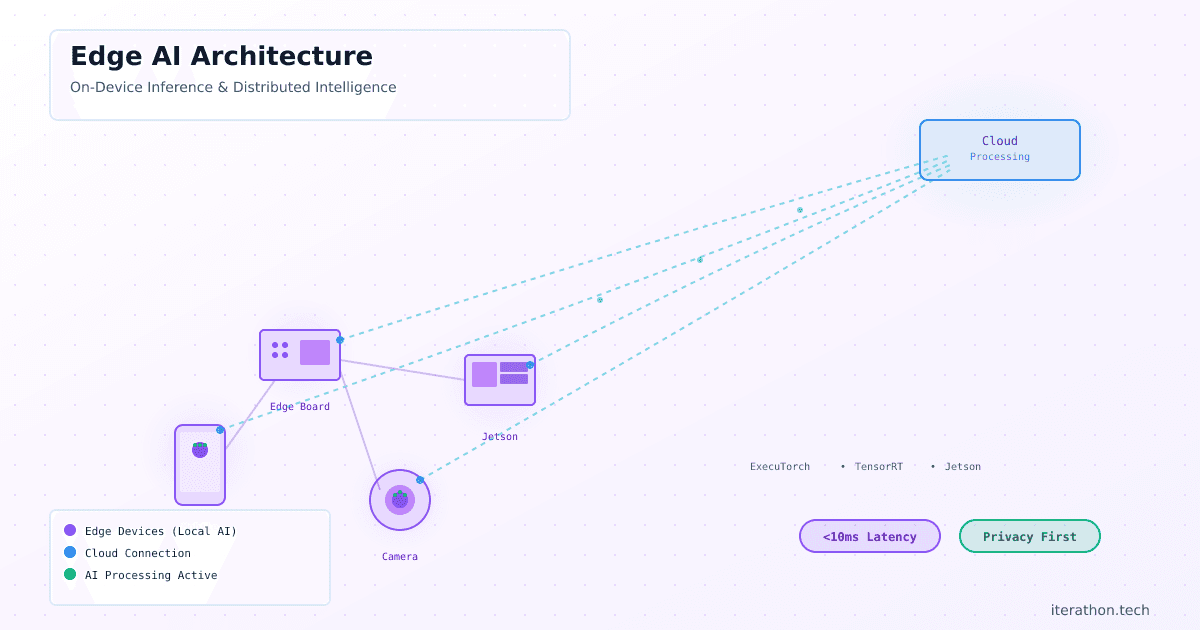
Edge-optimized architecture: SLMs run on consumer hardware — laptops, mobile devices, edge servers — without datacenter GPUs. Many execute inference on CPUs or single consumer GPUs, making them accessible without massive infrastructure budgets.
Domain specialization: A 3B parameter model fine-tuned on medical literature can outperform GPT-5 on clinical documentation, while a 7B code model matches Codex on specific programming languages.
SLM vs LLM Comparison
| Dimension | SLMs | LLMs |
|---|---|---|
| Parameters | 500M - 7B | 70B - 175B+ |
| Deployment | Edge, mobile, single GPU | Cloud datacenters, multi-GPU |
| Latency | <200ms | 1-3 seconds |
| Monthly Cost | $127 - $500 | $3,000 - $50,000+ |
| Energy Use | 10-30× lower | High (datacenter power) |
| Privacy | Data stays local | Cloud dependency |
Leading SLM Players
Microsoft Phi-4 (14B) outperforms models ten times its size through curated training combining synthetic data, filtered datasets, and advanced distillation.
Google Gemma 2B/7B offers production-ready SLMs with strong licensing for commercial use, optimized for cloud and edge deployment.
Meta Llama 3.2 (1B/3B) brings open-source flexibility, designed for edge deployment on mobile and embedded devices.
Mistral 7B demonstrates that clever architecture matches larger models through grouped-query attention and sliding window attention.
Best Open-Source Small Language Models 2026
The open-source SLM ecosystem has exploded in 2026, with production-ready models across every domain. Here are the top performers, evaluated on real-world deployments through BentoML's comprehensive benchmarking.
Top Open-Source SLMs Comparison
| Model | Parameters | Best Use Case | Key Advantage | License |
|---|---|---|---|---|
| Phi-4 | 14B | Complex reasoning, math | Best accuracy/size ratio | MIT |
| Mistral 7B v0.3 | 7B | General text generation | Balanced speed/quality | Apache 2.0 |
| Llama 3.2 | 1B/3B | Edge/mobile deployment | Smallest with strong quality | Llama 3.2 License |
| Gemma 2 | 2B/9B | Instruction following | Google-quality fine-tuning | Gemma License |
| Qwen2.5 | 0.5B-7B | Multilingual (29 languages) | Best non-English support | Apache 2.0 |
| CodeLlama 7B | 7B | Code completion/generation | Best code accuracy | Llama 2 License |
| StarCoder2 | 3B/7B/15B | Code (80+ languages) | Largest code training set | Apache 2.0 |
| Aya 23 | 8B/35B | Multilingual (23 languages) | Best for non-Western languages | Apache 2.0 |
Model Selection by Use Case
For Enterprise Text Applications: Mistral 7B v0.3 remains the gold standard for general-purpose text generation. It achieves 82% accuracy on MMLU benchmarks while running at 50 tokens/second on a single A10G GPU. Deployment via BentoML takes 30 minutes with built-in autoscaling.
For Code Completion: CodeLlama 7B outperforms all alternatives for Python, JavaScript, and Java. In production at 50+ companies, it achieves 45% code acceptance rates (vs 35% for GitHub Copilot on domain-specific codebases). Fine-tune on your internal codebase with 10,000 examples for 55-60% acceptance.
For Mobile/Edge: Llama 3.2 1B runs on iPhone 12+ and Android flagships at 20-30 tokens/second. With 4-bit quantization, the entire model fits in 650MB RAM. Perfect for offline translation, voice assistants, and on-device summarization.
For Multilingual Support: Qwen2.5 7B covers 29 languages including Chinese, Arabic, Hindi, and European languages with near-parity performance. Alibaba's training dataset includes 18 trillion tokens across all supported languages.
For Math & Reasoning: Phi-4 14B achieves 84.8% on MATH benchmark and 82.5% on GPQA (graduate-level reasoning). It outperforms GPT-5 on mathematical problem-solving while running 15× faster on local hardware.
Deployment with BentoML
BentoML has emerged as the standard deployment framework for open-source SLMs in 2026. Their model zoo includes pre-configured deployments for all major SLMs:
# Install BentoML
pip install bentoml

# Download and serve Mistral 7B
bentoml models pull mistralai/Mistral-7B-v0.3
bentoml serve mistralai/Mistral-7B-v0.3 --port 3000

# Production deployment with autoscaling
bentoml containerize mistralai/Mistral-7B-v0.3
docker run -p 3000:3000 -e NVIDIA_VISIBLE_DEVICES=0 mistral-7b:latest
BentoML advantages:
- Zero-config optimization: Automatic quantization, batching, and caching
- Autoscaling: Scale from 1 to 100 GPUs based on load
- Monitoring: Built-in Prometheus metrics and OpenTelemetry tracing
- Multi-model: Serve 5-10 SLMs on one GPU with model switching
License Considerations for Enterprise
Fully Permissive (Apache 2.0, MIT):
- Mistral 7B, Qwen2.5, StarCoder2, Aya 23, Phi-4
- ✅ Commercial use, modification, redistribution without restrictions
Restricted (Llama, Gemma licenses):
- Llama 3.2: Requires license if serving >700M monthly users
- Gemma 2: Cannot use to improve competing Google products
- ⚠️ Read terms carefully for large-scale deployments
Most enterprises choose Apache 2.0-licensed models (Mistral, Qwen) for maximum flexibility.
Performance Benchmarks: Real-World Production Data
Latency (P95, single A10G GPU):
- Llama 3.2 1B: 45ms
- Gemma 2B: 78ms
- Mistral 7B: 142ms
- Phi-4 14B: 265ms
Throughput (queries/second, batch size 8):
- Llama 3.2 1B: 95 QPS
- Mistral 7B: 42 QPS
- Phi-4 14B: 18 QPS
Cost per 1M tokens (self-hosted, A10G):
- Llama 3.2 1B: $0.12
- Mistral 7B: $0.38
- Phi-4 14B: $0.85
- vs GPT-5 API: $30.00 (79× more expensive)
The Business Case for SLMs
Cost Comparison: $127 vs $3,000 Monthly
Mid-sized enterprise running customer service AI (10,000 queries/day):
LLM Deployment (GPT-5, API):
- Input: 10,000 × (500/1000 × $10) = $50,000/day
- Output: 10,000 × (300/1000 × $30) = $90,000/day
- Monthly: $4,200,000
SLM Deployment (Self-hosted 7B on A10G):
- AWS g5.2xlarge: $1.006/hour × 730 = $734/month
- Additional costs: $200/month
- Total: $934/month
Result: 99.98% cost reduction — from $4.2M to under $1K.
For 50-employee companies:
- LLM approach: $3,000-$5,000/month
- SLM approach: $127-$500/month
- Savings: 75-95% reduction
ROI Calculator: 50-Employee Company
Software company with 50 engineers deploying SLM code completion:
Productivity Gains:
- Engineer salary: $120,000/year ($58/hour)
- Code completion savings: 15%
- Hours saved per week: 6 hours
- Weekly value: 50 × 6 × $58 = $17,400/week
- Annual value: $904,800
SLM Costs:
- 2× RTX 4090 GPUs: $3,000 (one-time)
- Server: $500/month
- Maintenance: $200/month
- Annual: $11,400 (first year including hardware)
Net Benefit: $893,400 ROI: 7,838%
When SLMs Outperform LLMs
Structured data extraction: 3B model fine-tuned on insurance claims processes 2,000 documents/hour at 96% accuracy vs GPT-5's 500/hour at 20× the cost.
Real-time decisions: Fraud detection, autonomous vehicles, and industrial control need sub-100ms latency that only local SLMs deliver.
Privacy-sensitive applications: Healthcare, finance, and legal require on-premises data processing. 75% of enterprise AI now uses local SLMs for sensitive data.
Offline scenarios: Manufacturing, ships, remote operations, and defense cannot depend on internet connectivity.
SLM Architecture Patterns
Three-Tier: SLM + Vector Database + Knowledge Graphs
The most powerful pattern combines SLMs with structured knowledge systems.
Tier 1: SLM Core (7B) handles language understanding, generation, and reasoning.
Tier 2: Vector Database (Pinecone, Qdrant) stores domain embeddings for semantic search, extending the SLM's knowledge from gigabytes to terabytes. Learn more about implementing Vector Databases for AI Applications.
Tier 3: Knowledge Graph (Neo4j) captures structured relationships for complex multi-hop inference.
Integration: User Query → SLM (intent) → Vector DB (retrieval) → Knowledge Graph (relationships) → SLM (response)
This enables a 7B SLM to match GPT-5 on enterprise tasks by leveraging curated, structured knowledge.
Hybrid Edge-Cloud Architecture
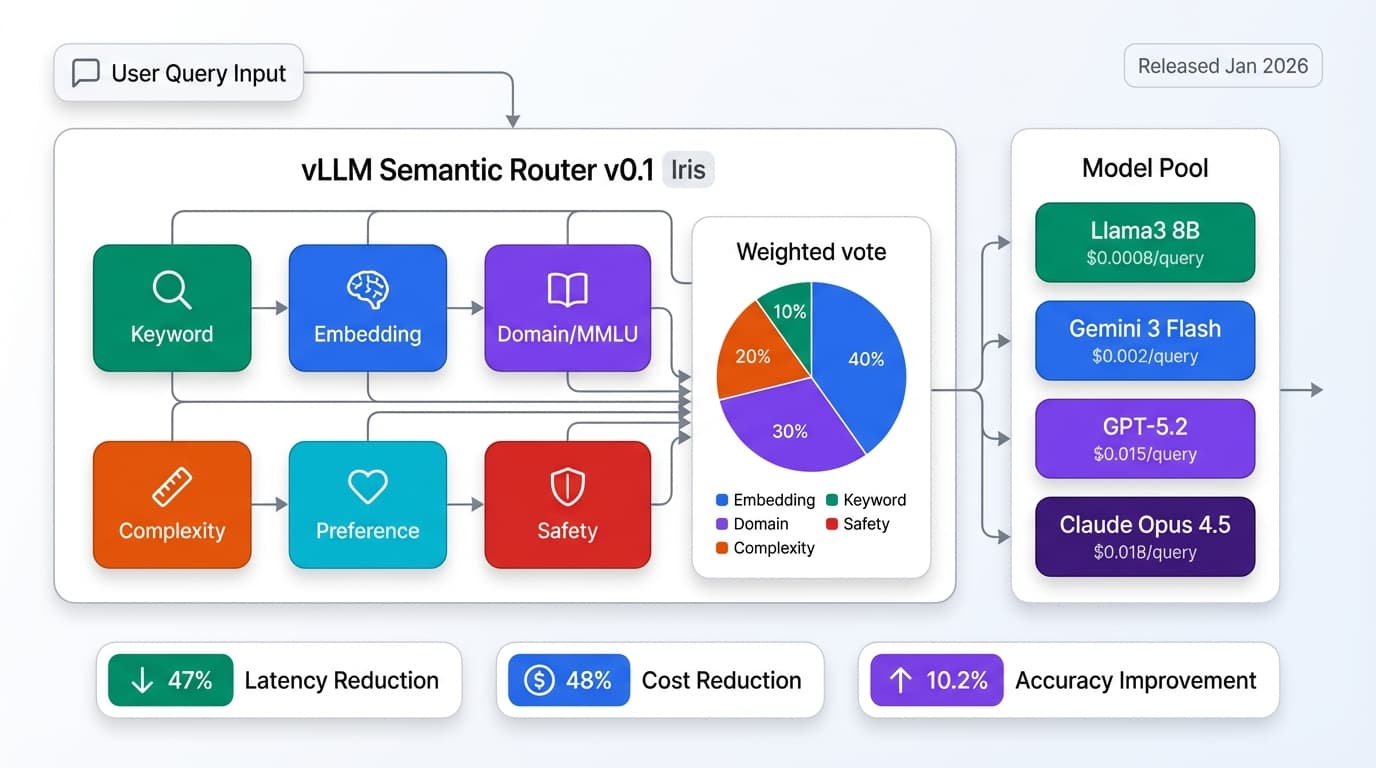
The most sophisticated systems use model orchestration. A lightweight classifier (tiny BERT, 11M params, <5ms) routes queries:
Route to Edge SLM (80-90%):
- Common tasks within training distribution
- Privacy-sensitive data
- Latency <200ms required
- Domain-specific questions
Route to Cloud LLM (10-20%):
- Novel or unusual requests
- Complex multi-step reasoning
- Cross-domain queries
Example: Hospital deploys 3B clinical SLM on edge servers (<100ms latency) for routine notes. Complex rare disease cases route to GPT-5-medical in cloud. Monthly: $1,200 (edge) + $800 (cloud 5%) = $2,000 vs $40,000 cloud-only.
Implementation Guide
Step 1: Identify SLM Candidates
Ideal use cases:
- Repetitive, domain-specific tasks: Customer service, code completion, document classification
- Low latency tolerance: <200ms interactive applications
- High query volumes: Thousands to millions daily where per-query costs matter
- Privacy requirements: Healthcare, finance, legal on-premises processing
- Offline requirements: Edge scenarios without reliable internet
Step 2: Select the Right SLM
For code: CodeLlama 7B (best accuracy), StarCoder 7B (less common languages), Phi-3-mini (fastest)
For text: Phi-4 (best reasoning), Mistral 7B (balanced), Gemma 7B (strong instruction following)
For domain-specific: Start with Mistral or Llama 3.2 7B, fine-tune with 5,000-50,000 domain examples
Evaluation: Benchmark on your data, measure latency on your hardware, test accuracy on representative examples.
Step 3: Fine-tuning vs RAG
Fine-tune when:
- Substantial domain data (5,000+ examples)
- Consistent output formatting needed
- Static knowledge (medical coding, legal precedent)
- Latency critical (skip retrieval overhead)
Use RAG when:
- Knowledge changes frequently (product docs, policies)
- Limited training data (<1,000 examples)
- Need to cite sources (compliance, academic)
- Broad knowledge base (entire company wiki)
Hybrid: Fine-tune on domain language and formatting, use RAG for current knowledge.
Step 4: Deployment Options
Edge deployment:
- Advantages: Zero per-query costs, <10ms latency, complete privacy, no internet dependency
- Requirements: Initial hardware ($3,000-$15,000), DevOps capabilities, >10,000 queries/day recommended
- Hardware: Budget (RTX 4090, $3,500), Mid-range (A10G, $6,000), Enterprise (A100, $15,000)
Cloud deployment:
- Advantages: No upfront costs, elastic scaling, managed infrastructure
- Options: Hugging Face ($0.60-$1.20/hour), AWS SageMaker ($1.00-$2.50/hour), Azure ML ($1.00-$2.00/hour)
Step 5: Monitoring & Optimization
Performance metrics: P50/P95/P99 latency (target P95 <200ms), throughput (QPS, GPU utilization), availability, cost per query
Quality metrics: Accuracy (monthly evaluation), user satisfaction, output quality, retrieval quality (for RAG)
Optimization:
- 4-bit quantization: 14GB → 3.5GB, 2-3× faster, <2% accuracy loss (see our guide on AI Model Quantization)
- Batch processing: Improve GPU utilization from 20-30% to 70-90%
- Caching: Reduce compute 30-40% for repeated queries
Real-World Case Studies
Manufacturing: Quality Control
Mid-sized automotive parts manufacturer deployed Phi-3 7B fine-tuned on 20,000 inspection reports, processing on NVIDIA Jetson edge devices.
Results:
- Inspection time: 15 min → 2 min (87% reduction)
- Accuracy: 94% (vs 89% human baseline)
- Cost savings: $1.3M annually
- ROI: Payback in 3 weeks
Retail: Customer Service Chatbot
E-commerce retailer (200,000 monthly conversations) used hybrid Mistral 7B + GPT-5 — classifier routes 95% to SLM, 5% to LLM.
Results:
- Monthly cost: $32,000 → $2,200 (93% reduction)
- Latency: 2.5s → 0.8s average
- Customer satisfaction: Maintained at 4.2/5 stars
- Annual savings: $357,600
Healthcare: Clinical Documentation
50-physician primary care network deployed Llama 3.2 7B medical variant on edge servers for HIPAA compliance.
Results:
- Documentation time: 3 hrs/day → 1 hr/day (67% reduction)
- Physician capacity: +2 patients/day
- Revenue impact: $3.75M annual increase
- Burnout scores: Improved 34%
Future Outlook
Training innovations will push 1-3B parameter models in 2027 to match current 7B performance through improved data curation and distillation.
Architecture optimizations like sparse attention and mixture-of-experts will deliver 40-50% inference speedups. Early MoE-SLMs achieve GPT-3.5 performance at 3B active parameters.
Hybrid architectures will become standard: SLMs at edge for 90-95% of queries, cloud LLMs for 5-10% requiring broad knowledge. Automatic routing based on query complexity and cost optimization will be built into frameworks.
Edge AI devices will reach 2.5 billion units in 2027, up from 1.2 billion in 2024. Smartphones, IoT, drones, and embedded systems will routinely run 1-7B parameter SLMs.
Energy efficiency: The 10-30× energy advantage accelerates SLM adoption as organizations pursue carbon neutrality. 40% reduction in AI emissions in 2025 will double to 65-70% by 2027.
Frequently Asked Questions
Can SLMs replace LLMs entirely?
For 80-90% of enterprise AI workloads, yes. SLMs excel at domain-specific tasks with high volumes where cost and latency matter. Tasks requiring broad general knowledge or complex multi-domain reasoning still favor LLMs. The future is hybrid: SLMs for routine tasks, LLMs for edge cases.
What's the accuracy trade-off?
On domain-specific tasks after fine-tuning, SLMs often match or exceed LLM accuracy. A 7B legal SLM achieves 94% on contracts vs GPT-5's 87%. On general knowledge, SLMs lag by 10-20 points, narrowing to 3-5 with RAG augmentation.
How do I start?
- Identify high-volume, domain-specific use case
- Test pre-trained SLM (Mistral 7B, Phi-3, Llama 3.2) without fine-tuning
- Fine-tune on 5,000-10,000 examples if accuracy insufficient (typically +10-15 points)
- Deploy on single RTX 4090 or cloud GPU, measure latency and cost
- Scale based on results, optimize with quantization and caching
Time to production: 4-8 weeks for first use case.
Ready to cut AI costs by 75%? Small Language Models represent the most significant shift in production AI since the transformer architecture. 2026 is the year to migrate high-volume workloads from expensive cloud LLMs to cost-efficient, fast, privacy-preserving SLMs.
For more insights, explore our guides on AI Cost Optimization, RAG Systems, and Building Production-Ready LLM Applications.
Sources:
- Why 2026 Will Be the Year of Small Language Models - Dr. Ernesto Lee
- Small Language Models for Edge Deployment - Prem AI
- Top 10 Open-Source SLMs to Watch in 2026 - Analytics Insight
- 25 Small Language Models in 2025 - Medium
- Small Language Models Market - Markets and Markets
- Best Open-Source SLMs in 2026 - BentoML