AI ROI Calculator for Small Business: Complete Implementation Guide 2025
Calculate AI ROI for your small business with our proven framework. Step-by-step guide includes cost breakdown, payback period, and real implementation examples.
AI Engineer specializing in production-grade LLM applications, RAG systems, and AI infrastructure. Passionate about building scalable AI solutions that solve real-world problems.
Artificial Intelligence is no longer a futuristic concept—it's a critical business imperative. In 2026, companies leveraging AI are seeing average ROI of 300% within three years, while those delaying adoption risk falling behind competitors who are automating processes, enhancing decision-making, and delivering superior customer experiences.
This guide provides executives with a practical framework for implementing AI: calculating return on investment, building adoption roadmaps, mitigating risks, and measuring tangible business impact.
Why AI Matters for Business Leaders in 2026
The business landscape has fundamentally shifted. Companies using AI in production are reporting:
- 40% productivity gains across knowledge workers
- 35% cost reduction in customer service operations
- 25% revenue increase through personalized customer experiences
- 60% faster decision-making with AI-powered analytics
Major corporations like Walmart, JPMorgan Chase, and Siemens have deployed AI across operations, achieving billions in savings and competitive advantages that would be impossible to replicate manually.
The risk of inaction: Companies that delay AI adoption face declining market share, higher operational costs, and inability to attract top talent who expect modern tools. A 2025 McKinsey study found that 72% of Fortune 500 companies now use AI in production—up from just 35% in 2024.
The question is no longer "Should we adopt AI?" but rather "How do we implement AI strategically to maximize business value?"
Calculating AI ROI: A Framework for Executives
Before investing in AI, leaders need a clear understanding of expected returns. Here's a practical framework:
1. Identify High-Impact Use Cases
Start with processes that are:
- Repetitive and time-consuming: Customer support, data entry, report generation
- Data-rich: Marketing analytics, supply chain optimization, fraud detection
- High-volume: Invoice processing, HR screening, quality inspection
Example: A mid-sized insurance company deployed AI for claims processing, reducing manual review time from 45 minutes to 3 minutes per claim—saving $2.4M annually while improving accuracy from 92% to 98%.
2. Calculate Total Cost of Ownership (TCO)
Initial Investment:
- Platform licenses: $50K-$500K annually depending on scale
- Infrastructure (cloud compute): $10K-$100K/month
- Integration and customization: $100K-$1M one-time
- Training and change management: $50K-$200K
Ongoing Costs:
- API usage fees: $2K-$50K/month based on volume
- Maintenance and monitoring: 15-20% of initial investment annually
- Continuous improvement and fine-tuning: $50K-$150K/year
3. Quantify Benefits
Direct Cost Savings:
- Labor hours automated × hourly rate × productivity factor
- Error reduction × cost per error
- Faster turnaround × opportunity cost
Revenue Impact:
- Improved customer satisfaction → retention increase → lifetime value
- Personalization → conversion rate improvement → sales increase
- Faster insights → better decisions → market share growth
Example ROI Calculation:
Customer Service AI Chatbot
-----------------------------------------
Initial Investment:       $250,000
Annual Operating Cost:    $120,000

Annual Benefits:
- Support tickets reduced: 60,000 × $8 = $480,000
- Customer satisfaction increase → 5% retention improvement = $200,000
- 24/7 availability → 15% conversion improvement = $150,000

Total Annual Benefit:     $830,000
Net Annual Value:         $710,000 (Year 1), $950,000 (Year 2+)
ROI:                      184% (Year 1), 392% (Year 2+)
Payback Period:           4.2 months
4. Account for Risk and Intangible Benefits
Factor in:
- Risk mitigation: Data privacy compliance, reduced liability from errors
- Competitive positioning: Market differentiation, talent attraction
- Organizational learning: Building AI capabilities for future innovation
- Scalability: Ability to handle growth without proportional headcount increase
Most successful AI implementations achieve breakeven within 6-18 months and deliver 250-400% ROI over three years.
Building Your AI Adoption Roadmap
A successful AI strategy requires phased implementation, not a big-bang approach.
Phase 1: Foundation (Months 1-3)
Executive Alignment:
- Form an AI steering committee with C-level sponsorship
- Define strategic objectives tied to business KPIs
- Allocate budget and resources
Data Readiness Assessment:
- Audit existing data sources, quality, and accessibility
- Identify gaps in data infrastructure
- Establish data governance policies
Pilot Use Case Selection:
- Choose 2-3 high-value, low-risk use cases
- Ensure executive sponsorship for each pilot
- Define clear success metrics
Phase 2: Pilot Deployment (Months 4-9)
Proof of Value:
- Implement AI solutions in controlled environments
- Measure performance against baseline metrics
- Gather user feedback and iterate
Change Management:
- Communicate benefits to affected teams
- Provide training and support resources
- Address concerns about job displacement proactively
Vendor Selection (if applicable):
- Evaluate platforms (OpenAI, Anthropic, Google, AWS) - see our detailed comparison of ChatGPT vs Claude vs Gemini
- Assess build vs. buy tradeoffs
- Negotiate contracts with performance guarantees
Example pilot: A retail bank implemented an AI fraud detection system for credit card transactions. Within 6 months, they reduced false positives by 40% while catching 25% more fraudulent transactions—saving $3.2M annually.
Phase 3: Scale Deployment (Months 10-18)
Expand Successful Pilots:
- Roll out proven use cases across departments
- Standardize on AI platforms and frameworks
- Build internal AI competency centers
Integration with Business Processes:
- Embed AI into existing workflows and systems
- Automate data pipelines and model retraining
- Establish monitoring and governance
Continuous Improvement:
- Track KPIs and business impact metrics
- Refine models based on production data
- Expand to adjacent use cases
Phase 4: Optimization and Innovation (Months 18+)
Advanced Capabilities:
- Deploy multi-agent AI systems for complex workflows
- Leverage fine-tuning for domain-specific performance
- Explore cutting-edge models (GPT-5, Claude 4+, Gemini Ultra)
AI-Driven Transformation:
- Redesign business processes around AI capabilities
- Develop AI-powered products and services
- Build competitive moats through proprietary data and models
Companies that follow this phased approach see 3x higher success rates compared to those attempting organization-wide AI transformations simultaneously.
Overcoming Common Implementation Challenges
Challenge 1: Data Quality and Availability
Problem: AI models require clean, labeled, accessible data. Many organizations have data trapped in silos, inconsistent formats, or poor quality.
Solution:
- Start with readily available, high-quality datasets
- Invest in data infrastructure (data warehouses, ETL pipelines)
- Implement data quality monitoring and governance
- Use AI for data cleaning and labeling (semi-automated approach)
Challenge 2: Skills Gap
Problem: Shortage of AI/ML talent and limited technical expertise within business teams.
Solution:
- Partner with AI vendors who provide managed services
- Upskill existing technical teams through training programs
- Hire a small core AI team and leverage consultants for specialized projects
- Use low-code/no-code AI platforms for business users
Challenge 3: Change Resistance
Problem: Employees fear job displacement and resist adoption of AI tools.
Solution:
- Communicate AI's role in augmentation, not replacement
- Highlight how AI eliminates tedious work, allowing focus on high-value tasks
- Involve employees in pilot design and feedback
- Provide retraining for roles significantly impacted
- Celebrate early wins and user testimonials
Example: A manufacturing company introduced AI-powered quality inspection. Initially, inspectors feared job loss. After deployment, they transitioned to analyzing root causes of defects—leading to 30% defect reduction and higher job satisfaction.
Challenge 4: Measuring and Attributing Value
Problem: Difficulty proving AI's impact and justifying continued investment.
Solution:
- Define clear baseline metrics before deployment
- Use A/B testing to isolate AI's contribution
- Track both leading indicators (usage, accuracy) and lagging indicators (revenue, cost)
- Report results quarterly to executive stakeholders
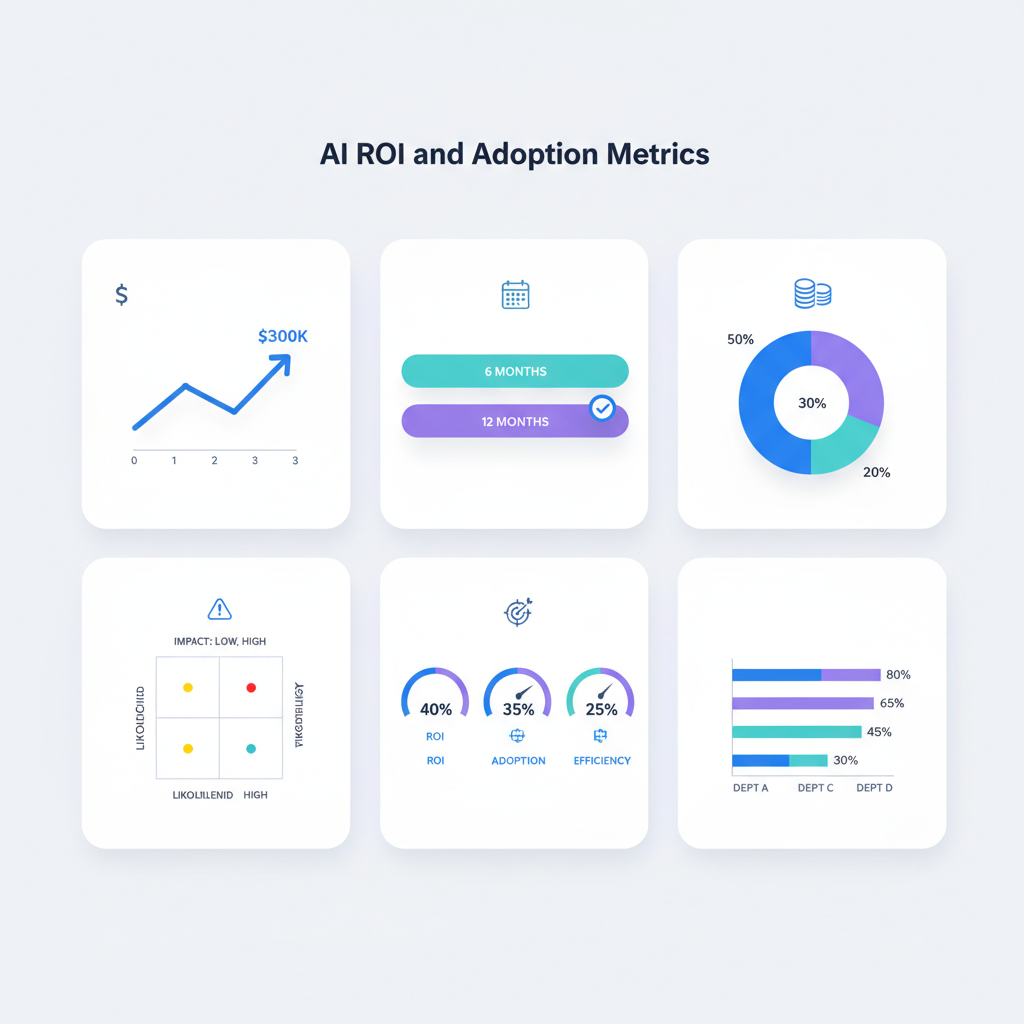
Create a simple dashboard tracking:
- Adoption rate (% of users actively using AI tools)
- Efficiency gains (time saved, throughput increase)
- Quality improvements (error reduction, customer satisfaction)
- Financial impact (cost savings, revenue increase)
Risk Mitigation and AI Governance
Responsible AI implementation requires addressing risks proactively:
Security and Privacy
- Implement data encryption and access controls
- Use privacy-preserving techniques (differential privacy, federated learning)
- Comply with regulations (GDPR, CCPA, industry-specific requirements)
- Conduct regular security audits
Bias and Fairness
- Test models for discriminatory outcomes across demographic groups
- Use diverse training data and bias detection tools
- Establish human oversight for high-stakes decisions
- Document AI decision-making processes for transparency
Reliability and Safety
- Set performance thresholds and automated monitoring
- Implement human-in-the-loop for critical decisions
- Maintain fallback mechanisms when AI fails
- Test edge cases and failure modes
Vendor Lock-In
- Prefer open standards and interoperable platforms
- Avoid proprietary data formats
- Maintain ability to switch providers
- Keep core IP and data under organizational control
Measuring Success: Key Metrics for Leaders
Track these metrics to ensure AI delivers business value:
Operational Metrics:
- Process automation rate (% of tasks automated)
- Cycle time reduction (before/after AI implementation)
- Error rate improvement
- Employee productivity increase
Financial Metrics:
- Cost savings realized vs. projected
- Revenue attribution to AI capabilities
- Customer lifetime value improvement
- ROI and payback period
Strategic Metrics:
- AI adoption rate across organization
- Time-to-market for AI-powered features
- Competitive position vs. industry peers
- Innovation pipeline (new AI use cases identified)
Leading organizations establish AI dashboards reviewed monthly by leadership, ensuring visibility into progress and enabling data-driven decisions about scaling or course corrections.
Getting Started: Your 90-Day Action Plan
Week 1-4: Assessment and Planning
- Form AI steering committee
- Conduct current state assessment
- Identify 3-5 pilot use cases
- Define success criteria
Week 5-8: Vendor Evaluation and POC
- Shortlist AI platforms and vendors
- Run proof-of-concept tests
- Calculate projected ROI
- Present business case to leadership
Week 9-12: Pilot Launch
- Select final platform and use case
- Allocate budget and resources
- Kick off pilot implementation
- Begin change management activities
This focused 90-day sprint provides momentum, validates assumptions, and builds organizational confidence in AI's potential.
The Competitive Imperative
By 2026, AI has transitioned from experimental technology to essential business infrastructure. Companies achieving AI maturity are:
- Operating more efficiently: Automating 40-60% of repetitive tasks
- Making better decisions: Leveraging real-time data and predictive analytics
- Delivering superior experiences: Personalizing interactions at scale
- Innovating faster: Accelerating product development and go-to-market
The window for competitive advantage is narrowing. Organizations that establish AI capabilities now will compound their advantages, while those delaying face exponentially higher catch-up costs.
The path forward: Start with clear business objectives, pilot high-value use cases, measure rigorously, and scale what works. AI success isn't about bleeding-edge technology—it's about disciplined execution aligned with strategic priorities.
Conclusion
AI presents a generational opportunity for business leaders to transform operations, enhance decision-making, and create sustainable competitive advantages. Success requires:
- Executive commitment and strategic alignment
- Pragmatic ROI-focused approach
- Phased implementation with clear metrics
- Proactive risk management and governance
- Continuous learning and optimization
The organizations that will thrive in 2026 and beyond are those treating AI not as a technology project, but as a fundamental business transformation—led from the top, measured rigorously, and executed with discipline.
Start small, prove value quickly, and scale systematically. The return on investment is real, measurable, and increasingly necessary for competitive survival.