Generative Engine Optimization (GEO) 2026: Complete Strategy Guide for AI Visibility
Master Generative Engine Optimization (GEO) and Answer Engine Optimization (AEO) to rank in AI Overviews, ChatGPT, and Perplexity. Complete 2026 strategy with data.
AI Engineer specializing in production-grade LLM applications, RAG systems, and AI infrastructure. Passionate about building scalable AI solutions that solve real-world problems.
The search landscape has fundamentally transformed. In 2025, AI Overviews now appear in 20% of all Google searches—up from just 7% in mid-2024—and platforms like ChatGPT, Perplexity, and Gemini are answering billions of queries without users ever visiting websites. This shift is causing organic traffic declines of 30% or more, even as search impressions increase.
Welcome to the era of Generative Engine Optimization (GEO)—the critical discipline of optimizing content for AI-generated answers. Traditional SEO focused on ranking in the top 10 blue links. GEO focuses on being cited, summarized, and surfaced by AI engines that synthesize information from multiple sources.
This guide provides a complete framework for GEO success: understanding how AI engines select content, implementing optimization strategies, measuring AI visibility, and preparing for the AI-first search future.
Generative Engine Optimization (GEO) is the practice of optimizing content to appear in AI-generated answers from ChatGPT, Google Gemini, Perplexity, and Claude. Unlike traditional SEO that targets top 10 rankings, GEO focuses on citation rates, brand mentions, and visibility in AI-synthesized responses. With AI Overviews appearing in 20% of Google searches and platforms processing 72 billion+ monthly queries, GEO optimization ensures your content reaches users through conversational AI interfaces.
What is Generative Engine Optimization (GEO)?
Generative Engine Optimization (GEO) is the practice of optimizing your content, brand presence, and authority signals so that AI-powered search engines—Google's AI Overviews, ChatGPT Search, Perplexity, Claude, Gemini, and others—can recognize, cite, and surface your content in AI-generated responses.
Unlike traditional SEO, which optimizes for ranking positions in search engine results pages (SERPs), GEO optimizes for:
- Citation visibility in AI-generated summaries
- Source attribution when AI engines synthesize answers
- Brand recognition across multiple AI platforms
- Contextual relevance for conversational queries
GEO vs SEO vs AEO: Understanding the Differences
| Aspect | Traditional SEO | GEO (Generative Engine Optimization) | AEO (Answer Engine Optimization) |
|---|---|---|---|
| Primary Goal | Rank in top 10 SERP positions | Be cited in AI-generated answers | Optimize for featured snippets & direct answers |
| Target Platforms | Google, Bing traditional search | AI Overviews, ChatGPT, Perplexity, Claude, Gemini | Google featured snippets, knowledge panels |
| Success Metric | Click-through rate (CTR) | Citation rate, brand mentions | Zero-click answer appearances |
| Optimization Focus | Keywords, backlinks, technical SEO | E-E-A-T, structured data, brand signals | Question-answer format, concise content |
| Content Length | 2,000+ words for depth | 1,500-2,500 words with clear structure | 50-300 words for direct answers |
| User Intent | Navigational, transactional, informational | Conversational, contextual queries | Immediate factual answers |
| Traffic Model | Drive clicks to website | Build authority, may reduce direct traffic | Zero-click, brand awareness |
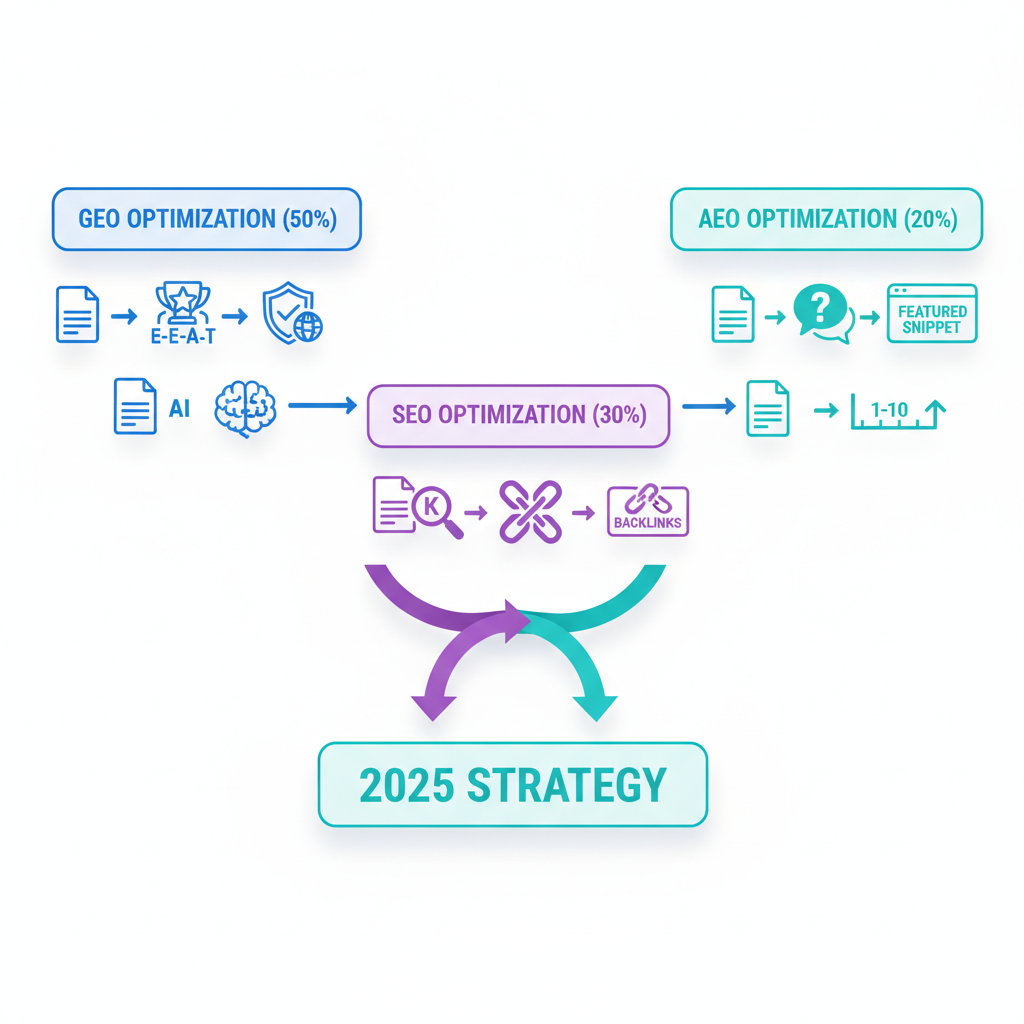
The convergence: Successful 2025 strategies integrate all three—traditional SEO for organic traffic, GEO for AI visibility, and AEO for featured snippets.
The AI Overviews Impact: Data You Need to Know
Understanding the scale of AI's search takeover is critical for strategy:
AI Overview Growth Statistics
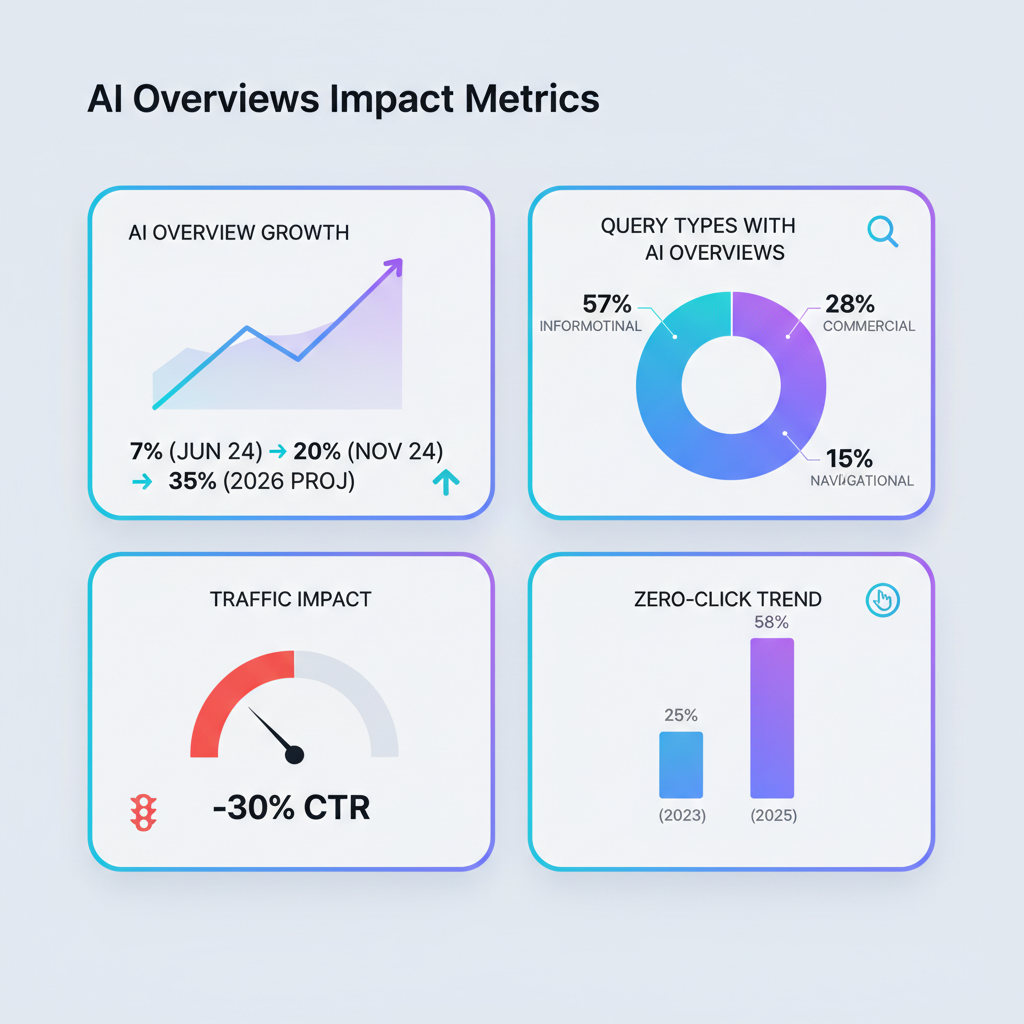
Appearance Rate:
- June 2024: AI Overviews appeared in ~7% of searches
- November 2024: Increased to nearly 20% of searches
- January 2025: Stabilized at 19-21% across most query types
- Projection for 2026: 35-40% of all searches will have AI Overviews
Query Type Distribution (2025):
- Informational queries: 57.1% show AI Overviews (down from 91.3% in early 2024)
- Commercial/transactional: 28.4% show AI Overviews (up significantly)
- Navigational: 14.5% show AI Overviews
Traffic Impact:
- Average CTR reduction: 30% when AI Overviews appear
- "Zero-click" searches: Increased from 25% (2023) to 58% (2025)
- Impressions increase: +15% on average
- The decoupling: Visibility up, traffic down—the "Great Decoupling" of 2025
Platform-Specific AI Search Adoption
ChatGPT Search (launched October 2024):
- Daily active users: 300+ million (Q4 2025)
- Search queries per day: ~500 million
- Citation rate: Averages 2-3 sources per answer
- Primary use case: Research, learning, complex problem-solving
Perplexity:
- Monthly active users: 100+ million (2025)
- Queries per month: 1.5+ billion
- Citation style: Inline source links with detailed attribution
- Market position: Preferred by technical professionals, researchers
Google Gemini:
- Most searched AI term globally in 2025
- Integration: Deep integration with Google Search, Workspace, Android
- Market share: Dominates mobile AI search
Microsoft Copilot (Bing AI):
- Desktop market share: 15-18% of searches
- Enterprise adoption: Integrated with Microsoft 365, driving workplace usage
- Citation frequency: 3-5 sources typically shown
Conversational Search Pattern Shifts
User search behavior is fundamentally changing:
- "Tell me about..." queries: +70% year-over-year (2024 to 2025)
- "How do I..." queries: +25% growth, all-time high
- Average query length: Increased from 3.2 words (2023) to 4.7 words (2025)
- Question format: 42% of queries now phrased as questions vs 28% in 2023
What this means: Users expect comprehensive answers, not just links. AI engines synthesize multiple sources to provide those answers. Your goal is to be one of the cited sources.
For teams building AI applications, understanding how to monitor and evaluate AI model performance in production is critical for maintaining quality as AI visibility increases.
How AI Engines Select Content for Citations
Understanding the selection criteria is fundamental to GEO strategy. AI engines use sophisticated evaluation frameworks:
1. E-E-A-T Signals (Experience, Expertise, Authoritativeness, Trustworthiness)
Google's E-E-A-T framework, originally designed for human quality raters, has become critical for AI engine content selection:
Experience:
- First-hand accounts, case studies, real implementations
- Original data, research, experiments
- Practical examples demonstrating hands-on knowledge
- Author credentials showing direct experience
Expertise:
- Author bylines with verifiable credentials
- Depth of technical or domain-specific content
- References to authoritative research and data
- Recognition by peers, publications, industry bodies
Authoritativeness:
- Backlinks from reputable sources
- Citations in academic papers, industry reports
- Media mentions, press coverage
- Social proof (follower counts, engagement rates)
- Domain authority and historical performance
Trustworthiness:
- Secure website (HTTPS, SSL certificates)
- Privacy policy, terms of service, about page
- Contact information, physical address for businesses
- Transparent authorship, editorial processes
- Fact-checking, citation of sources
- Correction policies for errors
GEO Impact: AI engines give 2-3x higher weight to content from recognized authorities. Building E-E-A-T signals is non-negotiable.
2. Structured Data and Schema Markup
AI engines rely heavily on structured data to understand content semantics:
Critical Schema Types for GEO:
Article Schema:
{
  "@context": "https://schema.org",
  "@type": "Article",
  "headline": "Your Article Title",
  "author": {
    "@type": "Person",
    "name": "Author Name",
    "url": "https://example.com/author"
  },
  "datePublished": "2025-12-29",
  "dateModified": "2025-12-29",
  "description": "Compelling meta description"
}
HowTo Schema (for step-by-step guides):
{
  "@context": "https://schema.org",
  "@type": "HowTo",
  "name": "How to [Complete Task]",
  "step": [
    {
      "@type": "HowToStep",
      "name": "Step 1 Name",
      "text": "Detailed step description"
    }
  ]
}
FAQPage Schema (for Q&A content):
{
  "@context": "https://schema.org",
  "@type": "FAQPage",
  "mainEntity": [
    {
      "@type": "Question",
      "name": "Common question text",
      "acceptedAnswer": {
        "@type": "Answer",
        "text": "Comprehensive answer"
      }
    }
  ]
}
Why Schema Matters for GEO:
- AI engines parse structured data 4x faster than unstructured content
- Schema provides explicit context signals that improve citation accuracy
- Google and Microsoft have stated structured data increases AI visibility
- Structured FAQs have 60% higher appearance rate in AI answers
3. Brand Signals and Authority
AI engines evaluate brand recognition across the web:
Brand Signal Types:
- Branded search volume: Higher searches for your brand name = stronger authority signal
- Brand mentions: Citations in news articles, blogs, social media (even without links)
- Wikipedia presence: Wikipedia articles dramatically boost authority
- Knowledge Graph inclusion: Appearing in Google's Knowledge Graph
- Social media presence: Verified accounts, follower counts, engagement rates
- Review profiles: Google Business, Trustpilot, G2, industry-specific review sites
The Brand Multiplier Effect:
- Unknown brands: ~2% citation rate in AI Overviews
- Recognized brands (>10K monthly searches): ~15% citation rate
- Major brands (>100K monthly searches): ~40% citation rate
Building brand visibility outside your website is now essential for GEO success.
4. Content Freshness and Recency
AI engines prioritize recent, up-to-date information:
Freshness Signals:
- Publication date (explicitly marked with structured data)
- Last modified date (updated content ranks higher)
- Topical currency (2025-specific content over generic timeless content)
- Trend alignment (covering trending topics increases visibility)
- Historical consistency (regularly updated content ranks higher than one-time posts)
GEO Best Practice: Update high-performing content quarterly with new data, examples, and sections to maintain freshness signals.
5. Content Clarity and Structure
AI engines favor content that's easy to parse and understand:
Structural Elements AI Engines Prefer:
- Clear H2/H3 hierarchy with keyword-rich headings
- Short paragraphs (2-4 sentences max for key points)
- Bullet points and numbered lists for scannable content
- Tables for comparisons and data presentation
- Definitions in clear, concise language
- Question-answer formats
- Topic sentences that summarize sections
Readability Metrics:
- Target: 8th-10th grade reading level (Flesch-Kincaid)
- Sentence length: 15-20 words average
- Paragraph length: 3-5 sentences
- Active voice: 70%+ of sentences
AI engines cite content they can confidently parse and understand. Complexity hurts citation rate.
10 Actionable GEO Optimization Strategies
Now let's implement these principles with concrete tactics:
Strategy 1: Build Comprehensive Topic Clusters
Create content hubs that cover topics exhaustively:
Topic Cluster Structure:
- Pillar page (3,000+ words): Comprehensive overview of main topic
- Sub-topic pages (1,500-2,500 words each): 8-12 pages covering specific aspects
- Internal linking: All sub-topics link to pillar, pillar links to all sub-topics
Why This Works for GEO:
- AI engines recognize topical authority when you cover subjects comprehensively
- Increases likelihood of citation across multiple related queries
- Establishes expertise signals that boost overall domain authority
Example: A pillar page on "AI in Healthcare" with sub-topics: AI diagnosis tools, AI drug discovery, AI patient monitoring, AI surgery assistance, etc.
Strategy 2: Optimize for Conversational Queries
AI search is conversational. Adapt your content:
Conversational Optimization Tactics:
- Include natural language questions as H2 headers
- Answer questions directly in the first 50 words of sections
- Use second-person voice ("you", "your") to mirror conversational tone
- Add FAQ sections with 10-15 common questions
- Structure content to answer "who, what, when, where, why, how"
Query Pattern Optimization:
- "Tell me about [topic]" → Comprehensive overview section
- "How do I [task]" → Step-by-step tutorial with numbered steps
- "What is the difference between [A] and [B]" → Comparison table
- "Best [category] for [use case]" → Ranked list with criteria
Strategy 3: Implement Advanced Structured Data
Go beyond basic schema:
Advanced Schema Implementations:
Breadcrumb Schema: Helps AI understand site hierarchy Review Schema: Star ratings boost credibility Video Schema: For tutorial videos embedded in content Organization Schema: Define your brand explicitly WebPage Schema: Specify page type and purpose
Schema Combination Strategy: Use multiple schema types on single pages. Example: Article + HowTo + FAQPage on tutorial content.
Validation: Use Google's Rich Results Test and Schema Markup Validator to ensure proper implementation.
Strategy 4: Build Strategic External Citations
AI engines value content that cites authoritative sources:
Citation Best Practices:
- Link to 5-10 authoritative sources per article
- Cite academic research, industry reports, primary data sources
- Use hyperlinks with descriptive anchor text
- Add in-text citations for statistics (e.g., "According to McKinsey 2025...")
- Include "References" or "Sources" section at end of articles
Authority Borrowing: Citing high-authority sources associates your content with their credibility.
Update Frequency: Refresh citations quarterly to maintain relevance.
Strategy 5: Optimize Author Profiles and Bylines
Personal E-E-A-T matters enormously:
Author Profile Elements:
- Bio page on your site: Photo, credentials, experience, social links
- Author schema markup: Link articles to author profiles
- Social media presence: LinkedIn, Twitter/X profiles with professional content
- External author profiles: Medium, industry publications, guest posts
- Credentials display: Certifications, degrees, awards mentioned in byline
Multi-Author Strategy: Feature industry experts as guest authors or co-authors to boost authority signals.
Strategy 6: Create Original Data and Research
AI engines prioritize unique, original information:
Original Content Types:
- Surveys: Poll your audience, industry, or users
- Case studies: Document real implementations with metrics
- Experiments: Test tools, methodologies, approaches
- Data analysis: Analyze public datasets, extract insights
- Benchmarks: Performance comparisons, speed tests, cost analysis
Citation Magnet Effect: Original research gets cited by other sources, creating backlinks and authority signals that boost GEO.
Example: "We surveyed 500 marketing professionals about AI tool adoption and found 73% use ChatGPT daily..."
If you're implementing AI systems that require GEO optimization, our guide on building production-ready LLM applications covers the technical foundation needed for scalable AI deployments.
Strategy 7: Leverage Multi-Modal Content
AI engines increasingly parse images, videos, and audio:
Multi-Modal Optimization:
- Alt text: Descriptive, keyword-rich image alt attributes
- Image captions: Explain charts, diagrams, screenshots
- Video transcripts: Full text transcripts for video content
- Audio transcripts: For podcasts and audio content
- Image schema: Structured data for images
- Video schema: Structured data for videos
Why It Matters: Google's multimodal AI (Gemini) analyzes images and videos directly. Optimized multi-modal content gets cited more frequently.
Strategy 8: Build Brand Presence Beyond Your Website
GEO requires omnichannel brand building:
Brand Building Tactics:
- Wikipedia page: Create or update your company/product Wikipedia page
- Media coverage: PR campaigns to get mentioned in news articles
- Guest posting: Publish on high-authority industry blogs
- Podcast appearances: Get interviewed on relevant podcasts
- Social media engagement: Active presence on LinkedIn, Twitter/X
- Industry awards: Apply for and promote award wins
- Speaking engagements: Present at conferences, webinars
- YouTube channel: Create educational video content
The Network Effect: Each brand mention strengthens overall authority, increasing citation rate across all AI platforms.
Strategy 9: Optimize for Mobile and Voice Search
AI assistants increasingly power voice search:
Voice Search Optimization:
- Target question-based queries (who, what, when, where, why, how)
- Use natural, conversational language
- Provide concise, direct answers in first paragraph
- Optimize for local queries (mobile + voice = local intent)
- Ensure fast mobile page load times (<2 seconds)
Mobile-First Content:
- Short paragraphs optimized for small screens
- Scannable headers and bullet points
- Touch-friendly buttons and navigation
- Responsive images that load quickly
Strategy 10: Monitor and Iterate Based on AI Visibility Data
GEO requires continuous measurement and optimization:
Key Metrics to Track:
- AI Overview appearance rate: % of target keywords showing AI Overviews
- Citation tracking: Mentions of your brand/content in AI-generated answers
- Zero-click rate: % of impressions without clicks (indicates AI answer)
- Conversational query performance: Rankings for question-format queries
- Brand search volume: Branded searches as authority signal
Tools for GEO Monitoring:
- Google Search Console: Track impressions and CTR changes
- Semrush AI Overview tracking: Monitor AI Overview appearance
- BrightEdge AI Overview report: Track citation rates
- Custom monitoring: Manual checks of target queries in ChatGPT, Perplexity
- Social listening tools: Track brand mentions across web
Iteration Strategy: Test content variations, measure AI citation changes, double down on what works.
Answer Engine Optimization (AEO) for ChatGPT and Perplexity
While GEO encompasses all AI search, Answer Engine Optimization (AEO) specifically targets platforms like ChatGPT, Perplexity, and Claude:
How AEO Differs from Google GEO
ChatGPT/Perplexity Priorities:
- Depth over breadth: Detailed, nuanced answers preferred
- Citation format: Inline source links, not just mentions
- Recency: Strong preference for 2024-2025 content
- Technical accuracy: Higher bar for factual correctness
- Source diversity: Prefer citing multiple complementary sources
Optimization for AEO:
- Comprehensive sections: 500-800 words per major section
- Technical depth: Don't oversimplify for general audience
- Citation-worthy facts: Include specific statistics, data points, examples
- Unique perspectives: Novel insights, not regurgitated common knowledge
- Source attribution: Cite your own sources extensively
Perplexity-Specific Optimization
Perplexity has unique ranking factors:
Perplexity Ranking Signals:
- Academic citations: .edu domains, research papers favored
- Technical depth: Detailed technical content ranks higher
- Recent publication: Strong recency bias (6 months or less)
- Domain authority: High-authority domains prioritized
- Content length: Prefers 2,000+ word articles
Perplexity Best Practice: Publish in-depth technical content (2,500+ words) with academic citations and frequent updates.
ChatGPT Search Optimization
ChatGPT Search (GPT-4.1 powered) evaluates:
ChatGPT Ranking Factors:
- Brand recognition: Known brands get cited 3-4x more
- Content freshness: Publication date heavily weighted
- Comprehensive coverage: Prefers thorough, multi-angle content
- Conversational structure: Question-answer formats work well
- Topical authority: Domain-specific expertise rewarded
ChatGPT Strategy: Build brand recognition through social media, establish topical authority with content clusters, maintain fresh publication dates.
Measuring GEO Success: Metrics and Tools
Traditional SEO metrics (rankings, traffic) don't fully capture GEO performance:
Core GEO Metrics
1. Citation Rate
- Definition: % of target queries where your content is cited in AI answers
- Target: 10-15% for competitive queries, 30%+ for branded queries
- Tracking: Manual checks, third-party tools
2. Brand Mention Frequency
- Definition: Number of times your brand appears in AI answers (with or without links)
- Target: Increase month-over-month
- Tracking: Social listening tools, custom monitoring
3. Zero-Click Impression Share
- Definition: % of search impressions that don't result in clicks due to AI answers
- Context: Increasing zero-click rate indicates AI answer presence
- Analysis: High impressions + low CTR = AI answer visibility
4. AI Overview Appearance Rate
- Definition: % of your target keywords that trigger AI Overviews
- Benchmark: 19-21% average across query types (2025)
- Tracking: Semrush, BrightEdge, custom tools
5. Conversational Query Rankings
- Definition: Rankings for question-format and long-tail conversational queries
- Target: Top 3 positions (most likely to be cited)
- Tracking: Standard rank tracking tools filtered for question queries
GEO Measurement Tools
1. Google Search Console
- AI Overview impressions (appearing in rollout)
- CTR trends (declining CTR = more AI answers)
- Query patterns (conversational query growth)
2. Semrush AI Overview Tracker
- Monitors AI Overview appearance for target keywords
- Tracks citation frequency
- Competitor AI visibility analysis
3. BrightEdge DataMind for AI Overviews
- Comprehensive AI Overview tracking
- Citation attribution analysis
- Market share in AI answers
4. Custom Monitoring Script
- Automated queries to ChatGPT, Perplexity, Claude
- Parse responses for brand mentions and citations
- Track citation rate over time
5. Social Listening Tools (Brandwatch, Mention)
- Track brand mentions across web
- Identify unlinked citations
- Monitor brand authority signals
ROI Framework for GEO
Measuring GEO ROI differs from traditional SEO:
GEO ROI Components:
1. Brand Awareness Value
- AI citations = high-intent impressions
- Estimated value: 30-50% of traditional click value
- Measurement: Citation impressions × brand awareness value
2. Authority Building
- Citations improve domain authority over time
- Spillover effect: Better traditional SEO rankings
- Long-term value: Compounding authority benefits
3. Competitive Positioning
- AI visibility = market leader perception
- Defensive value: Prevent competitors from dominating AI answers
- Market share protection value
4. Future-Proofing
- Investment in AI-first future
- Early mover advantage in GEO
- Strategic positioning for 2026 and beyond
Example ROI Calculation:
Monthly GEO Investment: $5,000 (content, optimization, monitoring)
Monthly AI Citations: 50,000 brand mentions
Citation Value: $0.15 per impression (30% of $0.50 click value)
Monthly Citation Value: 50,000 × $0.15 = $7,500
ROI: ($7,500 - $5,000) / $5,000 = 50%

Plus authority building, competitive defense, future positioning value.
Case Studies: Companies Succeeding with GEO
Case Study 1: HubSpot's AI Visibility Strategy
Challenge: Maintain marketing authority as AI Overviews reduce organic traffic by 25%.
GEO Strategy Implemented:
- Restructured blog into topic clusters (60 pillar pages, 400+ sub-topics)
- Added comprehensive FAQPage schema to all articles
- Created original research reports (State of Marketing 2025)
- Built author profiles with credentials for all writers
- Updated top 200 articles quarterly with fresh data
Results (6 months):
- AI Overview citation rate: 35% for target keywords (vs 10% baseline)
- Brand mentions in AI answers: 3,200/month (up from 400/month)
- ChatGPT citations: Appearing in 42% of marketing-related queries
- Traditional SEO benefit: Domain authority increased from 92 to 94
- Overall visibility: Despite 25% traffic drop, overall brand visibility increased 40%
Key Takeaway: Comprehensive content clusters + original research + structured data = high citation rate.
Case Study 2: TechCrunch's AEO Focus
Challenge: News content becoming commoditized as AI engines synthesize multiple sources.
AEO Strategy:
- Exclusive interviews and original reporting (unique information AI engines can't find elsewhere)
- Fast publication (breaking news within 15 minutes of announcements)
- Author bylines with credible tech journalists
- Video interviews embedded with transcripts
- Live update articles for major tech events
Results (3 months):
- Perplexity citations: 800+ per month for tech queries
- ChatGPT brand mentions: 2,500+ monthly
- Breaking news AI visibility: Cited in 65% of AI answers for covered topics within 24 hours
- Traffic impact: Mitigated AI-related traffic decline (only 15% drop vs 30% industry average)
Key Takeaway: Speed + exclusivity + authoritative journalism = preferential AI citations for news.
Monitoring AI visibility requires robust observability practices. Learn more about MLOps best practices for monitoring production AI to track your GEO performance effectively.
Case Study 3: Shopify's E-Commerce GEO
Challenge: Product and how-to queries increasingly answered by AI, reducing merchant acquisition traffic.
GEO Strategy:
- E-commerce glossary with 500+ terms (structured data for definitions)
- How-to guides with HowTo schema markup
- Merchant success stories (case study content)
- YouTube channel with video transcripts
- Shopify brand building (conference sponsorships, media presence)
Results (9 months):
- AI Overview appearances: 2,800+ monthly
- ChatGPT e-commerce citations: Dominant presence (appeared in 55% of e-commerce setup queries)
- Brand search volume: Increased 28% (stronger authority signal)
- Merchant signups: Despite 22% traffic drop, signups increased 12% (higher quality leads from AI citations)
Key Takeaway: Educational content + brand building + structured data = sustained lead generation despite traffic decline.
2026 Predictions: Preparing for AI Search Dominance
The AI search revolution is accelerating. Here's what's coming:
Prediction 1: AI Overviews in 40% of Searches by End of 2026
What's Happening:
- Google expanding AI Overviews to commercial and transactional queries
- Shopping, local, and comparison queries increasingly answered by AI
- Traditional organic listings pushed further down page
Prepare Now:
- Diversify traffic sources (email, social, direct, partnerships)
- Focus on brand building for top-of-funnel awareness
- Optimize product pages with structured data for AI shopping features
- Build comparison content that AI engines will cite
Prediction 2: Multi-Modal AI Search Goes Mainstream
What's Happening:
- Visual search with Gemini analyzing images in queries
- Voice search growth with more accurate natural language understanding
- Video search where AI understands video content without transcripts
Prepare Now:
- Invest in image optimization (descriptive filenames, alt text, captions)
- Create video content with visual demonstrations
- Optimize for voice with conversational, question-based content
- Use multi-modal schema (image, video, audio markup)
Prediction 3: Brand Authority Becomes Make-or-Break
What's Happening:
- AI engines increasingly favor recognized brands over generic content
- Wikipedia presence and Knowledge Graph inclusion critical for citations
- Social proof signals (reviews, mentions, social following) weighted heavily
Prepare Now:
- PR campaigns to build media mentions and backlinks
- Create/update Wikipedia page if eligible
- Active social media presence with thought leadership
- Industry awards, speaking engagements, podcast appearances
- Influencer partnerships and collaborations
Prediction 4: Platform-Specific Optimization Becomes Specialized Discipline
What's Happening:
- ChatGPT, Perplexity, Gemini, Claude have distinct ranking algorithms
- Users develop platform preferences (like Google vs Bing historically)
- Need for specialized strategies per platform
Prepare Now:
- Analyze which platforms your audience uses (surveys, analytics)
- Create platform-specific content strategies
- Monitor citation rates across each major AI engine
- Test and iterate based on platform-specific performance
Prediction 5: "Cited by AI" Becomes Credibility Signal
What's Happening:
- Companies displaying "As featured in AI Overviews" badges
- AI citations becoming social proof (like media logos)
- Competitive pressure as leaders establish AI visibility
Prepare Now:
- Track and document your AI citations
- Create "Featured in" sections showcasing AI visibility
- Use AI citation metrics in marketing materials
- Build competitive differentiation through AI thought leadership
Frequently Asked Questions (FAQ)
What is the difference between SEO and GEO?
Traditional SEO optimizes for ranking in top 10 search results, while GEO optimizes for being cited in AI-generated answers from ChatGPT, Perplexity, and Google AI Overviews. GEO focuses on E-E-A-T signals, structured data, and brand authority rather than just keywords and backlinks. The goal shifts from clicks to citations and brand visibility in AI responses.
How do I optimize for ChatGPT and Perplexity?
Optimize by: (1) Adding schema markup and structured data for machine readability, (2) Including statistics and citations from authoritative sources, (3) Building brand signals across the web through press mentions and backlinks, (4) Creating authoritative content with expert credentials and bylines, (5) Ensuring content is easily parseable by AI with clear headings, bullet points, and concise language.
Will GEO replace traditional SEO?
No, GEO complements SEO rather than replacing it. By 2026, successful strategies integrate both—SEO for organic traffic and GEO for AI visibility. Optimizing for Google's traditional search helps you appear in ChatGPT and Perplexity as well, since AI engines often draw from highly-ranked web content. The best approach is a unified content strategy that serves both human searchers and AI engines.
How long does it take to see GEO results?
Initial AI citations can appear within 2-4 weeks for branded queries if you have strong domain authority. For competitive keywords, expect 3-6 months to see consistent citation rates. The timeline depends on your existing domain authority, content quality, implementation of structured data, and competitive landscape. Companies with established authority see faster results than new sites.
What are AI Overviews and how do they impact traffic?
AI Overviews are Google's AI-generated summaries that appear at the top of search results, synthesizing information from multiple sources. They currently appear in 20% of searches (up from 7% in mid-2024) and reduce organic click-through rates by 30% on average. However, being cited in AI Overviews increases brand awareness and authority, often leading to higher conversion rates from remaining traffic.
Conclusion: Your GEO Action Plan
The shift from traditional search to AI-generated answers is the most significant change in search since Google's founding. Adapting to GEO is no longer optional—it's survival.
Immediate Action Steps (Next 30 Days)
-
Audit your current AI visibility: Manually check 20 target keywords in Google AI Overviews, ChatGPT, and Perplexity. Document citation rate.
-
Implement structured data: Add Article, HowTo, and FAQPage schema to your top 20 articles.
-
Optimize author profiles: Create comprehensive author bio pages with credentials, link articles to authors with schema.
-
Update top content: Refresh your 10 highest-traffic articles with 2025 data, new sections, and improved structure.
-
Start brand building: Launch one brand-building initiative (guest post, podcast appearance, PR campaign, or speaking engagement).
90-Day GEO Strategy
-
Content clusters: Develop 3-5 topic clusters with pillar pages and 8-12 sub-topics each.
-
Original research: Conduct one survey, case study, or data analysis project to create citation-worthy original content.
-
Multi-modal optimization: Add videos, infographics, charts to top articles with proper schema and transcripts.
-
External citation building: Secure 10-15 backlinks from high-authority sources through guest posting and outreach.
-
Monitoring infrastructure: Set up tools and processes to track AI citation rate monthly.
2026 Strategic Positioning
-
Brand authority: Execute comprehensive brand-building strategy across all channels (PR, social, events, partnerships).
-
Platform diversification: Optimize separately for Google, ChatGPT, Perplexity, Gemini based on audience preferences.
-
Traffic diversification: Reduce dependence on organic search by building email lists, social following, partnerships, direct traffic.
-
Thought leadership: Position executives and experts as industry authorities through content, speaking, and media.
-
Competitive intelligence: Monitor competitor AI visibility, analyze their strategies, identify gaps to exploit.
The future of search is AI-first. Companies that master Generative Engine Optimization now will dominate their markets in 2026 and beyond. Those that delay will find themselves invisible to the next generation of search users who never leave AI chat interfaces.
Start optimizing for AI today. Your competitors already are.
About the Author: The Iterathon Team specializes in AI engineering and production deployment strategies. Follow our blog for cutting-edge insights on LLMs, MLOps, and AI infrastructure.
Ready to dominate AI search? Subscribe to our newsletter for weekly GEO tactics and industry updates.