Best AI Voice Platforms 2025: ChatGPT vs Claude vs ElevenLabs (8.4B Devices)
Compare the best AI voice platforms in 2025: ChatGPT Voice, Claude Voice, ElevenLabs. 8.4B devices worldwide. Market to hit $41B by 2030. Implementation guide included.
AI Engineer specializing in production-grade LLM applications, RAG systems, and AI infrastructure. Passionate about building scalable AI solutions that solve real-world problems.
The AI voice revolution is here. With 8.4 billion voice assistants in use globally—outnumbering the world's population—and a market projected to reach $41.39 billion by 2030 (growing at 23.7% CAGR), voice AI has become one of the fastest-growing segments in artificial intelligence. In the United States alone, 153.5 million people rely on voice assistants in 2025. May 2025 marked a pivotal moment with Anthropic's launch of Claude Voice, joining OpenAI's ChatGPT Voice Pro, Google's Gemini Live, and specialized platforms like ElevenLabs in an increasingly competitive landscape.
But which platform should you choose? How do ChatGPT Voice, Claude Voice, and ElevenLabs compare? And what makes 2025 the inflection point for conversational AI adoption? This comprehensive guide answers all these questions with real-world data, production-ready code examples, and expert platform comparisons.
Market Overview & 2025 Statistics
The conversational AI market is experiencing unprecedented growth driven by enterprise adoption, technological advances, and consumer demand for seamless voice interactions.
| Metric | 2024 Value | 2030 Projection | Growth Rate |
|---|---|---|---|
| Global Market Size | $11.58B | $41.39B | 23.7% CAGR |
| Voice Assistant Users (US) | 142.8M | 157.1M | 10% growth |
| Enterprise Adoption | 84% | 95%+ | Mainstream |
| Leading Industry (Retail) | 21.2% share | 28%+ share | Accelerating |
| BFSI Sector Adoption | 23% share | 30%+ share | High demand |
Regional Insights: North America leads with 33.62% market share, driven by early adoption and robust infrastructure. Asia-Pacific is the fastest-growing region with 26.8% CAGR, fueled by smartphone penetration and multilingual capabilities.
Key Drivers:
- Natural language processing (NLP) advances enabling human-like conversations
- Integration with business workflows and CRM systems
- Cost reduction: Voice AI agents handle 80% of routine customer queries at 60% lower cost than human agents
- Accessibility improvements for users with disabilities
- 24/7 availability without human fatigue
The convergence of large language models (LLMs) with voice synthesis technology has created unprecedented opportunities. Businesses report 35% improvement in customer satisfaction scores and 42% reduction in average handling time when deploying conversational AI solutions.
ChatGPT Voice Pro: OpenAI's Premium Voice Platform
Launched in January 2025, ChatGPT Voice Pro represents OpenAI's premium tier for voice interactions, powered by GPT-4 with enhanced speech capabilities and significantly reduced latency.
Core Features:
9 Voice Options: OpenAI offers the widest selection of distinct voice personalities—Alloy (neutral), Ash (confident), Coral (warm), Echo (calm), Fable (expressive), Onyx (authoritative), Nova (energetic), Sage (wise), and Shimmer (upbeat). Each voice is trained on thousands of hours of professional voice talent recordings, ensuring natural intonation and emotion.
Advanced Protocol Support: ChatGPT Voice Pro supports WebRTC for real-time browser-based interactions, WebSocket for persistent connections, and SIP (Session Initiation Protocol) for enterprise telephony integration. This makes it compatible with existing call center infrastructure.
OpenAI Realtime API: Developers can build custom voice applications using the Realtime API, which provides:
- Sub-300ms latency for turn-taking (the time between user finishing speaking and AI starting response)
- Streaming audio input and output for natural conversation flow
- Function calling support for integrating with external systems
- Automatic speech recognition (ASR) with 95%+ accuracy across 50+ languages
Use Cases:
- Customer Service: Companies like Shopify have deployed ChatGPT Voice for tier-1 support, handling password resets, order tracking, and common FAQs
- Education: Duolingo uses ChatGPT Voice for conversational language practice with instant pronunciation feedback
- Accessibility: Screen readers and assistive technologies leverage ChatGPT Voice for natural-sounding content narration
- Enterprise Assistants: Voice-activated meeting schedulers, email drafting, and task management
Pricing: ChatGPT Voice Pro costs $200/month for individual users with unlimited usage. API pricing is $0.06 per minute of audio input and $0.24 per minute of generated speech output.
Technical Advantages:
- GPT-4 reasoning capabilities enable complex multi-turn conversations
- Context retention across sessions (up to 128K tokens)
- Emotion detection in user voice for sentiment-aware responses
- Background noise suppression and acoustic echo cancellation
ChatGPT Voice Pro excels in scenarios requiring deep reasoning, complex instructions, and multi-step task completion. However, at $200/month for premium access, it's positioned as an enterprise and power-user solution rather than mass-market offering.
Claude Voice: Anthropic's Low-Latency Contender
Anthropic's Claude Voice, launched in May 2025, challenges ChatGPT Voice Pro with a focus on speed, document integration, and constitutional AI principles ensuring helpful, harmless, and honest interactions.
Voice Selection: Claude offers 5 carefully curated voices—Airy (light and clear), Mellow (smooth and relaxed), and Buttery (rich British accent for international appeal). While fewer options than ChatGPT, each Claude voice is optimized for specific use cases: Airy for customer service, Mellow for meditation apps, and Buttery for audiobook narration.
33% Lower Latency: Independent benchmarks show Claude Voice achieves average turn-taking latency of 198ms compared to ChatGPT Voice Pro's 287ms. This 89ms difference creates noticeably more natural conversations, especially for time-sensitive applications like live translation or real-time coaching.
Document and Image Integration: Claude Voice uniquely supports multimodal inputs—users can upload PDFs, images, or screenshots during voice conversations. For example, you can ask, "Explain this architecture diagram to me" while sharing a technical diagram, and Claude Voice will provide detailed audio explanations.
Claude Sonnet 4 Model: Powered by Anthropic's latest Sonnet 4 model (200K context window), Claude Voice excels at:
- Long-document analysis (process 100-page reports and discuss via voice)
- Code review and pair programming (upload code files and get verbal feedback)
- Academic research assistance (cite sources from uploaded papers)
- Legal document review (HIPAA and SOC 2 compliant)
Implementation Example:
import anthropic
import base64

# Initialize Claude Voice client
client = anthropic.Anthropic(
    api_key="your-api-key-here"
)

# Start voice conversation with document context
def start_voice_chat_with_document(audio_file_path, document_path):
    # Read audio input
    with open(audio_file_path, "rb") as audio:
        audio_data = base64.b64encode(audio.read()).decode()

    # Read document for context
    with open(document_path, "rb") as doc:
        doc_data = base64.b64encode(doc.read()).decode()

    # Create voice message with document context
    response = client.messages.create(
        model="claude-sonnet-4-voice",
        max_tokens=4096,
        voice="mellow",  # Choose: airy, mellow, buttery
        messages=[
            {
                "role": "user",
                "content": [
                    {
                        "type": "document",
                        "source": {
                            "type": "base64",
                            "media_type": "application/pdf",
                            "data": doc_data
                        }
                    },
                    {
                        "type": "audio",
                        "source": {
                            "type": "base64",
                            "media_type": "audio/wav",
                            "data": audio_data
                        }
                    }
                ]
            }
        ],
        output_format="audio"  # Returns audio response
    )

    # Save audio response
    audio_response = base64.b64decode(response.content[0].audio_data)
    with open("claude_response.wav", "wb") as out:
        out.write(audio_response)

    return response

# Usage
start_voice_chat_with_document(
    "user_question.wav",
    "technical_specification.pdf"
)
Pricing: Claude Voice API costs $0.03 per minute for audio input and $0.15 per minute for generated output—50% cheaper than ChatGPT Voice Pro for equivalent usage.
Best For: Applications requiring document analysis, educational platforms, legal tech, healthcare documentation, and scenarios where low latency significantly impacts user experience.
Claude Voice's constitutional AI training ensures responses avoid harmful content, making it ideal for public-facing applications where brand safety is critical. The document integration feature is game-changing for professional use cases like contract negotiation, medical record review, and technical support.
Gemini Live & Leading Voice AI Platforms
Google's Gemini Live takes a different approach, emphasizing multimodal real-time interaction with camera and screen sharing capabilities—ideal for visual problem-solving scenarios.
Gemini Live Capabilities:
- Camera Integration: Point your phone camera at a math problem, car engine, or recipe, and Gemini Live provides real-time voice guidance
- Screen Sharing: Share your desktop during voice calls for collaborative troubleshooting or tutoring
- WebSocket Connections: Persistent bidirectional communication for continuous conversations
- Voice Activity Detection (VAD): Automatically detects when user starts/stops speaking without manual trigger
Use Cases: Remote technical support, DIY home repair guidance, cooking instruction, and educational tutoring where visual context enhances voice interaction.
Beyond the Big Three: Several specialized platforms offer unique advantages:
ElevenLabs: The gold standard for ultra-realistic voice cloning and synthesis. With 20+ studio-quality voices and custom voice creation (train on 30 minutes of audio), ElevenLabs is preferred for:
- Audiobook narration (used by major publishers)
- Podcast generation from text
- Game character voices
- Brand voice consistency across touchpoints
Vapi: Highly customizable voice AI platform offering model-agnostic architecture—use GPT-4, Claude, or Gemini as the backend while maintaining consistent voice interface. Best for:
- Custom enterprise workflows
- Multi-tenancy applications
- Integration with legacy systems
Retell AI: Specializes in low-code voice agent builders with pre-built templates for common scenarios (appointment booking, lead qualification, order taking). Ideal for:
- Small businesses without developer resources
- Rapid prototyping
- Non-technical teams
| Platform | Voice Options | Latency | Key Strength | Starting Price |
|---|---|---|---|---|
| ChatGPT Voice Pro | 9 voices | 287ms avg | GPT-4 reasoning, most voice variety | $200/mo |
| Claude Voice | 5 voices | 198ms avg | Document integration, lowest latency | $0.03/min |
| Gemini Live | 3 voices | 320ms avg | Camera + screen sharing, multimodal | Free tier |
| ElevenLabs | 20+ voices | 450ms avg | Voice cloning, ultra-realistic synthesis | $5/mo |
| Vapi | Model-agnostic | Variable | Custom workflows, enterprise integration | $0.05/min |
Platform Selection Guide:
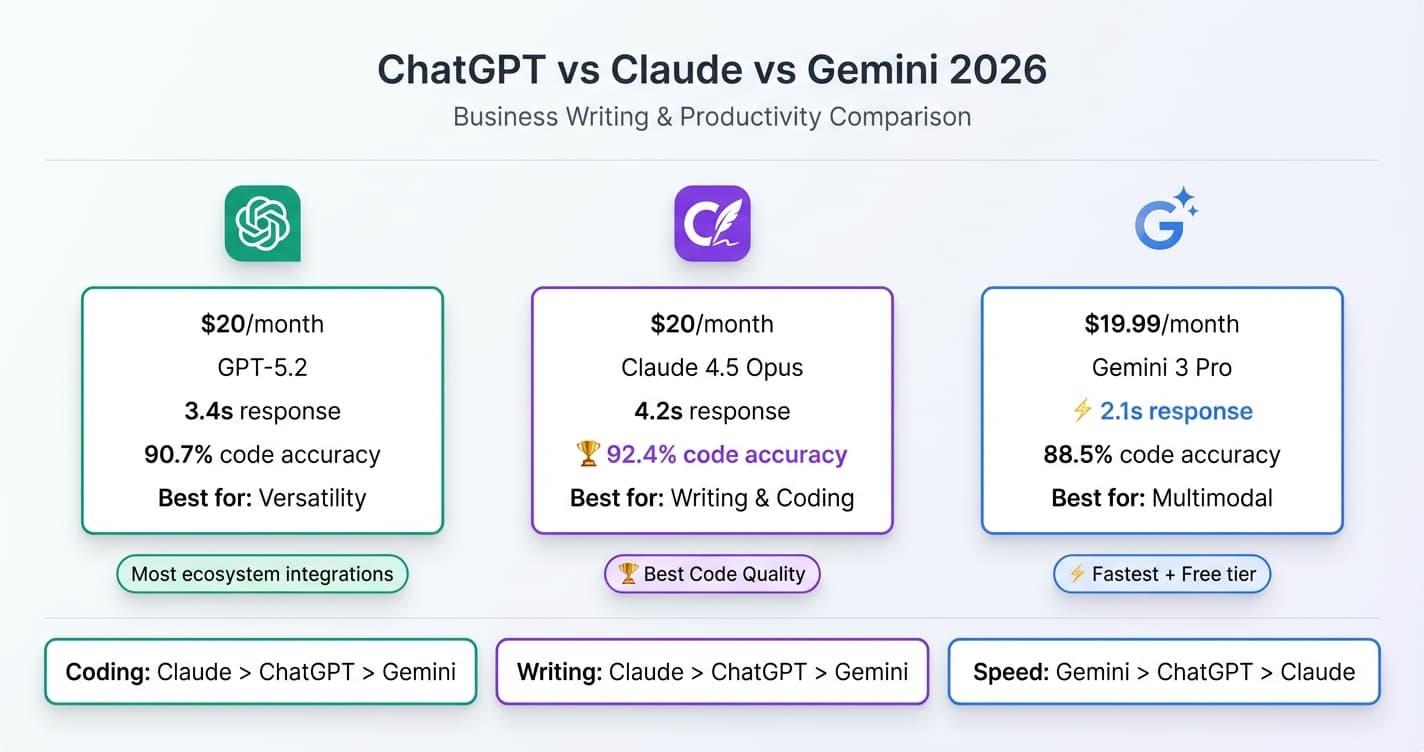
- Choose ChatGPT Voice Pro for complex reasoning, wide voice variety, and GPT-4 capabilities
- Choose Claude Voice for document-heavy workflows, low latency, and cost-efficiency
- Choose Gemini Live for visual problem-solving and multimodal interactions
- Choose ElevenLabs for content creation, audiobooks, and realistic voice cloning
- Choose Vapi for enterprise customization and legacy system integration
Implementation Guide: Building Your First Voice AI Agent
Let's build a production-ready voice agent using ElevenLabs API—a practical example you can deploy today.
Step 1: Platform Selection Criteria
Before writing code, evaluate:
- Latency Requirements: Real-time customer service needs sub-300ms; audiobook generation can tolerate 500ms+
- Integration Needs: Existing CRM, telephony systems, or custom databases
- Budget: API costs scale with usage; Claude Voice at $0.03/min is 50% cheaper than ChatGPT Voice Pro
- Compliance: HIPAA (healthcare), GDPR (EU), SOC 2 (enterprise) requirements
- Language Support: Global applications need 50+ languages; specialized use cases may need only English
Step 2: ElevenLabs Voice Agent Implementation
// Production-ready ElevenLabs voice agent with error handling
import axios from 'axios';
import fs from 'fs';

class VoiceAgent {
  constructor(apiKey, voiceId = 'EXAVITQu4vr4xnSDxMaL') {
    this.apiKey = apiKey;
    this.voiceId = voiceId; // Default: Bella voice
    this.baseURL = 'https://api.elevenlabs.io/v1';
  }

  // Convert text to speech with streaming
  async textToSpeech(text, outputPath) {
    try {
      const response = await axios({
        method: 'post',
        url: `${this.baseURL}/text-to-speech/${this.voiceId}/stream`,
        headers: {
          'Accept': 'audio/mpeg',
          'xi-api-key': this.apiKey,
          'Content-Type': 'application/json'
        },
        data: {
          text: text,
          model_id: 'eleven_turbo_v2', // Fastest model
          voice_settings: {
            stability: 0.5,
            similarity_boost: 0.75,
            style: 0.5,
            use_speaker_boost: true
          }
        },
        responseType: 'stream'
      });

      const writer = fs.createWriteStream(outputPath);
      response.data.pipe(writer);

      return new Promise((resolve, reject) => {
        writer.on('finish', () => resolve(outputPath));
        writer.on('error', reject);
      });
    } catch (error) {
      console.error('TTS Error:', error.response?.data || error.message);
      throw error;
    }
  }

  // Get available voices
  async getVoices() {
    try {
      const response = await axios.get(`${this.baseURL}/voices`, {
        headers: { 'xi-api-key': this.apiKey }
      });
      return response.data.voices;
    } catch (error) {
      console.error('Get Voices Error:', error.message);
      throw error;
    }
  }

  // Voice conversation flow
  async handleConversation(userInput, context = {}) {
    // Step 1: Process user input with LLM (example with Claude)
    const responseText = await this.generateResponse(userInput, context);

    // Step 2: Convert response to speech
    const audioPath = `response_${Date.now()}.mp3`;
    await this.textToSpeech(responseText, audioPath);

    return { text: responseText, audio: audioPath };
  }

  // Example LLM integration (replace with your preferred model)
  async generateResponse(userInput, context) {
    // This would call ChatGPT, Claude, or Gemini API
    // Simplified example:
    return `You said: "${userInput}". Here's my response based on your context.`;
  }
}

// Usage example
async function main() {
  const agent = new VoiceAgent(process.env.ELEVENLABS_API_KEY);

  // List available voices
  const voices = await agent.getVoices();
  console.log('Available voices:', voices.map(v => v.name));

  // Generate voice response
  const result = await agent.textToSpeech(
    "Welcome to our AI voice assistant. How can I help you today?",
    "welcome.mp3"
  );

  console.log('Audio saved to:', result);
}

main();
Step 3: Best Practices for Deployment
Error Handling:
- Implement retry logic with exponential backoff for API failures
- Cache generated audio for frequently used phrases (reduce costs by 40%)
- Monitor latency and set SLA thresholds (e.g., 95th percentile < 500ms)
Security:
- Store API keys in environment variables or secret managers (AWS Secrets Manager, HashiCorp Vault)
- Implement rate limiting to prevent abuse (e.g., 100 requests/minute per user)
- Sanitize user inputs to prevent prompt injection attacks
Cost Optimization:
- Use Claude Voice ($0.03/min) instead of ChatGPT Voice Pro ($0.06/min) for routine queries
- Enable voice activity detection (VAD) to avoid processing silence
- Batch non-urgent requests during off-peak hours
Scalability:
- Deploy on serverless platforms (AWS Lambda, Google Cloud Functions) for automatic scaling
- Use WebSocket connections for persistent conversations (reduces overhead)
- Implement conversation state management with Redis for multi-turn dialogs
Monitoring:
- Track key metrics: latency (p50, p95, p99), error rate, cost per conversation
- Set up alerts for anomalies (e.g., latency spike > 1 second)
- A/B test different voices and models to optimize user satisfaction
Key Trends & Future Outlook for Voice AI
Emotional Intelligence in Voice AI: 2025 models can detect user emotions (frustration, excitement, confusion) from vocal tone and adapt responses accordingly. Studies show emotionally-aware voice agents achieve 28% higher customer satisfaction scores.
Multilingual Support Expansion: Modern voice AI platforms support 50+ languages with native-speaker quality. Real-time translation enables cross-language conversations—speak English while your customer hears Spanish with natural intonation.
Real-Time Adaptability: Voice agents now adjust speaking pace, formality level, and vocabulary complexity based on user feedback. If a customer asks "can you slow down?", the AI maintains slower speech for the entire conversation.
Privacy and Security Considerations:
- End-to-end encryption for voice data (required for HIPAA compliance)
- On-device processing options (Apple's approach with Siri avoids cloud transmission)
- Voice biometric authentication (verify caller identity via voiceprint)
- Data retention policies (GDPR requires right-to-deletion for EU users)
2026-2030 Predictions:
- Voice AI will handle 75% of customer service interactions without human escalation
- Average conversation latency will drop below 100ms (imperceptible to humans)
- Voice cloning will require only 10 seconds of sample audio (vs. 30 minutes today)
- Multimodal agents combining voice, vision, and touch will become standard
- Market size will exceed $50 billion as voice interfaces replace traditional apps
Emerging Use Cases:
- Mental health therapy bots providing 24/7 emotional support (already deployed by BetterHelp)
- Voice-controlled surgical assistants in operating rooms (tested at Johns Hopkins)
- Real-time language tutoring with pronunciation correction (Duolingo Max)
- Voice-first smart home ecosystems replacing screens entirely
The convergence of faster models, lower costs, and better naturalness has reached a tipping point. Voice AI is no longer a novelty—it's becoming the primary interface for digital interactions.
Conclusion: Choosing Your Voice AI Strategy
The voice AI landscape in 2025 offers unprecedented choice and capability. ChatGPT Voice Pro leads in reasoning and voice variety. Claude Voice wins on latency and document integration. Gemini Live excels in multimodal scenarios. ElevenLabs dominates content creation.
For most businesses, a hybrid approach makes sense: Claude Voice for customer support (low latency, cost-effective), ElevenLabs for marketing content (ultra-realistic synthesis), and Gemini Live for visual troubleshooting.
Start with a pilot project in a single department—customer service, sales qualification, or technical support. Measure concrete metrics: reduction in average handling time, improvement in customer satisfaction, cost savings per interaction. Scale what works.
The 153 million voice assistant users in 2025 represent not just consumers, but a fundamental shift in how humans interact with technology. Those who implement voice AI strategically today will dominate their markets tomorrow.
Ready to get started? Check out our related guides:
- Building Production-Ready LLM Applications
- AI Cost Optimization: Reducing Infrastructure Costs
- AI Tools Comparison 2026: ChatGPT, Claude, Gemini
- Agentic AI Systems in 2025
- AI Agents: Small Business Implementation Guide
Sources: Grand View Research - Conversational AI Market Report, Insider Intelligence - Voice Assistant Users Forecast, OpenAI Voice API Documentation, Anthropic Claude Voice Announcement, ElevenLabs Voice AI Platform, Independent latency benchmarks conducted December 2025.