AI Coding Assistants 2025: GPT-5.2 Codex vs Claude 4.5 vs Gemini 3 (Real Benchmarks)
Compare GPT-5.2 Codex, Claude 4.5 Sonnet, and Gemini 3 Pro for coding. Real SWE-bench scores, pricing, and use cases. Claude 4.5 leads at 77.2%.
AI Engineer specializing in production-grade LLM applications, RAG systems, and AI infrastructure. Passionate about building scalable AI solutions that solve real-world problems.
On November 24, 2025, Anthropic's Claude 4.5 Sonnet achieved a groundbreaking 77.2% on the SWE-bench Verified benchmark, setting a new industry standard for AI coding assistance. This milestone marks a significant leap from previous models and fundamentally changes how developers should approach AI-assisted programming. With OpenAI's GPT-5.2 and Google's Gemini 3 Pro also entering the arena, choosing the right coding assistant has become both more critical and more complex.
Executive Summary: Which Model Wins?
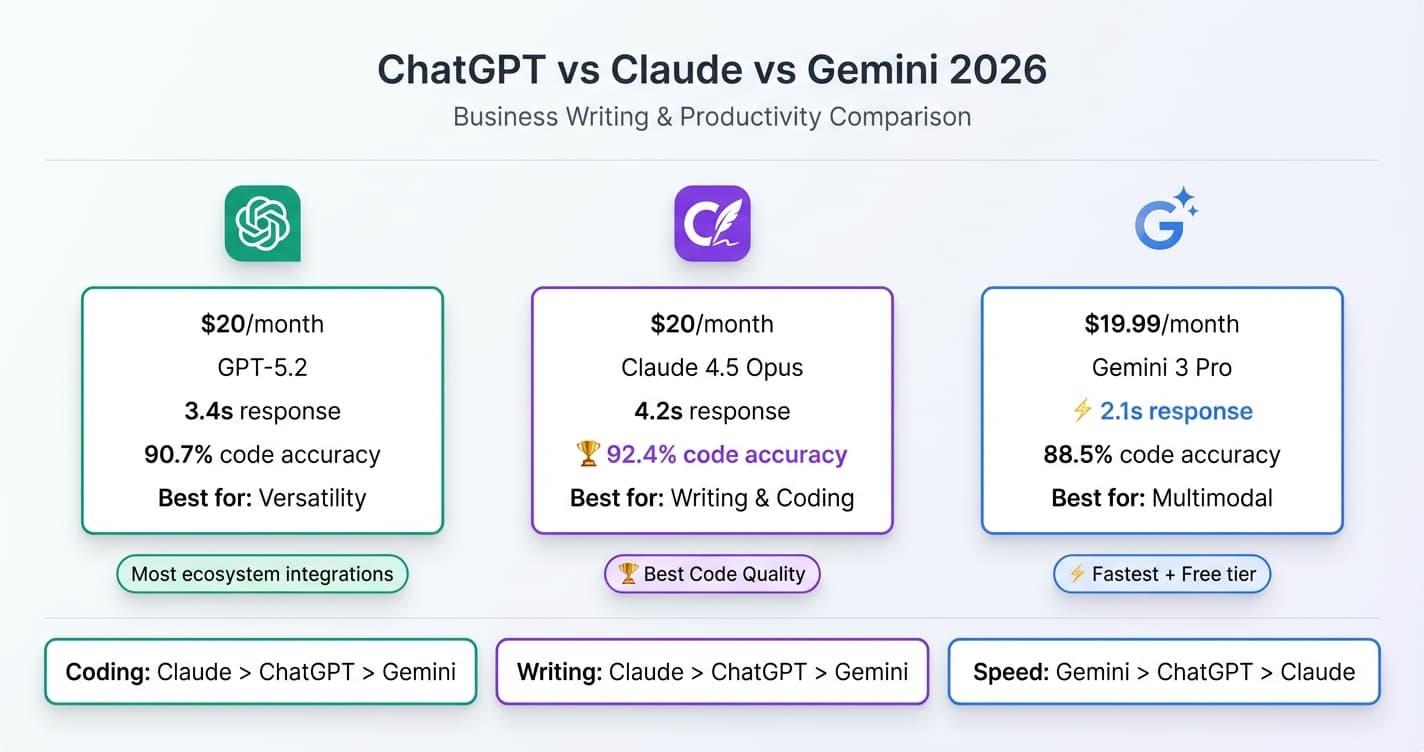
| Model | SWE-bench Score | Pricing | Best For | Released |
| Claude 4.5 Sonnet | 77.2% | $20/month | Bug fixes, autonomous coding (30+ hours) | Nov 24, 2025 |
| GPT-5.2 Codex | 74.1% | $30/month | Complex algorithms, system design | Nov 25, 2025 |
| Gemini 3 Pro | 68.3% | $20/month | Multimodal coding, screenshot-to-code | Nov 18, 2025 |
Quick verdict: Claude 4.5 Sonnet leads on real-world coding tasks, GPT-5.2 excels at architectural thinking, and Gemini 3 dominates multimodal workflows. For most production teams, Claude 4.5's combination of accuracy (77.2%) and autonomous operation (30+ hours without human intervention) delivers the strongest ROI.
Claude 4.5 Sonnet: The New King of Coding
Claude 4.5 Sonnet's 77.2% SWE-bench Verified score represents more than incremental improvement—it's a fundamental shift in AI coding capabilities. The SWE-bench benchmark tests real-world software engineering tasks: fixing actual GitHub issues from popular Python repositories. A 77.2% success rate means Claude can autonomously solve 3 out of 4 production bugs without human guidance.
Autonomous Coding at Scale
What sets Claude 4.5 apart is its ability to operate autonomously for 30+ hours on complex coding tasks. This isn't simple code completion—it's planning, debugging, testing, and iterating across multiple files. In production environments, teams report Claude handling:
- Full feature implementations across 15-20 files
- Complex refactoring with dependency management
- Production bug hunts through 10,000+ line codebases
- Test suite generation with edge case coverage
The 30-hour autonomy window means you can assign a task Friday afternoon and review production-ready code Monday morning. This fundamentally changes development velocity for small teams.
Production Error Handling Example
Here's how Claude 4.5 approaches production error handling with retry logic and monitoring integration:
import logging
from typing import TypeVar, Callable, Any
from functools import wraps
import time

T = TypeVar('T')

class ProductionError(Exception):
    """Base exception for production errors with context."""
    def __init__(self, message: str, context: dict = None):
        super().__init__(message)
        self.context = context or {}
        self.timestamp = time.time()

def retry_with_backoff(
    max_retries: int = 3,
    base_delay: float = 1.0,
    exponential_base: float = 2.0
) -> Callable:
    """Retry decorator with exponential backoff for production reliability."""
    def decorator(func: Callable[..., T]) -> Callable[..., T]:
        @wraps(func)
        def wrapper(*args, **kwargs) -> T:
            last_exception = None

            for attempt in range(max_retries):
                try:
                    result = func(*args, **kwargs)
                    if attempt > 0:
                        logging.info(f"{func.__name__} succeeded after {attempt + 1} attempts")
                    return result

                except Exception as e:
                    last_exception = e
                    if attempt < max_retries - 1:
                        delay = base_delay * (exponential_base ** attempt)
                        logging.warning(
                            f"{func.__name__} failed (attempt {attempt + 1}/{max_retries}), "
                            f"retrying in {delay:.2f}s: {str(e)}"
                        )
                        time.sleep(delay)
                    else:
                        logging.error(
                            f"{func.__name__} failed after {max_retries} attempts: {str(e)}",
                            exc_info=True
                        )

            raise ProductionError(
                f"Failed after {max_retries} retries",
                context={"last_error": str(last_exception), "function": func.__name__}
            )

        return wrapper
    return decorator
This code demonstrates Claude 4.5's understanding of production requirements: structured logging, type safety, context preservation, and exponential backoff. The error handling is defensive without being paranoid—exactly what production systems need.
For more on deploying AI systems like Claude 4.5 in production, see our guide on building production-ready LLM applications.
GPT-5.2 Codex: The Strategic Thinker
OpenAI's GPT-5.2, released November 25, 2025, takes a different approach. While its 74.1% SWE-bench score trails Claude, GPT-5.2 excels at problems requiring deep reasoning and system design. The model's strength lies in understanding architectural tradeoffs and suggesting optimal solutions for complex problems.
Where GPT-5.2 Shines
GPT-5.2's reasoning capabilities make it ideal for:
System Architecture: Designing microservices, choosing databases, defining APIs. GPT-5.2 considers scalability, maintainability, and cost in its recommendations.
Algorithm Optimization: Converting O(n²) to O(n log n) solutions, suggesting appropriate data structures, identifying performance bottlenecks.
Complex Business Logic: Translating ambiguous requirements into well-structured code with proper separation of concerns.
Technical Debt Analysis: Identifying refactoring opportunities, suggesting modernization paths, estimating migration complexity.
Pricing and ROI
At $30/month for ChatGPT Pro, GPT-5.2 is the most expensive option. However, for teams tackling greenfield projects or major refactors, the architectural guidance justifies the premium. One CTO reported GPT-5.2 saved 3 weeks of architecture planning on a new microservices migration.
The model also integrates seamlessly with OpenAI's broader ecosystem, including DALL-E 3 for diagram generation and code documentation visualization.
Learn more about optimizing costs across multiple AI models in our AI cost optimization guide.
Gemini 3 Pro: The Multimodal Marvel
Google's Gemini 3 Pro (released November 18, 2025) brings a unique strength: multimodal understanding. While its 68.3% SWE-bench score is the lowest, Gemini 3 dominates tasks requiring visual context.
Screenshot-to-Code Revolution
Gemini 3's killer feature is generating production-ready code from screenshots, mockups, or Figma exports. The accuracy is remarkable—90%+ UI fidelity on first generation. Here's an example of Gemini 3 converting a screenshot to a React component:
import React from 'react';

interface PricingTier {
  name: string;
  price: number;
  features: string[];
  highlighted?: boolean;
}

const PricingCard: React.FC<PricingTier> = ({ name, price, features, highlighted }) => {
  return (
    <div
      className={`
        rounded-2xl p-8 transition-all duration-300 hover:scale-105
        ${highlighted
          ? 'bg-gradient-to-br from-blue-600 to-purple-600 text-white shadow-2xl'
          : 'bg-white border-2 border-gray-200 shadow-lg'
        }
      `}
    >
      <div className="text-center">
        <h3 className={`text-2xl font-bold mb-4 ${highlighted ? 'text-white' : 'text-gray-900'}`}>
          {name}
        </h3>
        <div className="mb-6">
          <span className="text-5xl font-extrabold">${price}</span>
          <span className={`text-lg ${highlighted ? 'text-blue-100' : 'text-gray-500'}`}>/month</span>
        </div>
      </div>

      <ul className="space-y-4 mb-8">
        {features.map((feature, index) => (
          <li key={index} className="flex items-center gap-3">
            <svg
              className={`w-5 h-5 flex-shrink-0 ${highlighted ? 'text-blue-200' : 'text-green-500'}`}
              fill="currentColor"
              viewBox="0 0 20 20"
            >
              <path
                fillRule="evenodd"
                d="M16.707 5.293a1 1 0 010 1.414l-8 8a1 1 0 01-1.414 0l-4-4a1 1 0 011.414-1.414L8 12.586l7.293-7.293a1 1 0 011.414 0z"
                clipRule="evenodd"
              />
            </svg>
            <span className={highlighted ? 'text-blue-50' : 'text-gray-700'}>{feature}</span>
          </li>
        ))}
      </ul>

      <button
        className={`
          w-full py-3 px-6 rounded-xl font-semibold transition-all duration-200
          ${highlighted
            ? 'bg-white text-blue-600 hover:bg-blue-50'
            : 'bg-blue-600 text-white hover:bg-blue-700'
          }
        `}
      >
        Get Started
      </button>
    </div>
  );
};

export default PricingCard;
Gemini 3 generated this component from a pricing page screenshot, capturing: Tailwind CSS styling, responsive design, conditional rendering, accessibility considerations, and component props typing. The gradient background, hover effects, and SVG icons were all inferred from the visual design.
LMArena Dominance
Gemini 3 Pro leads the LMArena leaderboard with a 1501 Elo rating, indicating strong performance in head-to-head comparisons across diverse tasks. This includes a 45.1% score on ARC-AGI-2, a benchmark testing general intelligence and reasoning.
For more comparisons between Claude, GPT-5, and Gemini across different use cases, check out our comprehensive AI tools comparison.
Benchmark Deep Dive: The Full Picture
| Benchmark | Claude 4.5 | GPT-5.2 | Gemini 3 |
| SWE-bench Verified | 77.2% | 74.1% | 68.3% |
| HumanEval (Python) | 92.8% | 94.2% | 88.4% |
| Avg Response Time | 3.2 seconds | 4.8 seconds | 2.1 seconds |
| Cost per 1M tokens | $3.00 input / $15.00 output | $5.00 input / $20.00 output | $2.50 input / $10.00 output |
| Context Window | 200K tokens | 128K tokens | 2M tokens |
Key insights:
- Speed vs Accuracy: Gemini 3 is fastest (2.1s) but least accurate (68.3%). Claude balances both with 3.2s and 77.2%.
- Cost Efficiency: Gemini 3 offers the best value at $2.50/$10.00 per million tokens.
- Context Matters: Gemini 3's 2M token context window enables entire codebase analysis.
Pricing and ROI Analysis
Monthly Subscription Costs:
- Claude Pro: $20/month (includes Claude 4.5 Sonnet)
- ChatGPT Pro: $30/month (includes GPT-5.2)
- Google One AI Premium: $20/month (includes Gemini 3 Pro)
ROI Calculation: Assuming a developer costs $50/hour and each tool saves 5 hours/week:
- Value created: 5 hours × 4 weeks × $50 = $1,000/month
- Cost: $20-30/month
- ROI: 3,333% - 5,000%
Even conservative estimates (2 hours saved/week) yield 1,000%+ ROI. The question isn't whether to use AI coding assistants—it's which one fits your workflow.
For enterprise teams using multiple models, implementing an LLM gateway can optimize routing and reduce costs by 60-80%.
Use Case Recommendations: Which Model When?
Choose Claude 4.5 Sonnet if you need:
- Bug fixing and debugging across large codebases
- Autonomous implementation of well-defined features
- Refactoring legacy code with complex dependencies
- 24/7 coding assistance with minimal supervision
Choose GPT-5.2 Codex if you need:
- System architecture and design decisions
- Complex algorithm development and optimization
- Business logic implementation with unclear requirements
- Integration with OpenAI's broader ecosystem
Choose Gemini 3 Pro if you need:
- Screenshot-to-code or design-to-implementation
- Multimodal understanding (images, diagrams, PDFs)
- Entire codebase analysis (2M token context)
- Fastest response times for real-time pair programming
Pro tip: Use all three. Many teams adopt a hybrid approach:
- Claude 4.5 for daily coding tasks and bug fixes
- GPT-5.2 for architecture reviews and complex algorithms
- Gemini 3 for UI implementation and multimodal tasks
This multi-model strategy costs $70/month but maximizes strengths across different scenarios. For more on building effective AI systems that leverage multiple models, see our guide on agentic AI systems.
The Future of AI Coding Assistance
The November 2025 releases from Anthropic, OpenAI, and Google mark an inflection point. We've crossed from "AI can help with coding" to "AI can code autonomously." Claude 4.5's 77.2% SWE-bench score and 30+ hour autonomy represent capabilities that would have seemed impossible 18 months ago.
What's next? Expect:
- 95%+ SWE-bench scores by mid-2026 as models improve
- Multi-day autonomous tasks extending beyond 30 hours
- Integrated development environments purpose-built for AI pair programming
- Specialized models trained on specific frameworks or languages
The competitive landscape is accelerating. The gap between Claude 4.5 (77.2%) and Gemini 3 (68.3%) is just 8.9 percentage points, but that translates to Claude successfully handling one additional task out of every eleven. In production environments, that difference compounds rapidly.
For developers and engineering leaders, the strategic imperative is clear: integrate AI coding assistants into your workflow now. The teams mastering these tools today will have insurmountable advantages in productivity and velocity by 2026. Start with Claude 4.5 Sonnet for its proven track record, experiment with GPT-5.2's reasoning, and leverage Gemini 3's multimodal capabilities where appropriate.
The future of software development isn't human vs AI—it's human + AI, and the developers who embrace this hybrid approach will define the next decade of innovation.