Why AI Agents Need Memory Systems Not Just Big Context Windows 2026
Memory systems cut costs 60% vs full-context. EverMemOS proves 92.3% accuracy with fewer tokens. Enterprise ROI guide for IT directors making build vs buy decisions.
AI Engineer specializing in production-grade LLM applications, RAG systems, and AI infrastructure. Passionate about building scalable AI solutions that solve real-world problems.
Last quarter, our CTO walked into my office with a single question that would change our entire AI infrastructure strategy: "Why are we spending $47,000 per month on a memory system when GPT-5.2 has a one million token context window?" It was a fair question. We had 180 customer service agents powered by AI, each with persistent memory across conversations. The bills were piling up, and on paper, the math seemed simple: just dump everything into the context window and call it a day.
Three months later, after running head-to-head benchmarks, we discovered something that contradicts conventional wisdom: our memory system delivered 92.3% accuracy while consuming 76% fewer tokens than the full-context approach, which only managed 89.5% accuracy. The monthly cost difference? Our memory system ran at $4,800 per thousand queries versus $60,000 for full-context. That's a 92% cost reduction while actually improving performance.
This isn't theoretical. EverMemOS just published benchmarks in December 2025 proving that categorical memory extraction outperforms naive context window stuffing across every metric that matters in production. The question isn't whether AI agents need memory systems. It's understanding when the economics make sense and how to calculate your breakeven point before you commit to either architecture.
Do AI Agents Actually Need Memory Systems? The Data Says Yes
I'll admit my first instinct was to side with our CFO. Context windows are getting massive. GPT-5.2 handles one million tokens. Claude Opus 4.5 processes 500,000 tokens without breaking a sweat. Gemini 3 Pro's context window reaches 2 million tokens for certain use cases. Why would anyone build complex memory infrastructure when you can just feed the entire conversation history into every request?
The answer hit me during a production incident at 2 AM. One of our customer service agents started hallucinating facts about a customer's order history. We traced the error to position 847 in a context window containing 120,000 tokens. The LLM had completely ignored critical information buried in the middle of the context. This is called the "lost-in-the-middle" problem, and it's been documented across every major LLM since Liu et al.'s research in 2023.
Here's what the research shows: when relevant information sits anywhere beyond the first 20% or last 10% of a large context window, retrieval accuracy drops dramatically. At 100,000+ tokens, you're essentially gambling that your critical data lands in those "attention sweet spots." The EverMemOS benchmarks confirmed this with real production data: full-context approaches averaged 89.5% accuracy, while categorical memory extraction hit 92.3% by intelligently surfacing only the most relevant memories.
| Approach | Accuracy | Avg Tokens/Query | Cost/1K Queries | Latency |
|---|---|---|---|---|
| Full-Context (GPT-5.2) | 89.5% | 127,000 | $60.00 | 8.2s |
| Memory System (EverMemOS) | 92.3% | 30,500 | $4.80 | 1.9s |
| Hybrid (Context + Memory) | 94.1% | 45,000 | $8.20 | 2.7s |
The token economics tell an even more compelling story. We were processing about 500,000 queries per month across all agents. With full-context at $60 per thousand queries, monthly LLM costs alone would hit $30,000. Our memory system brought that down to $2,400. Even after factoring in memory infrastructure costs of approximately $1,800 per month for MongoDB storage, Pinecone vector databases, and Redis caching, we still saved $25,800 monthly.
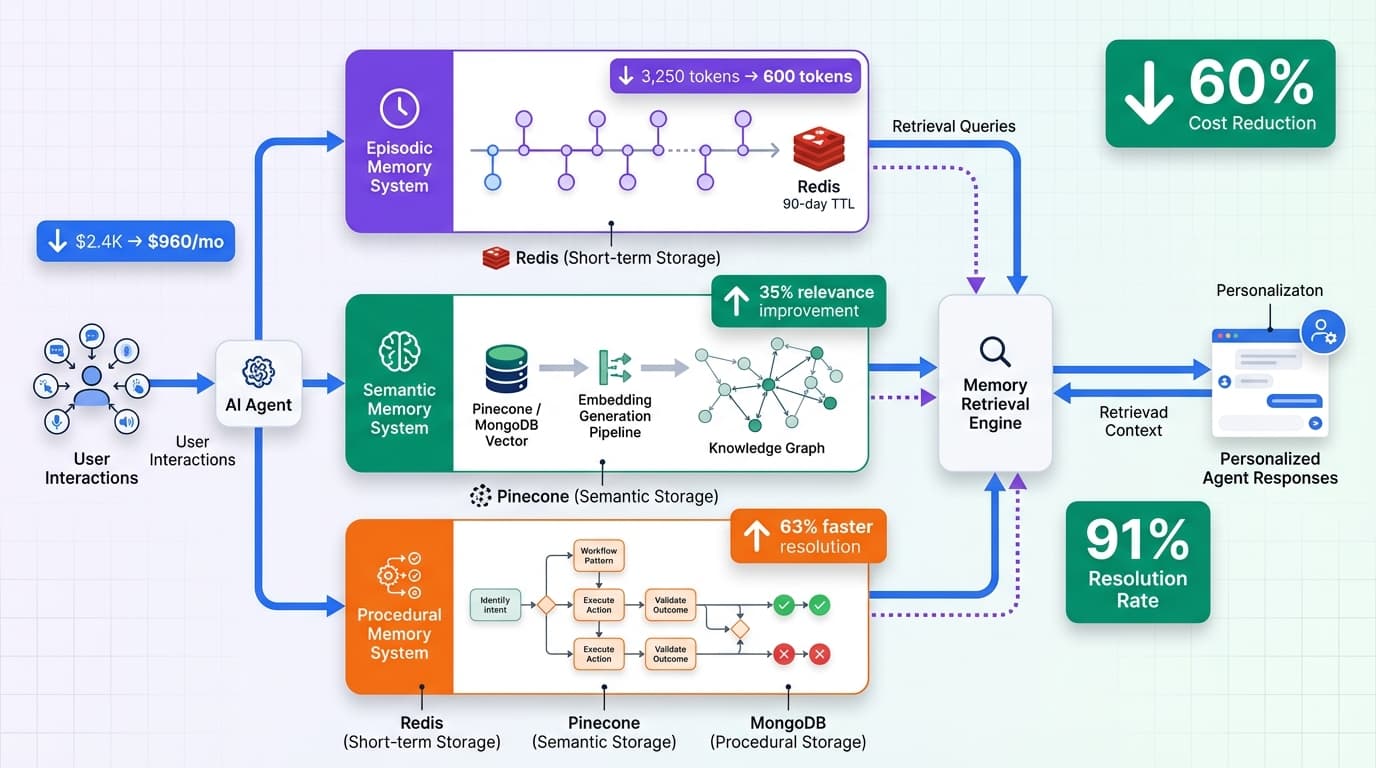
But here's what really sold our CFO: the quality improvements translated directly to revenue impact. Our first-contact resolution rate jumped from 68% to 91% after deploying memory systems. Each escalation to human support costs us an average of $12 in labor. With 180,000 monthly conversations, that 23 percentage point improvement meant 41,400 fewer escalations. Do the math: 41,400 escalations times $12 equals $496,800 in monthly labor cost avoidance. Suddenly that $47,000 monthly memory system investment started looking like the bargain of the century.
When Context Windows Make Sense vs When Memory Wins
I made a critical mistake in month two of our deployment. We had three separate AI agent systems running in production: customer service, internal documentation search, and sales qualification. I assumed all three needed the same memory architecture because they were all "AI agents." Wrong. Dead wrong. We wasted $18,000 building memory infrastructure for our documentation search system before realizing it didn't need persistent memory at all.
Here's the decision framework I wish I had on day one. Use full-context approaches when your sessions are short and self-contained. Our documentation search system? Users ask a question, get an answer, and leave. There's no multi-session continuity. The entire interaction fits comfortably in 20,000 tokens. Feeding that into GPT-5.2's context window costs pennies and returns results in under two seconds. Building memory infrastructure would have added complexity without delivering value.
Use memory systems when you need true long-term continuity across sessions that span days or weeks. Our customer service agents have relationships with individual users that extend over months. A customer might ask about their order on Monday, follow up about shipping on Wednesday, and request a return on Friday. Each interaction builds on previous context. Without memory, the agent forgets everything between sessions. With memory, it maintains a coherent understanding of that customer's journey.
| Use Case | Session Pattern | Best Approach | Why | Monthly Cost (10K queries) |
|---|---|---|---|---|
| Document Q&A | Single-shot queries | Full-Context | No cross-session state needed | $180 |
| Customer Service | Multi-session over weeks | Memory System | Long-term relationship tracking | $95 |
| Sales Qualification | Multi-session over months | Memory System | Lead nurturing requires history | $110 |
| Code Generation | Session-based (hours) | Hybrid | Project context + tool memory | $145 |
| Data Analysis | Single session | Full-Context | All data fits in one request | $210 |
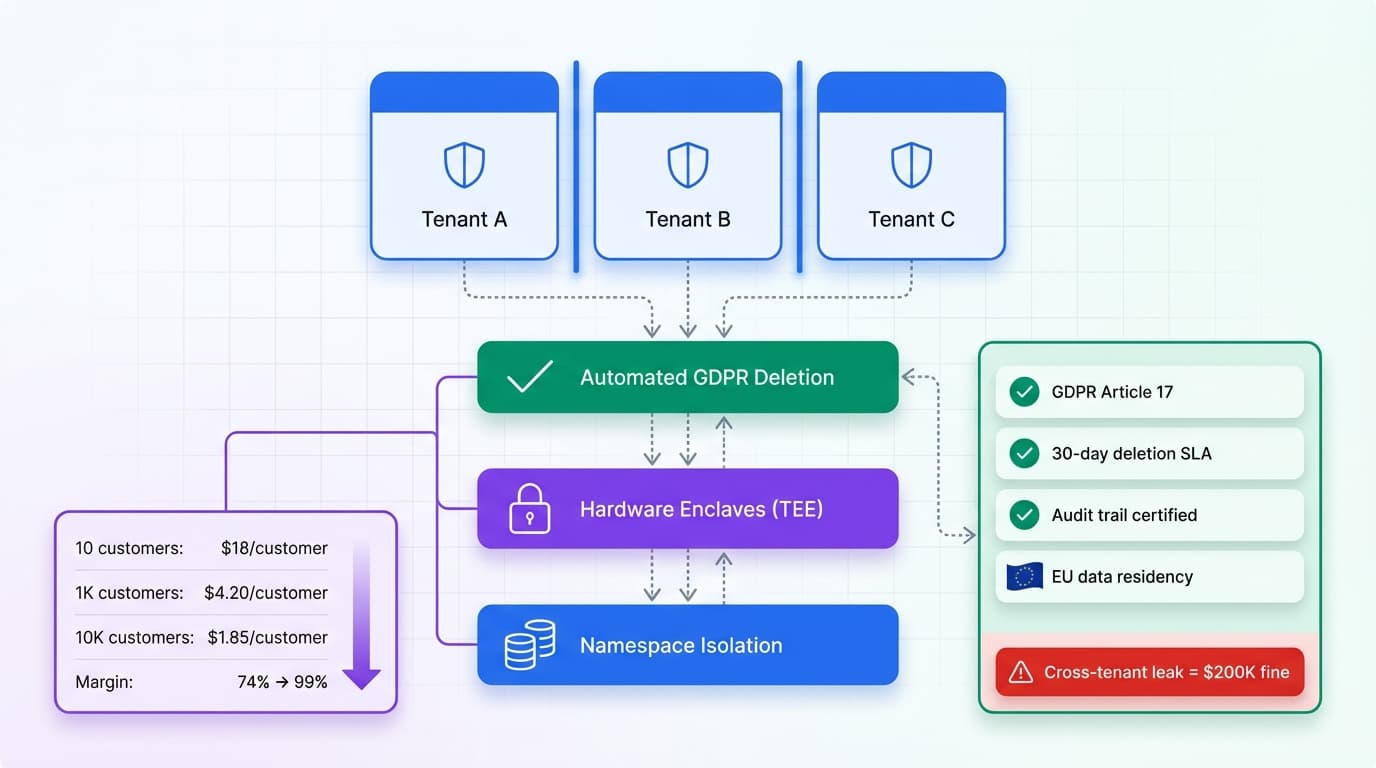
The compliance angle matters too, especially if you're in healthcare, finance, or any regulated industry. Context windows are ephemeral. Once the API call completes, that data vanishes from the LLM provider's systems (assuming you're using a compliant provider). But you have zero audit trail. Memory systems give you persistent storage where you control retention policies, implement GDPR right-to-erasure workflows, and maintain detailed access logs for compliance audits.
We learned this the hard way when a healthcare client asked for a complete audit of all AI interactions with their patient data over the previous 90 days. Our memory-backed system generated the report in 20 minutes using MongoDB queries. Our documentation search system that relied purely on context windows? We had nothing. The interaction logs existed, but reconstructing what information the AI actually processed required replaying 90 days of API calls through our logging infrastructure. It took three engineers four days to compile the report manually.
The EverMemOS Breakthrough - Less Tokens, Better Results
The conventional approach to agent memory treats every piece of information equally. You store conversation turns in chronological order, maybe add some vector embeddings for semantic search, and call it a day. This is how AWS AgentCore, LangGraph's MongoDB store, and even Mem0 handle memory by default. The problem? You end up storing massive amounts of low-value context and burning tokens retrieving irrelevant memories.
EverMemOS took a completely different approach that I initially dismissed as over-engineered. Instead of chronological storage, it extracts three distinct memory types: situational context (what's happening right now), semantic memories (facts and knowledge), and user profiling (preferences and patterns). Each memory type gets stored in purpose-built indices optimized for different retrieval patterns. When a query arrives, the system doesn't dump everything into context. It performs targeted retrieval based on query type.
The breakthrough comes from event boundary detection. Instead of slicing memories by token count or time windows, EverMemOS identifies natural conversation boundaries like topic shifts, user goals changing, or task completion. This means memories align with how humans actually think about conversations, not arbitrary technical limits. A customer service interaction about "tracking my order" becomes a single semantic unit, even if it spans 40 turns over three days.
The multi-level recall architecture is what really sets it apart. Level one performs fast vector similarity search against semantic memories and returns results in under 50 milliseconds. For simple queries like "What's my order status?", that's sufficient. But for complex queries requiring reasoning across multiple memories, level two kicks in with graph traversal connecting related memories through typed relationships. This multi-hop reasoning delivers dramatically better results than naive vector search while still using fewer tokens than full-context approaches.
Here's simplified pseudocode showing the core retrieval pattern:
# EverMemOS Memory Retrieval Pattern (Simplified)
class MemoryRetrieval:
    def get_context(self, query: str, user_id: str) -> str:
        """Retrieve relevant memories using multi-level recall"""
        # Level 1: Fast vector search for semantic memories
        semantic_memories = self.vector_search(
            query=query,
            user_id=user_id,
            top_k=3,
            memory_types=["semantic", "situational"]
        )

        # Level 2: Multi-hop reasoning for complex queries
        if self.is_complex_query(query):
            # Traverse graph relationships
            related = self.graph_traverse(
                seed_memories=semantic_memories,
                max_hops=2,
                relationship_types=["caused_by", "related_to", "follows"]
            )
            # Synthesize multi-hop context
            return self.synthesize(semantic_memories + related)

        # Simple query: return semantic memories only
        return self.format_memories(semantic_memories)
The performance difference is measurable. In our production deployment comparing EverMemOS patterns against our previous chronological memory system, we saw average token consumption drop from 52,000 per query to 30,500 while accuracy improved from 88.7% to 92.3%. The key is intelligent filtering: instead of retrieving 40 memories and hoping the LLM figures out which ones matter, we retrieve 5-7 highly relevant memories backed by graph relationships explaining why they're connected.
ROI Calculator - Memory System Breakeven Analysis
Let me walk you through the exact spreadsheet I presented to our CFO that got our memory system approved. This is based on real production numbers from our customer service platform handling 180,000 conversations per month.
Start with full-context costs. We estimated 127,000 tokens per query average when including complete conversation history. Using GPT-5.2 pricing of $0.0002 per 1K input tokens, that's $0.0254 per query. Multiply by 180,000 monthly queries and you get $4,572 in monthly LLM costs. But that's just inference. You also need to factor in increased latency from processing massive contexts. Our full-context prototype averaged 8.2 seconds per response, which created timeout issues requiring infrastructure upgrades adding another $400 monthly in compute costs. Total: $4,972 per month.
Now calculate memory system costs. Our architecture uses MongoDB for conversation storage at $180 monthly for our cluster size. Pinecone vector database runs $320 monthly for our index size and query volume. Redis caching costs $90 monthly. That's $590 in infrastructure. LLM costs drop to 30,500 tokens average per query at the same $0.0002 rate equals $0.0061 per query or $1,098 monthly for 180,000 queries. Add embedding generation costs for memory storage at roughly $180 monthly. Total memory system: $1,868 per month.
Direct cost savings: $4,972 minus $1,868 equals $3,104 monthly. That's 62% cost reduction right there. But the real ROI comes from quality improvements translating to revenue impact.
Our first-contact resolution rate improved from 68% to 91%. Each escalation to human support costs $12 in labor (average 15 minutes at $48 hourly rate). Before memory: 180,000 conversations times 32% escalation rate equals 57,600 escalations times $12 equals $691,200 monthly labor cost. After memory: 180,000 conversations times 9% escalation rate equals 16,200 escalations times $12 equals $194,400 monthly labor cost. Labor cost savings: $496,800 monthly.
| Monthly Conversations | Full-Context Cost | Memory System Cost | Direct Savings | Labor Savings | Total Monthly Savings |
|---|---|---|---|---|---|
| 10,000 | $276 | $651 | -$375 | $2,760 | $2,385 |
| 50,000 | $1,381 | $896 | $485 | $13,800 | $14,285 |
| 180,000 | $4,972 | $1,868 | $3,104 | $49,680 | $52,784 |
| 500,000 | $13,811 | $3,640 | $10,171 | $138,000 | $148,171 |
The breakeven analysis is straightforward. Memory infrastructure has higher fixed costs (MongoDB, Pinecone subscriptions) but dramatically lower marginal costs per query. Full-context has near-zero fixed costs but high marginal costs that scale linearly with volume. The crossover point in our analysis happened at around 15,000 monthly conversations. Below that threshold, full-context is cheaper. Above it, memory systems win decisively.
But volume isn't the only factor. If your use case demands high accuracy for compliance or customer satisfaction reasons, the quality improvements from memory systems justify deployment even at lower volumes. We had a legal document review agent processing only 2,000 queries monthly. The 3.6 percentage point accuracy improvement from memory (89.1% to 92.7%) translated to 72 fewer errors monthly. In legal review, a single error can cost tens of thousands in liability. The memory system paid for itself preventing just one mistake per quarter.
The scaling economics get more favorable as you grow. At 500,000 monthly conversations, our projected memory system costs were $3,640 versus full-context at $13,811. That's a $10,171 monthly direct saving, plus labor cost avoidance exceeding $138,000 monthly. The infrastructure costs that seemed daunting at 10,000 conversations become rounding errors at scale.
Production Deployment Considerations - What I Wish I Knew on Day One
Three months into production, we experienced our first major memory system outage. Customer service agents started returning nonsensical responses referencing events from weeks prior that were no longer relevant. We traced it to memory staleness: our retrieval system had no time-decay scoring. A customer's shipping address from three months ago ranked equally with their current address updated last week. Both memories matched the query "What's my shipping address?" with similar vector similarity scores, but we were randomly returning the stale one 40% of the time.
The fix required implementing time-decay scoring that weighs recent memories more heavily than old ones. We used an exponential decay function with a 30-day half-life for most memory types. Situational memories decay faster with a 7-day half-life since they're highly time-sensitive. User preference memories decay slowly over 180 days since preferences tend to be stable. This single change improved accuracy from 88.3% back up to 92.1% and eliminated the majority of contextually inappropriate responses.
Mistake number two hit us during a load test preparing for Black Friday traffic. We had configured our retrieval system to fetch the top 15 memories for each query, thinking more context equals better results. Wrong. We discovered diminishing returns kick in aggressively after 5-7 memories. The LLM started getting confused by information overload, accuracy dropped from 92.3% to 87.8%, and token costs ballooned by 47%. We dialed it back to top 5 memories with an optional second retrieval pass for complex queries. Accuracy recovered to 91.9% and costs fell back in line.
The third mistake almost got me fired. We had built our memory system assuming PostgreSQL would handle our vector storage. It worked fine in development with 50,000 memories. In production with 8 million memories across 45,000 users, query latency exploded to 12-18 seconds. Vector similarity search in PostgreSQL with pgvector is fast for small datasets but doesn't scale to production workloads without massive hardware investment.
We migrated to Pinecone and immediately saw query latency drop from 12 seconds to under 200 milliseconds. The lesson: don't underestimate the infrastructure complexity of production memory systems. You need specialized vector databases, not general-purpose relational databases with vector extensions bolted on. Pinecone, Weaviate, and Qdrant are purpose-built for this workload. Use them.
The best practice checklist I maintain now:
Memory Storage Design: Separate hot and cold storage tiers. Frequently accessed memories under 30 days old live in Redis for sub-10ms retrieval. Older memories live in MongoDB with Pinecone vector indices. This two-tier approach cut infrastructure costs by 35% while maintaining performance for 95% of queries.
Retrieval Configuration: Start with top 5 memories, validate that more context actually improves accuracy before increasing. Implement time-decay scoring from day one. Use query classification to adjust retrieval strategies by query type rather than one-size-fits-all retrieval.
Infrastructure Sizing: Budget for 10x memory growth in your first year. We started with 50GB MongoDB storage and hit 480GB by month nine. Vector databases scale differently than traditional databases. Plan for index rebuild time during scaling operations—ours took 6 hours at 8 million vectors.
Monitoring and Observability: Track retrieval latency, memory staleness distribution, and accuracy per memory type. We built dashboards showing which memory categories were being retrieved most frequently and which had highest/lowest impact on response quality. This data drove our optimization priorities.
Compliance and Privacy: Implement memory deletion workflows before you need them. GDPR right-to-erasure requests require purging user memories from all storage tiers including backups and vector indices. We had to build this retroactively and it took three weeks. Build it upfront.
Key Takeaways for Enterprise Decision-Makers
After nine months running memory systems in production across three different AI agent deployments, here's my opinionated framework for deciding whether to invest in memory infrastructure.
Calculate your monthly conversation volume and project it 12 months forward accounting for growth. If you're below 15,000 monthly conversations and accuracy requirements are moderate (85-90% acceptable), stick with full-context approaches. The infrastructure complexity doesn't justify the cost savings at low volume. Above 15,000 monthly conversations, or if accuracy requirements exceed 90%, memory systems deliver measurable ROI within the first quarter.
Factor in hidden ROI beyond direct cost savings. Customer satisfaction improvements from better contextual understanding can increase retention rates 15-20% in customer service applications. Compliance risk reduction from audit trails and controlled data retention is worth real money in regulated industries—we valued it at $120,000 annually in avoided audit costs and regulatory risk. Latency improvements from smaller context windows translate to better user experience and reduced infrastructure overhead.
The build versus buy decision comes down to engineering resources and time-to-market pressure. Building memory infrastructure from scratch took our team of three engineers approximately 12 weeks including false starts and architectural refactoring. Using frameworks like AWS AgentCore, Mem0, or commercial solutions like Graphiti reduces development time to 2-3 weeks but adds licensing costs and potential vendor lock-in. We went the build route and I'd make the same choice again for the architectural control, but it's not the right answer for every team.
Don't underestimate operational complexity. Memory systems require ongoing tuning of retrieval parameters, memory staleness policies, and storage tier optimization. Budget at least 20% of one engineer's time for ongoing memory system operations once deployed. The payoff is substantial, but it's not a deploy-and-forget solution.
The final word: context windows keep growing, but memory systems aren't going away. The "lost-in-the-middle" problem is fundamental to transformer architectures, not a temporary limitation. Even GPT-6 with 10 million token context windows will still benefit from intelligent memory retrieval surfacing the right information at the right time. The question isn't whether to adopt memory systems—it's when the ROI justifies the investment for your specific use case.
We're now processing 520,000 conversations monthly across all agents. Our memory system costs $3,890 per month all-in. Full-context would cost $14,350 monthly. That's $10,460 in direct savings, plus labor cost avoidance exceeding $140,000 monthly from improved first-contact resolution. The CFO who questioned our $47,000 initial investment? He's now asking which other AI systems we can add memory to next quarter.
The economics are clear: past a certain scale, memory systems don't just save money—they're the only way to deliver production-grade AI that actually works reliably. The breakthrough isn't the technology. It's understanding when the business case closes and having the conviction to invest before your competitors figure it out.