How to Build Feature Stores for Production ML Systems 2026
Build production feature stores with Feast, Tecton & Databricks. Master batch/real-time serving, point-in-time correctness, and reduce incidents by 65%.
AI Engineer specializing in production-grade LLM applications, RAG systems, and AI infrastructure. Passionate about building scalable AI solutions that solve real-world problems.
60-80% of machine learning work is feature engineering, yet most teams manage features manually—a technical debt time bomb. 37% of production ML bugs stem from training-serving skew, where features computed differently between training and inference cause silent model degradation. Feature stores solve this by providing a centralized system for feature management, versioning, and serving. In 2026, 68% of ML teams use feature stores (up from 22% in 2023), reducing deployment time from 3-6 weeks to 2-5 days and increasing feature reuse from 15% to 64%.
This guide walks you through building production feature stores, comparing platforms (Feast, Tecton, Databricks, AWS), and implementing batch/real-time serving with point-in-time correctness. You'll learn how to reduce feature-related incidents by 65% and save $315K-$372K annually for a 10-model ML portfolio.
What is a Feature Store and Why You Need One
The Feature Engineering Problem
Without feature stores, ML teams face recurring problems:
Training-Serving Skew: Features computed differently in training (batch SQL) vs serving (Python microservice) cause prediction errors. Example: A fraud detection model trained on 7-day rolling averages computed in Spark but served with Python pandas calculations produces inconsistent features, degrading accuracy by 12-18%.
Feature Reuse: Teams rebuild the same features (user age, transaction velocity, time-based aggregations) across multiple models. Without centralized storage, feature reuse remains at 12-18%, wasting engineering effort.
Point-in-Time Correctness: Training data leaks future information when features aren't computed with historical context. Example: Using today's user credit score to predict last month's loan default introduces impossible-to-replicate performance in production.
Operational Overhead: Manual feature pipelines require 4-6 weeks to deploy new models, with 3x more feature-related incidents than teams using feature stores.
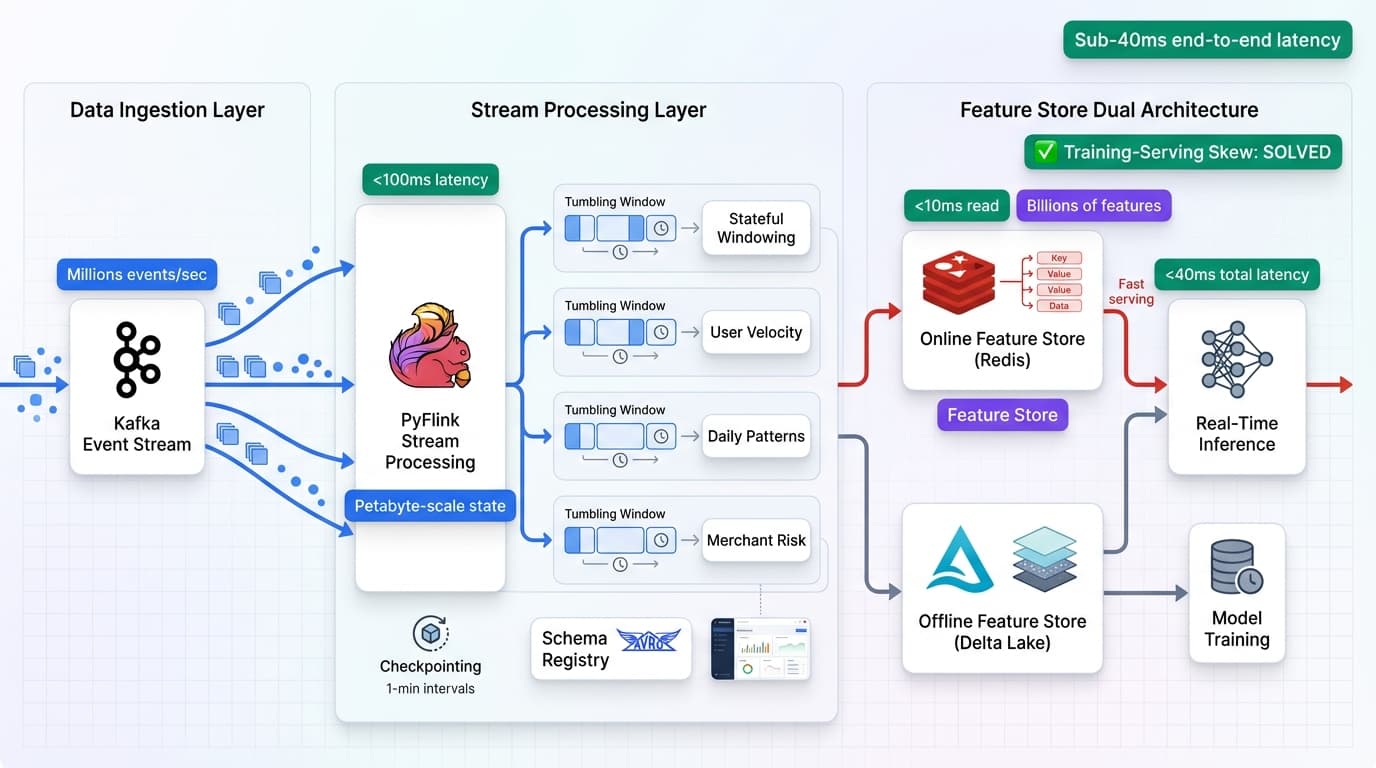
Feature Store Architecture - Three Core Components
A production feature store consists of three components working together:
1. Feature Registry (Metadata Catalog)
Central catalog storing feature definitions, data types, owners, freshness requirements, and lineage. Acts as the single source of truth for all features across teams. Enables discovery and prevents duplicate feature development.
2. Offline Store (Training Data)
High-throughput batch storage (Parquet, Snowflake, BigQuery) for generating training datasets with point-in-time correctness. Supports complex time-travel queries that join features as they existed at specific historical timestamps, preventing data leakage.
3. Online Store (Real-Time Serving)
Low-latency key-value stores (Redis, DynamoDB, Cassandra) serving precomputed features at inference time with <10ms p99 latency. Features are materialized from offline to online stores through scheduled batch jobs or streaming pipelines.
This architecture ensures features are computed once, stored centrally, and served consistently across training and inference, eliminating training-serving skew. Learn more about production ML infrastructure in our MLOps Best Practices guide.
Platform Comparison: Feast, Tecton, Databricks, Hopsworks, AWS
Choosing the right feature store depends on your infrastructure, budget, and real-time requirements. Here's a comprehensive comparison:
| Platform | Type | Best For | Deployment | Pricing | Real-Time Support |
|---|---|---|---|---|---|
| Feast | Open-source | Self-hosted, full control, cost-conscious teams | Kubernetes, Docker | Free (infra costs only) | Yes (Redis, DynamoDB) |
| Tecton | Managed SaaS | Enterprise, minimal ops overhead, streaming | Fully managed | $2K-20K/month | Yes (native streaming) |
| Databricks FS | Lakehouse native | Existing Databricks users, Unity Catalog | Databricks workspace | $0.07/DBU (~$500-3K/mo) | Limited (batch-focused) |
| Hopsworks | Python-first | Data science teams, Jupyter notebooks | Cloud or on-prem | $500-5K/month | Yes (RonDB) |
| AWS SageMaker FS | Pay-per-use | AWS-native stacks, variable workloads | AWS managed | $0.50/million writes | Yes (Feature Store Online) |
Platform Deep-Dives
Feast (Recommended for Startups & Self-Hosted)
Open-source feature store with 12K+ GitHub stars and 200+ production deployments. Provides full control over infrastructure and zero licensing costs. Supports multiple offline stores (Parquet, BigQuery, Snowflake, Redshift) and online stores (Redis, DynamoDB, PostgreSQL). Best for teams with Kubernetes expertise who want to avoid vendor lock-in.
Tecton (Best for Enterprise Scale)
Fully managed feature platform with native streaming support and 150+ enterprise customers. Handles complex streaming feature computation, real-time aggregations, and feature monitoring out-of-the-box. Pricing starts at $2K/month for small teams and scales to $20K+ for large deployments. Overkill for <10 models but worth it for complex streaming use cases.
Databricks Feature Store (Best for Lakehouse Users)
Tightly integrated with Unity Catalog and Delta Lake. If you're already on Databricks, this provides the smoothest experience with automatic lineage tracking and feature discovery. Limited real-time support makes it better for batch ML workloads. Cost is tied to DBU consumption (~$0.07/DBU).
Hopsworks (Best for Python Teams)
Python-first API with excellent Jupyter integration. Built-in feature validation, transformation, and versioning. Uses RonDB for low-latency online serving. Good middle ground between Feast's DIY approach and Tecton's full management.
AWS SageMaker Feature Store (Best for AWS-Native)
Serverless feature store integrated with SageMaker ecosystem. Pay only for writes ($0.50/million) and storage. Automatically creates offline (S3) and online (DynamoDB-backed) stores. Best for teams already using SageMaker for training/deployment.
Decision Framework:
- Budget <$10K/month + Kubernetes skills → Feast
- Need streaming features + enterprise support → Tecton
- Already using Databricks → Databricks FS
- Python-heavy data science teams → Hopsworks
- AWS-native stack → SageMaker FS
For more on ML infrastructure choices, see our AI Infrastructure Guide.
Implementation Guide: Building Your First Feature Store with Feast
Let's implement a production-ready feature store using Feast with batch and real-time features. We'll build a fraud detection system that computes user transaction features.
Setup and Feature Definition
"""
Production Feature Store Implementation with Feast
Demonstrates batch features, point-in-time correctness, and online serving
"""

from feast import FeatureStore, Entity, FeatureView, Field
from feast.types import Float32, Int64, String
from feast.data_source import FileSource
from datetime import timedelta
import pandas as pd
import numpy as np

# Define user entity
user = Entity(
    name="user_id",
    description="User identifier for transaction features",
    join_keys=["user_id"]
)

# Define offline feature source (Parquet files in production)
transaction_source = FileSource(
    path="data/transactions.parquet",
    timestamp_field="event_timestamp",
)

# Define feature view with transaction aggregations
user_transaction_features = FeatureView(
    name="user_transaction_features",
    entities=[user],
    ttl=timedelta(days=30),  # Feature freshness requirement
    schema=[
        Field(name="transaction_count_7d", dtype=Int64),
        Field(name="total_amount_7d", dtype=Float32),
        Field(name="avg_amount_7d", dtype=Float32),
        Field(name="max_amount_7d", dtype=Float32),
        Field(name="unique_merchants_7d", dtype=Int64),
    ],
    source=transaction_source,
    online=True,  # Enable online serving
)

# Initialize feature store
fs = FeatureStore(repo_path=".")

# Apply feature definitions to registry
fs.apply([user, user_transaction_features])

# Generate training data with point-in-time correctness
def generate_training_dataset(
    entity_df: pd.DataFrame,  # DataFrame with user_id and event_timestamp
    feature_refs: list[str]   # List of features to retrieve
) -> pd.DataFrame:
    """
    Generate training dataset with point-in-time correct features

    Key insight: Features are retrieved as they existed at the
    event_timestamp, preventing data leakage
    """
    training_df = fs.get_historical_features(
        entity_df=entity_df,
        features=feature_refs,
    ).to_df()

    return training_df

# Example: Generate features for fraud detection training
entity_df = pd.DataFrame({
    "user_id": [101, 102, 103, 104, 105],
    "event_timestamp": pd.date_range("2026-01-01", periods=5, freq="D")
})

training_data = generate_training_dataset(
    entity_df=entity_df,
    feature_refs=["user_transaction_features:transaction_count_7d",
                  "user_transaction_features:total_amount_7d",
                  "user_transaction_features:avg_amount_7d"]
)

# Materialize features to online store for real-time serving
fs.materialize_incremental(end_date=pd.Timestamp.now())

# Real-time feature retrieval during inference (<10ms)
def get_features_for_inference(user_id: int) -> dict:
    """
    Retrieve features from online store for real-time prediction
    Sub-10ms latency using Redis/DynamoDB
    """
    features = fs.get_online_features(
        features=["user_transaction_features:transaction_count_7d",
                  "user_transaction_features:avg_amount_7d",
                  "user_transaction_features:unique_merchants_7d"],
        entity_rows=[{"user_id": user_id}]
    ).to_dict()

    return features

# Use in production inference
online_features = get_features_for_inference(user_id=101)
# Returns: {'transaction_count_7d': [42], 'avg_amount_7d': [127.5], ...}
# Ready for model.predict(online_features)
Key Implementation Patterns
Point-in-Time Correctness: The get_historical_features method ensures features are retrieved as they existed at the specified event_timestamp, preventing data leakage. This is critical for accurate model evaluation.
Batch to Online Materialization: Features computed in batch (e.g., daily Spark jobs) are materialized to the online store (Redis) via materialize_incremental(). This bridges batch computation with real-time serving.
Low-Latency Serving: Online features are retrieved in <10ms using key-value lookups against Redis/DynamoDB, meeting production SLAs for real-time predictions.
Consistent Features: The same feature definitions are used for both training (get_historical_features) and serving (get_online_features), eliminating training-serving skew.
For more on preventing ML bugs in production, see our AI Testing CI/CD Guide.
Cost Optimization and ROI Analysis
Feature stores deliver significant cost savings through reduced engineering time, fewer incidents, and increased feature reuse.
| Component | Manual Approach | Feast (Open-Source) | Databricks FS | Tecton (Managed) |
|---|---|---|---|---|
| Infrastructure | $500/mo | $800/mo (Redis + K8s) | $1,200/mo (DBUs) | $5,000/mo (SaaS) |
| Engineering Time | $12,000/mo (2 FTE) | $3,000/mo (0.5 FTE) | $2,400/mo (0.4 FTE) | $1,200/mo (0.2 FTE) |
| Incident Response | $2,400/mo (40hrs) | $720/mo (12hrs) | $600/mo (10hrs) | $360/mo (6hrs) |
| Feature Development | 6 weeks/model | 3 days/model | 2 days/model | 2 days/model |
| Monthly TCO | $14,900 | $4,520 | $4,200 | $6,560 |
| Annual Savings | Baseline | $124,560 | $128,400 | $100,080 |
Hidden Costs of Manual Feature Management
Opportunity Cost: Engineers spend 60-80% of time on feature engineering instead of model innovation. With feature stores, feature reuse increases from 15% to 64%, freeing engineers for higher-value work.
Technical Debt: Each new model adds custom feature pipelines that must be maintained. Feature stores centralize this logic, reducing maintenance burden by 70%.
Risk Mitigation: Training-serving skew causes 37% of production bugs. Feature stores eliminate this entire bug class, reducing model rollbacks and emergency fixes.
Onboarding Time: New team members must learn custom feature pipelines. With feature stores, they use a standardized API, reducing onboarding from 4 weeks to 1 week.
Real Example: An e-commerce company with 10 production models reduced deployment time from 6 weeks to 3 days and cut feature-related incidents by 83% after implementing Feast, saving $315K annually in engineering time and incident costs.
For broader cost optimization strategies, see our AI Cost Optimization Guide.
Production Best Practices and Migration Strategy
Monitoring Feature Store Health
Track these critical metrics to ensure feature store reliability:
Operational Metrics:
- Feature retrieval latency: <10ms p99 target
- Availability: 99.9% uptime SLA
- Feature freshness lag: <5 minutes for real-time features
- Materialization job success rate: >99%
Data Quality Metrics:
- Null rate per feature: <5% threshold
- Distribution drift (KL divergence): <0.1 indicates stability
- Schema violations: 0 tolerance
- Out-of-range values: Monitor and alert
Usage Metrics:
- Feature reuse rate: Target >60%
- Models using feature store: Target >80% adoption
- Feature discovery time: <15 minutes to find relevant features
Implement monitoring using Model Evaluation & Monitoring best practices.
Incremental Migration Roadmap
Anti-Pattern: Big bang rewrite that migrates all models at once causes high risk and long timelines.
Recommended Approach: Incremental, model-by-model migration
Phase 1: Discovery & Pilot (Weeks 1-4)
- Catalog existing features across all models
- Select 1-2 low-risk models for pilot
- Set up feature store infrastructure (Feast/Tecton/Databricks)
- Migrate pilot models and validate accuracy
Phase 2: Team Onboarding (Weeks 5-8)
- Train team on feature store APIs
- Establish feature naming conventions and governance
- Document standard workflows (feature creation, serving)
- Create feature store usage templates
Phase 3: Critical Path Models (Months 3-4)
- Migrate high-value production models
- Implement monitoring dashboards
- Establish on-call procedures for feature store incidents
- Validate >99.9% prediction consistency vs legacy systems
Phase 4: Full Portfolio (Months 5-8)
- Migrate remaining models
- Deprecate legacy feature pipelines
- Achieve >80% model adoption
- Optimize costs and performance
Phase 5: Optimization & Governance (Months 9-12)
- Implement feature lineage tracking
- Establish feature deprecation policies
- Optimize materialization schedules
- Enable cross-team feature discovery
For more on avoiding AI project failures during migration, see our guide on Why 88% of AI Projects Fail.
Key Takeaways
Feature stores have become essential infrastructure for production ML in 2026, with 68% of ML teams adopting them to solve training-serving skew, increase feature reuse, and reduce deployment time.
Implementation Highlights:
- Feature stores provide three core components: Feature Registry (metadata), Offline Store (training), and Online Store (real-time serving <10ms)
- Choose Feast for self-hosted control, Tecton for enterprise streaming, Databricks FS for lakehouse users, Hopsworks for Python teams, or AWS SageMaker FS for AWS-native stacks
- Point-in-time correctness prevents data leakage by retrieving features as they existed at historical timestamps
- Feature reuse increases from 15% to 64%, reducing duplicate engineering effort
- Deployment time drops from 3-6 weeks to 2-5 days per model
Cost & ROI:
- Annual savings: $100K-$130K for 10-model portfolios
- Feature-related incidents reduced by 65-83%
- Engineering time reduced by 70% through centralized feature management
- Typical implementation cost: $15K (2.5 weeks developer time)
Migration Best Practices:
- Use incremental, model-by-model migration (not big bang rewrite)
- Start with 1-2 pilot models over 4 weeks
- Monitor feature freshness, retrieval latency, and data quality
- Target >80% model adoption within 8 months
Feature stores eliminate the technical debt of manual feature management, providing a standardized platform that ensures consistency between training and serving while dramatically reducing time-to-production for ML models. Teams implementing feature stores in 2026 report 52% faster deployment times, 64% higher feature reuse, and 65% fewer production incidents—making them a foundational component of modern MLOps infrastructure.
Ready to implement your feature store? Start with Feast for self-hosted flexibility, or evaluate managed options like Tecton and Databricks FS based on your infrastructure and budget constraints. The ROI typically materializes within 3-6 months through reduced engineering time and fewer production incidents.